 114-1 Group experiment, report written by me
Chen Ke-YouPut photo.jpg in the parent folder
will appear here
will appear here
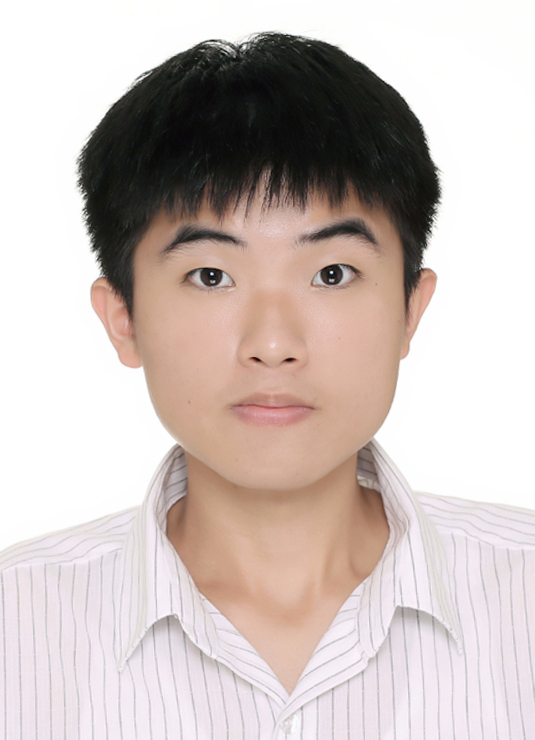
I. Profile
Chen Ke-You
Graduating senior · Special Selection applicant
Special Selection · E-Portfolio
Education
- Kaohsiung Municipal San Ming Senior High School Graduating senior
Three signature works
- Led system design, interview planning, and team direction(2026)
- System direction and integration; 55% on the official division-of-labor record(2026)
- Completed independently by me; 8 brands, 30+ models(2025)
Awards and competitions
- Kaohsiung City 66th Science Fair Engineering (II) Teamwork Award(2026-04-25)
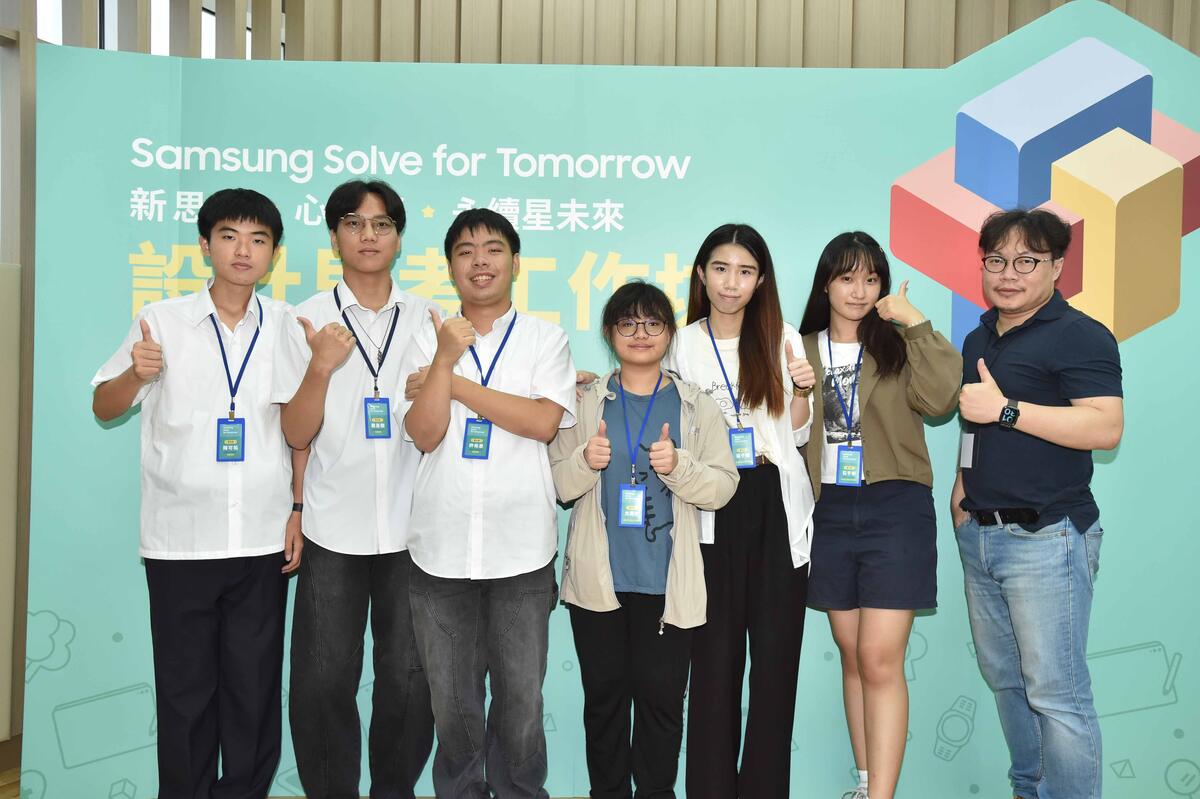
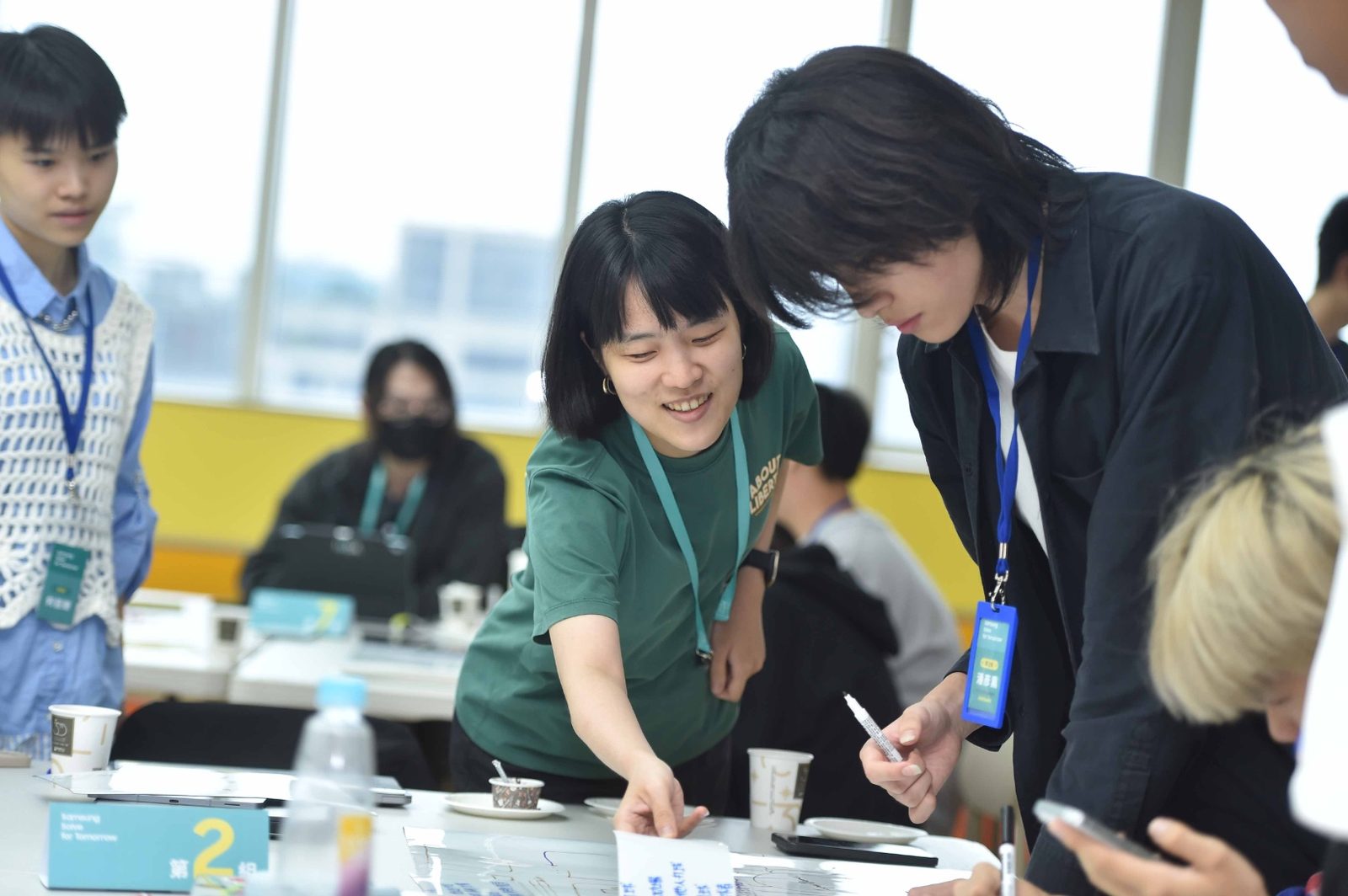
- 7th Samsung Solve for Tomorrow Finalist(2026)
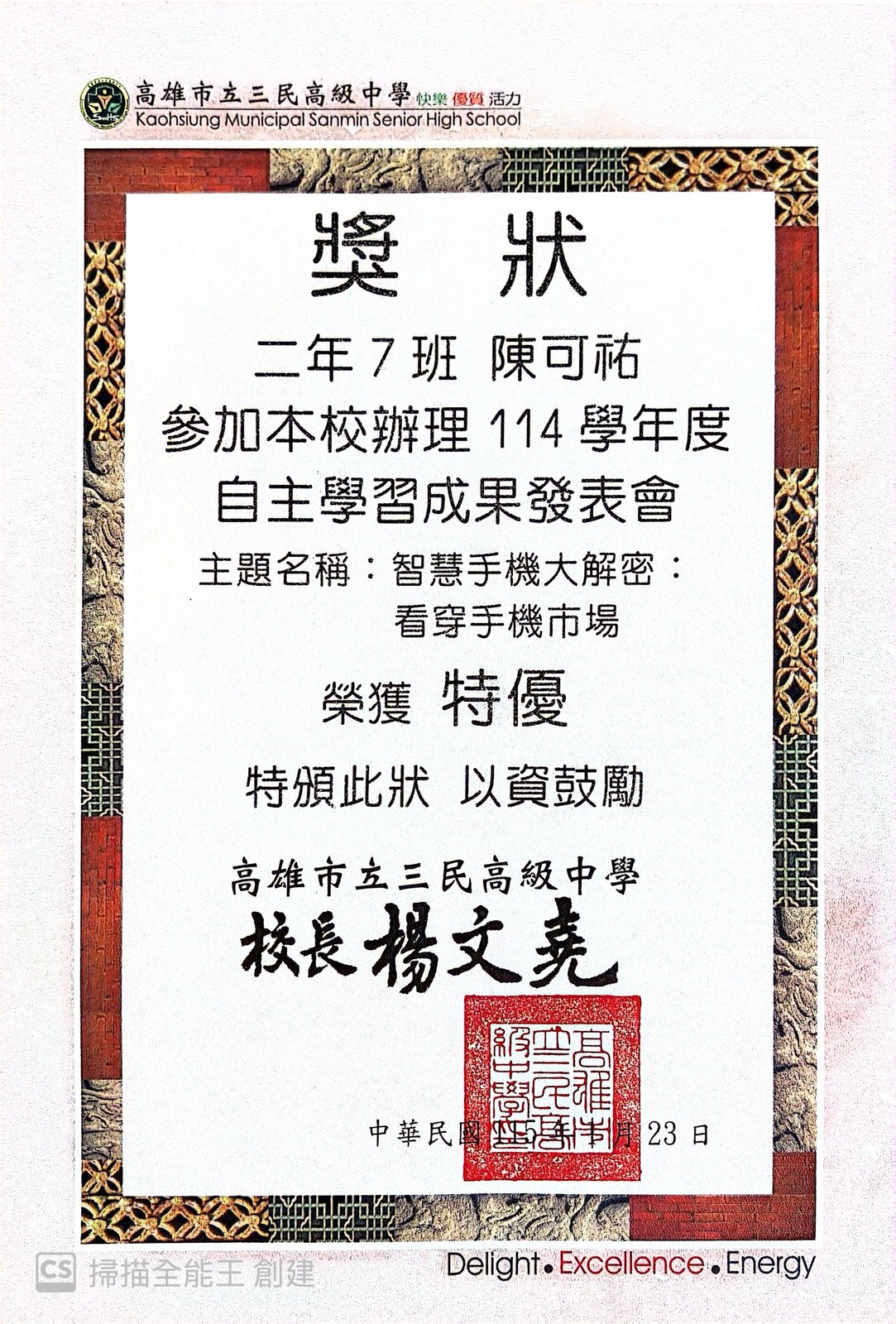
- Self-directed learning presentation Outstanding
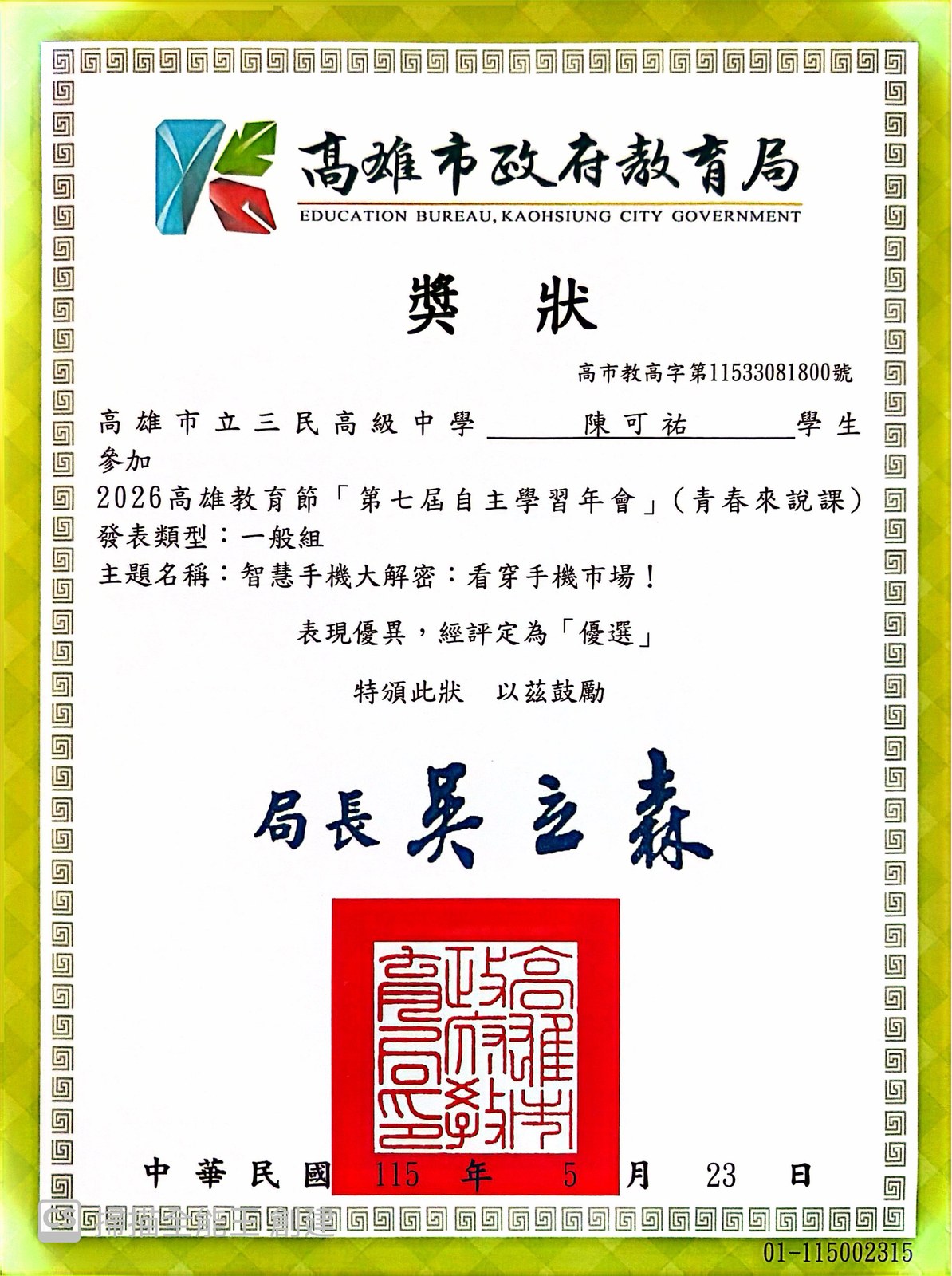
- Self-directed learning annual meeting Merit
Experience
- Equipment officer (from grade 4 through senior high, nearly every semester)
- Photography club (junior high, senior high)
- ASE, STUST cleanroom, NCKU, Macronix, SEMICON Taiwan, National Museum of Natural Science (Taichung)
- Including introducing it to foreign guests in English
Areas of strength
- System design and problem definition Extracting requirements from field interviews to decide what the system does and doesn't do
- AI collaboration and tool selection Assigning models by task, cross-validating across models, and drawing responsibility boundaries for AI
- Technology translation Explaining specs and principles in language non-specialists understand, including public explanations in English
- Data discipline Official sources first, de-identified external data, proactively obtaining third-party authorization
- Cross-domain foundations in energy and semiconductors Rules-based dispatch simulation, social external-cost quantification, basic semiconductor knowledge
Other
- The course that influenced me most 、
- My favorite course arrangement
- Interests , using AI, taking things apart and building, following product launches
- Photography portfolio @kergue_photo215
- Systems & backend Node-REDSmart grid, HERMES
- Protocols MQTT(Mosquitto)、HTTPCan state the pros, cons, and use cases of both
- Electronics & hardware Breadboard, Fritzing, TinkerCAD, basic semiconductors, YOLO (AMB82-mini), IFTTTSemiconductor courses; smart grid
- Frontend & data Learned HTML, JSON hierarchical data structures, Google Sheets cloud writesPhone-selection system spec database; this page
- Drafting & simulation Onshape 3D drafting, GeoGebra mechanism simulationTechnology application capstone
- Presentation & documentation Bilingual on-site explanation, writing the project documentation, designing interview guidesScience Day, Education Expo, science-fair defense
- AI-integrated development environments Claude Code、Cursor、Windsurf、Google Antigravity、CodexCan state each one's pros, cons, and suitable tasks
- AI collaboration tools Gemini、ChatGPT、Grok、Perplexity、NotebookLM、Google AI Studio
One thing I want to say first
My competition record may be shorter than others',But I kept moving outward——, going to major forums to see what the market is doing, , all of this feeds me.
I also actively took on what the teacher gave me:: explaining deep things to people who don't understand them; with foreigners, I enthusiastically introduce what I've learned in English.
These accumulated abilities all went into、, andon.
In three years of senior high I built three fairly complete works: a website that helps people pick phones, a grid-dispatch simulation system, and a power-plant e-tag management system — all smart systems tied to sustainability, all developed or co-developed by me personally with no one doing it for me. I was more engaged in the research than my teammates and started development first; teachers played the role of verifiers (critics).
Next, about three minutes
II. Autobiography
This chapter runs from playing with dad's parts box in elementary school to swapping out an already-awarded topic in grade 12. Twice in three years I changed my own research direction; nobody asked me to.
or jump straight to
II. Autobiography
It started with a camera
Understand the tool's traits first, build, look at feedback, then revise.
From the camera to the tag system, I've really been doing the same thing.
My first encounter with technology was the camera in the dry box. As a kid, dad brought a camera on outings and taught me to use it. I joined the photography club in junior and senior high. After getting my first DSLR in senior high, I truly started shooting, editing, and even sharing work on Instagram.After each post I read the backend analytics and worked backwards: “what's wrong with this photo? Why was the reach so low?”, next time adjusting the post caption, photo layout, and viewing rhythm,A bit like debugging code, revising step by step.
I have a near-instinctive interest in operating equipment. At home, I'm the first to finish the manual and the first to master new appliances — the air purifier, robot vacuum, TV. As a kid my dad gave me his childhood parts box with batteries and bulbs, and I wired circuits with them, burning out quite a few components; those explorations became the setup for senior high. In the Introduction to Semiconductors course I was especially familiar with the components, spoke up actively in class Q&A, answered many quick-fire questions correctly, and my group finished 2nd in the class.
I follow Apple, Google, and Samsung launches almost every year. Beyond loving spec sheets, I want to understand how a company turns features, interface, and real needs into one decision. And I ask myself: as tech races ahead, am I keeping up?
My earliest portfolio
Photography account @kergue_photo215. Cameras: Nikon D7000 and P340; post-processing in Lightroom.


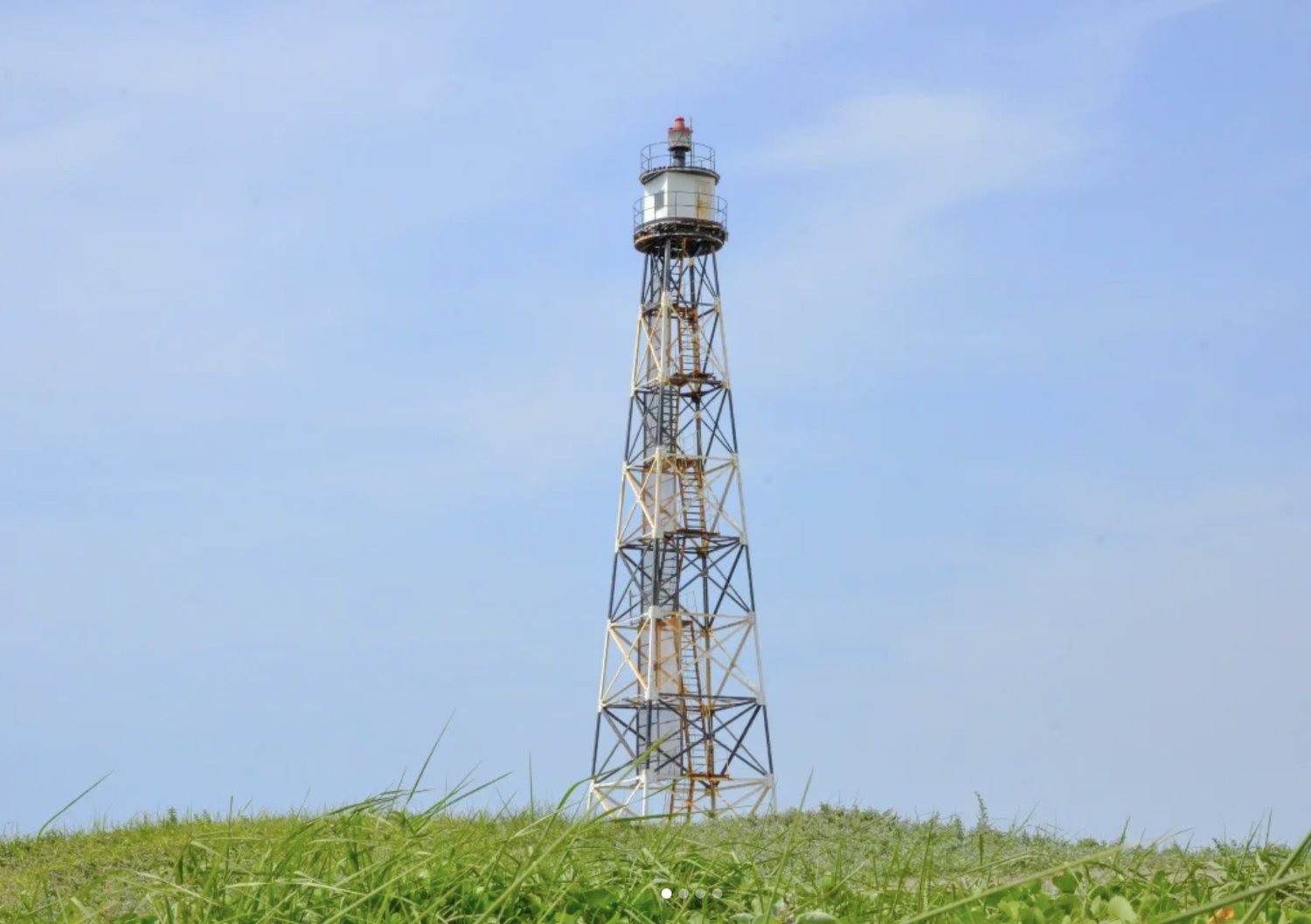

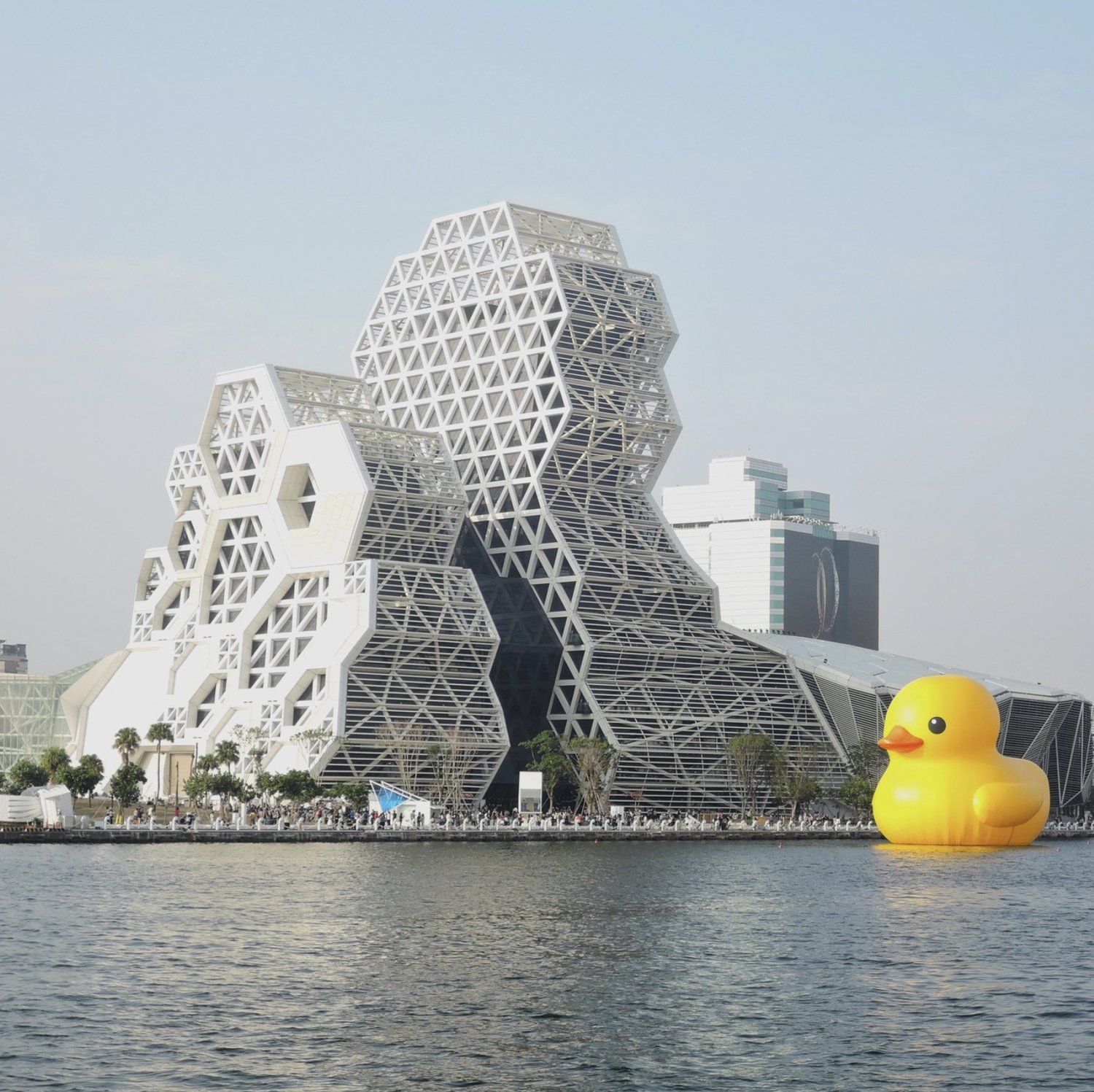
In each post I wrote three sections
- Goal What this photo wanted to say
- Technique How it was achieved
- Post-processing Which parameters were edited in post
Writing it down wasn't for teaching, it'sSo the next me knows what decisions the last me made— essentially a version history.
Why photography and my systems work are the same thing
After each post I read the backend analytics and worked backwards: “what's wrong with this photo? Why was the reach so low?”, next time adjusting the caption, layout, and viewing rhythm.Build first, look at feedback, then revise— the same method I use to keep improving my systems: build, get feedback, revise.
Timeline
From the parts box to HERMES, every step in between.
Click any row to expand event details
Elementary school
Dad's parts box and the camera in the dry box
Dad gave me his childhood parts box with batteries and bulbs, and I wired circuits with them. Around the same time I made a safe from hot glue and bamboo skewers; dad helped buy the lock and hinges — though it had essentially no security. From grade 4 I was equipment officer.
Junior high
Living Technology and photography club
Continued as equipment officer. Joined the photography club for love of photography. The Living Technology course and the parts box were where my circuit intuition came from.
Grade 10, 1st semester
Introduction to Semiconductors
Diodes, transistors, digital/analog, series/parallel circuit design and testing. For the final video assignment I chose Apple Vision Pro and “busted its myths.” I spoke up actively in class Q&A; my group ranked second in the class.
2025/1
Realtek AMB82-mini AI maker camp
Co-organized by Realtek and a university. Controlling the AMB82-mini with Arduino, training with Roboflow annotations and deploying a YOLO cup-recognition model on Google Colab — the full pipeline of data collection, training, evaluation, deployment; I also observed first-hand that changing light angles sharply drops recognition accuracy.
Grade 10, 2nd semester
Advanced Semiconductors: AI & Chips
nMOS switching and leakage tests, Fritzing drafting; simulated in TinkerCAD, then built on a breadboard to drive a fan. Class remarks cited in three other groups' slides.
Grade 11, 1st semester
First complete work: the smartphone selection system
Official specs for 8 brands and 30+ phones organized into a structured JSON database. Along the way I removed the “AI-generated pros/cons” feature because the AI cited unofficial forum reviews. In the same semester I started the smart grid capstone.
2026-01-23
Self-directed learning presentation · Outstanding
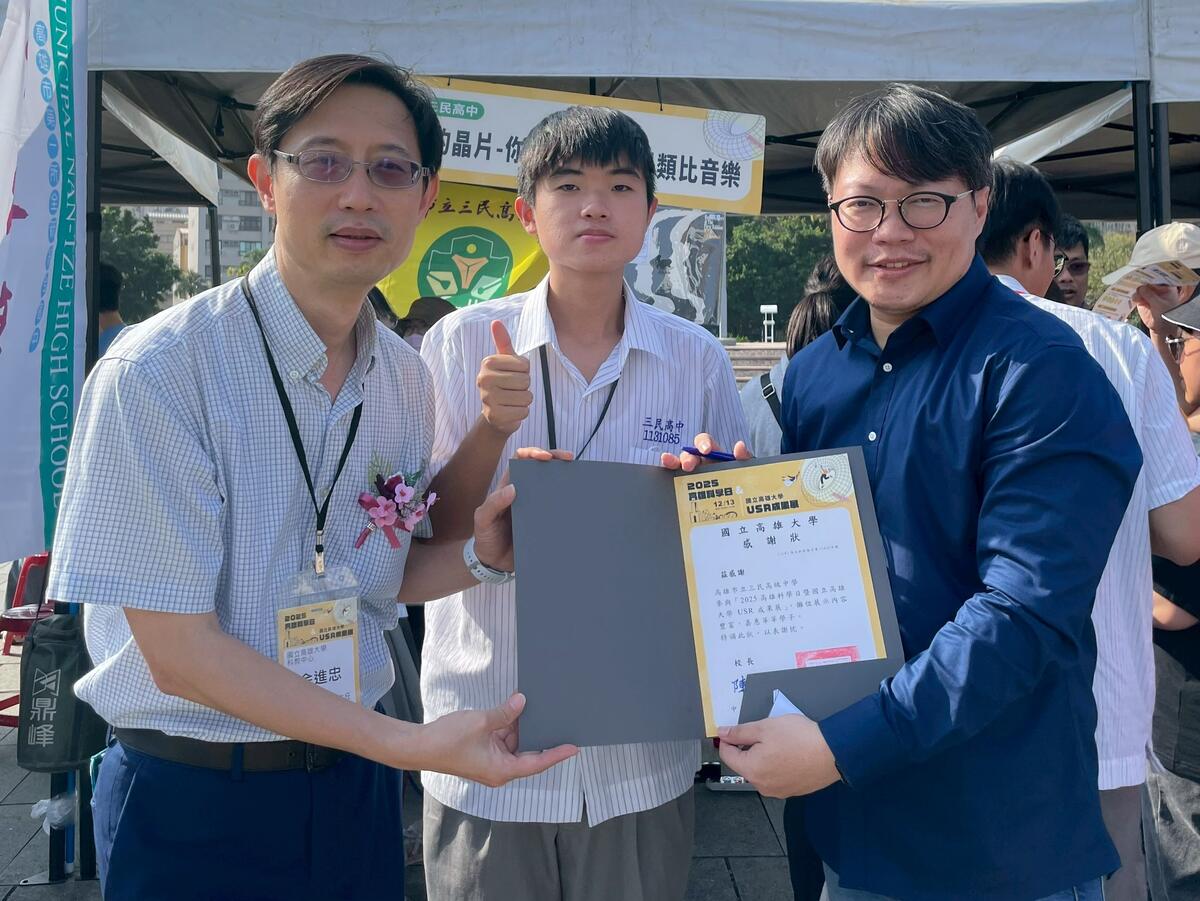
San Ming Senior High School, presented by Principal Yang Wen-Yao.
2026-02-12
Proactively wrote to obtain third-party website permission
The project needed Taiwan's real-time generation data; on behalf of the team I wrote to the site owner requesting iframe embedding and committed to four things: display-only without modification, no commercial use, clearly citing the source, and never treating the results as our own work. Approved the same day.
2026-04-25
Kaohsiung City 66th Science Fair Teamwork Award
Engineering (II). Entered the 7th Samsung Solve for Tomorrow finals with this work.
2026-05-23
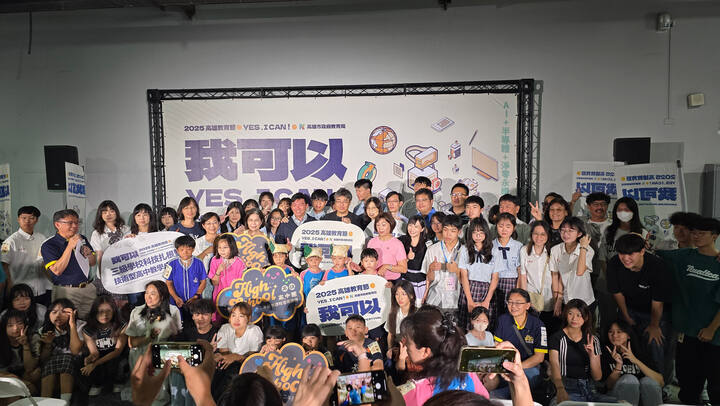
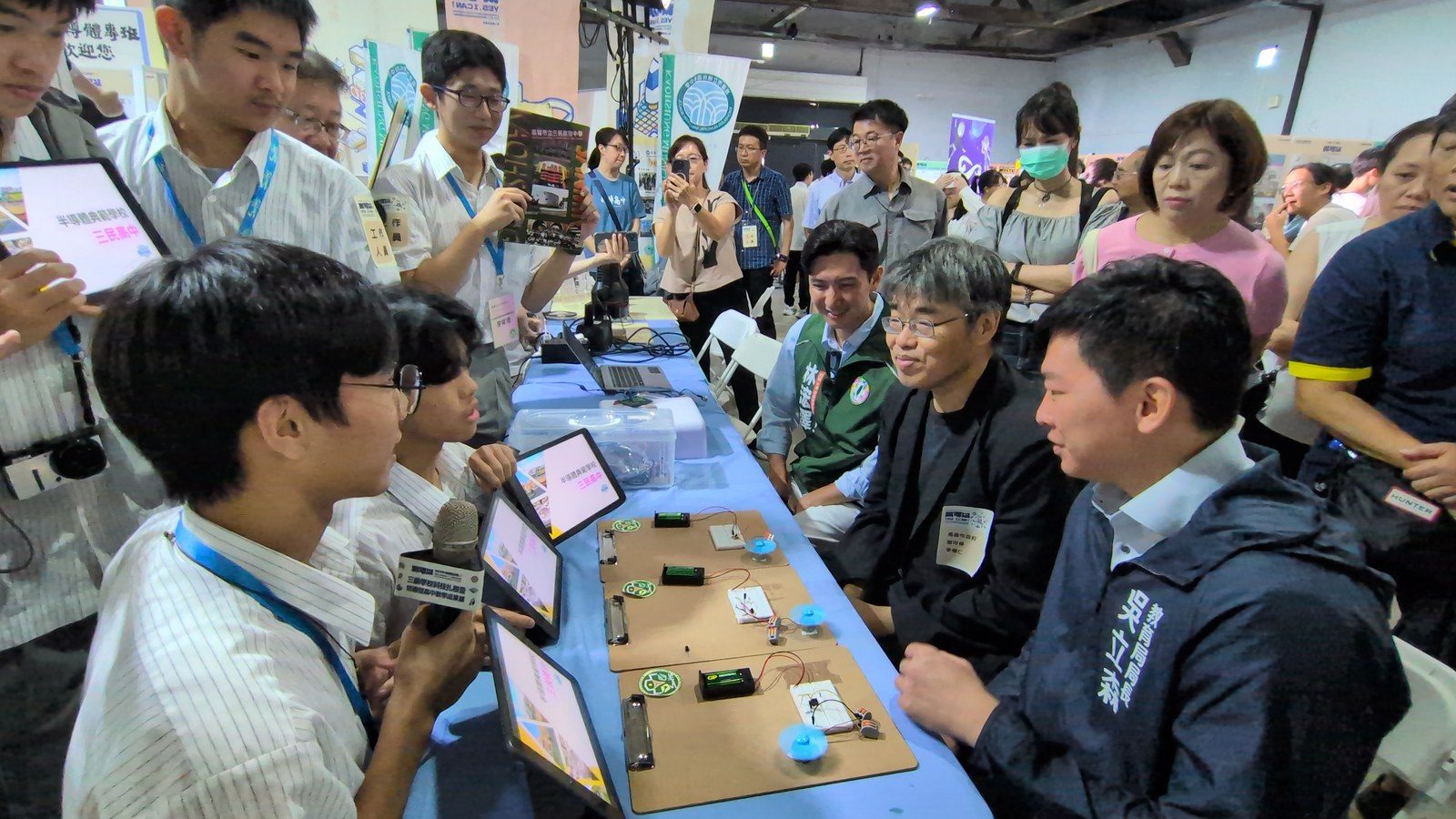
Kaohsiung Education Expo “Youth Talks” · Merit
Presented by Education Bureau Director Wu Li-Sen. At the presentation, Prof. Tsai Meng-Fang's comment was: “Your work could be better — focus on one point and do it well.” Looking back, every side of mine was merely “good enough.”
2026-07 / 08
Four industry-mentor coaching sessions and two interviews
I designed the interview guide for power-dispatch practice and personally interviewed the plant shift supervisor (no teammates involved), getting first-hand information on a thermal plant's field operations.
2026-08
Redesigning products around real pain points instead
The interviews put one thing in front of me: the topic's scale didn't match our resources or knowledge. So instead of quitting, I changed topics — carrying the same field information back to redefine the problem, finally locking onto the tag process during a plant's major overhaul.
Two weeks
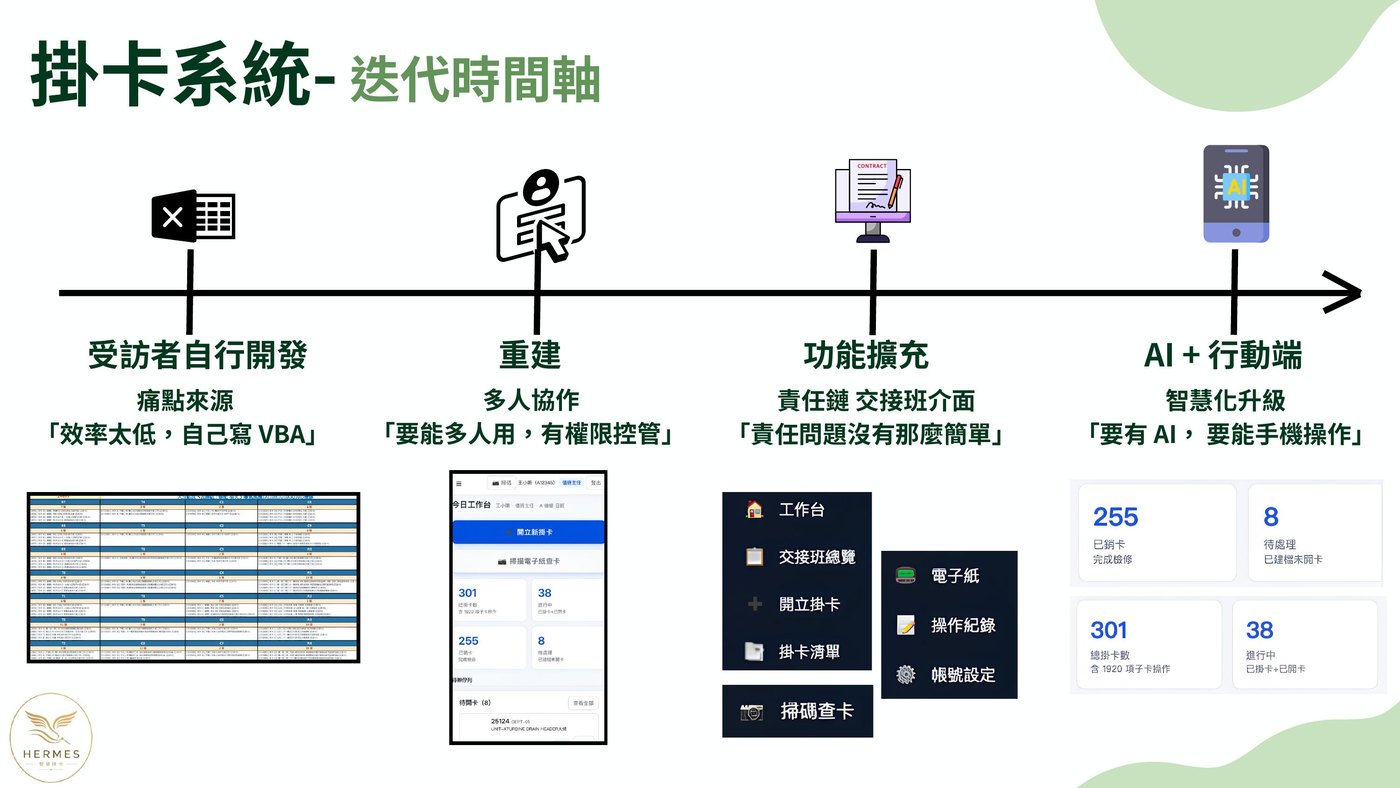
HERMES iterated through six versions
In two weeks I took the prototype from nothing through six versions, each shown to people and revised against feedback.
2026-09-06
Samsung Solve for Tomorrow finalist announcement
That pivot
What changed me wasn't the award — it was the pivot during Samsung finals preparation.
01
The original topic
Smart grid
ObtainedKaohsiung City Science FairEngineering (II) Teamwork Award, and entry into the Samsung finals with this work.
02
The judgment after the interviews
Scale mismatch
Taipower is critical infrastructure; every decision goes through layered review. A high-schooler's scale model is powerless against the scale and complexity of a real grid.
03
After the pivot
HERMES
Redefining the problem with the same field information, finding a cut point whose scale matches and whose pain is real.
Paper drove this decision — the on-site paper usage was astonishing. I kept thinking about it on the bus, was inspired by the EasyCard, and happened to see e-paper market news; the direction set itself.
What I did in this project
Code was AI-assisted, but architecture decisions, boundary conditions, and final logic verification were all led by me, this systemWhose problem it solves、Where to draw the line on data and permissions、What to fall back to when offline、Which feature to cut、which AI statements can't be trusted, all included in the system only after my own judgment.
I'm the driver, not the passenger.
See the written application materials.
III. Motivation
See each school's written application materials
Motivation statements are written per school/department, based solely on each department's official curriculum map, admissions brochure, and website, so they are not included in this general e-portfolio — please see each school's written application materials.
IV. Study Plan
See each school's written application materials
Course names and graduation requirements in the study plan are taken from each department's official pages and differ per school, so they aren't in this general e-portfolio — please see each school's written application materials.
V. Coursework
School curriculum part
Three categories. Open the one you want — details and on-site photos expand inside.
ResultsAnswered many quick-fire questions in class,Group ranked 2nd in class; produced two Canva decks and a three-minute short-talk video.Evidence ↗
Learned and didPeriodic table and semiconductor materials, diodes, LEDs, transistors, digital/analog conversion;I designed and tested the series/parallel circuits myself. The parts box I played with as a kid — burning out quite a few components — finally paid off in this course.
Final video assignment“How semiconductors affect human life” — my group chose Apple Vision Pro.The official record's reason: “it's hailed as a world-shaking masterpiece, but users say it has many flaws — so I chose it as my subject,Be a myth-buster” That was the first time I didn't take a single source as the conclusion.
Grade 10, 1st semester · coursework portfolio original text“A phone is small and light, but it actually contains many chips inside. One chip goes from sand to chipNot one company doing one process step, because it passes through different companies for production — processed differently from upstream to downstream before the tiny chip is finished.”That line is where all my later thinking began. “Integration is itself an engineering discipline” — reached after six industry sites in grade 10 — wasn't a day-of-visit impression; it's where that thought ended up after two years.
In the classroom
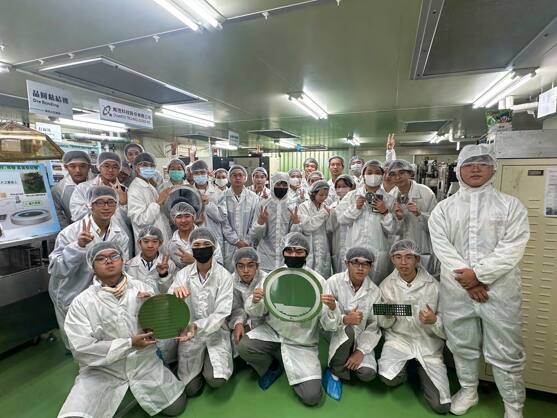

ResultsMy class remarks were cited in three other groups' slides; Kaohsiung Education Expo curation, IExplaining transistors and chips to the public bilingually. In the official record I wrote: “Truly effective learning is being able to answer other people's questions.”Evidence ↗
Core theoryCPU vs. GPU architecture, Apple M vs. Intel, field-effect transistors, Planar FET to FinFET structural evolution, pros and cons. The intro course taught me what components are; this one taught me why they're shaped that way.
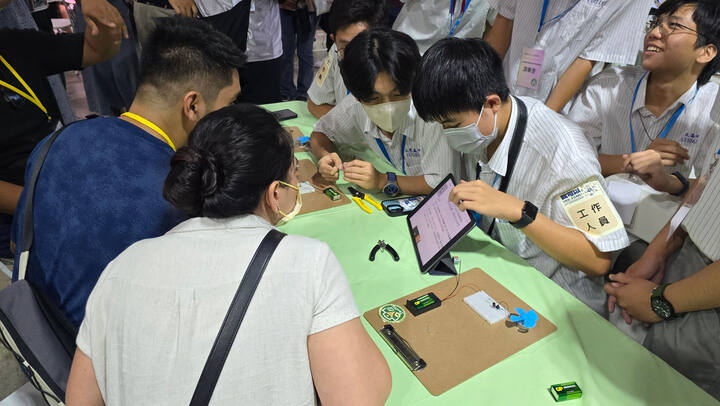
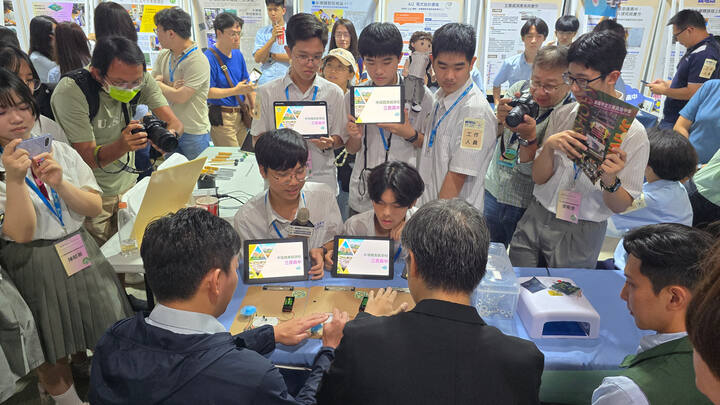
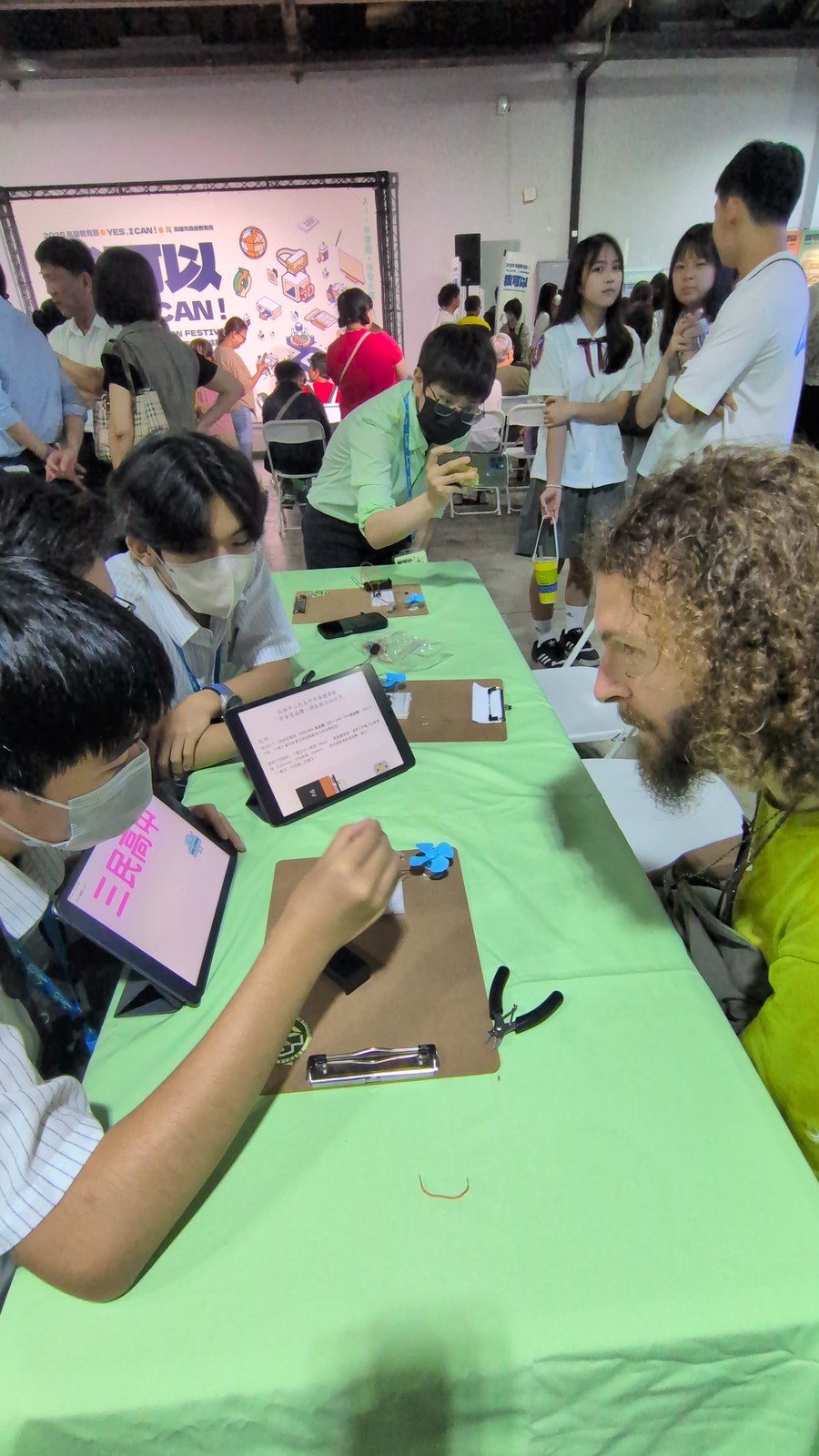
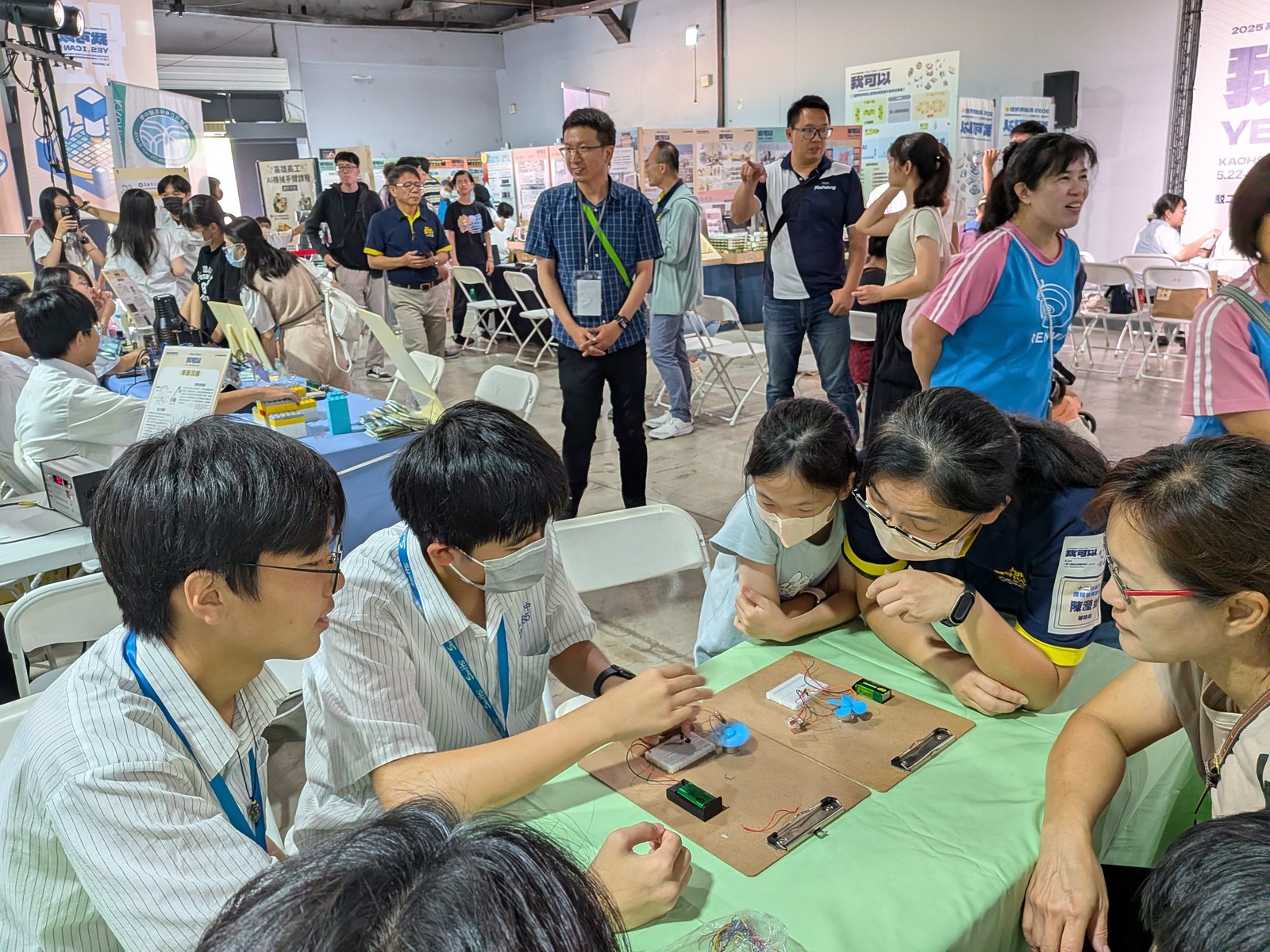
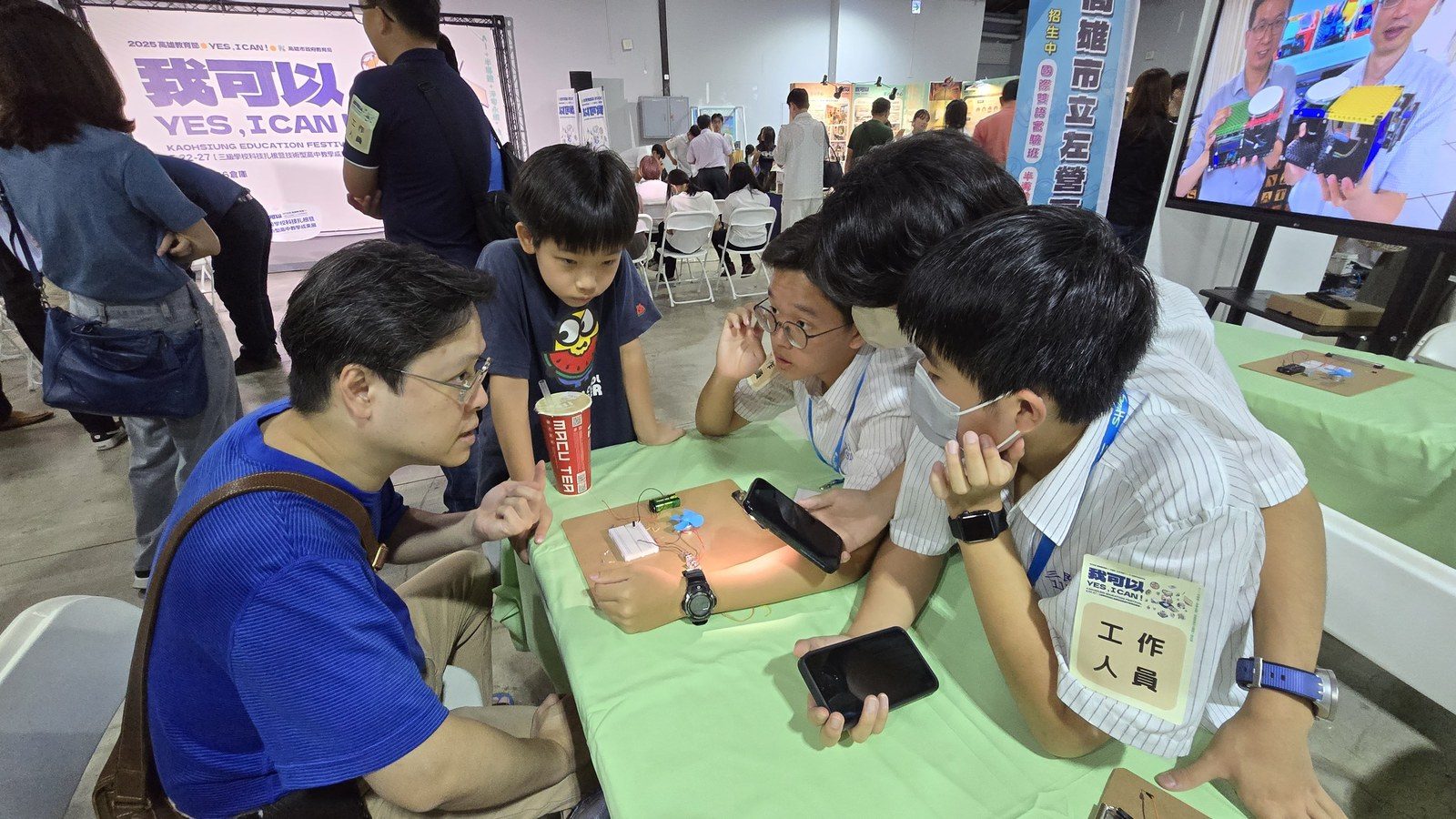
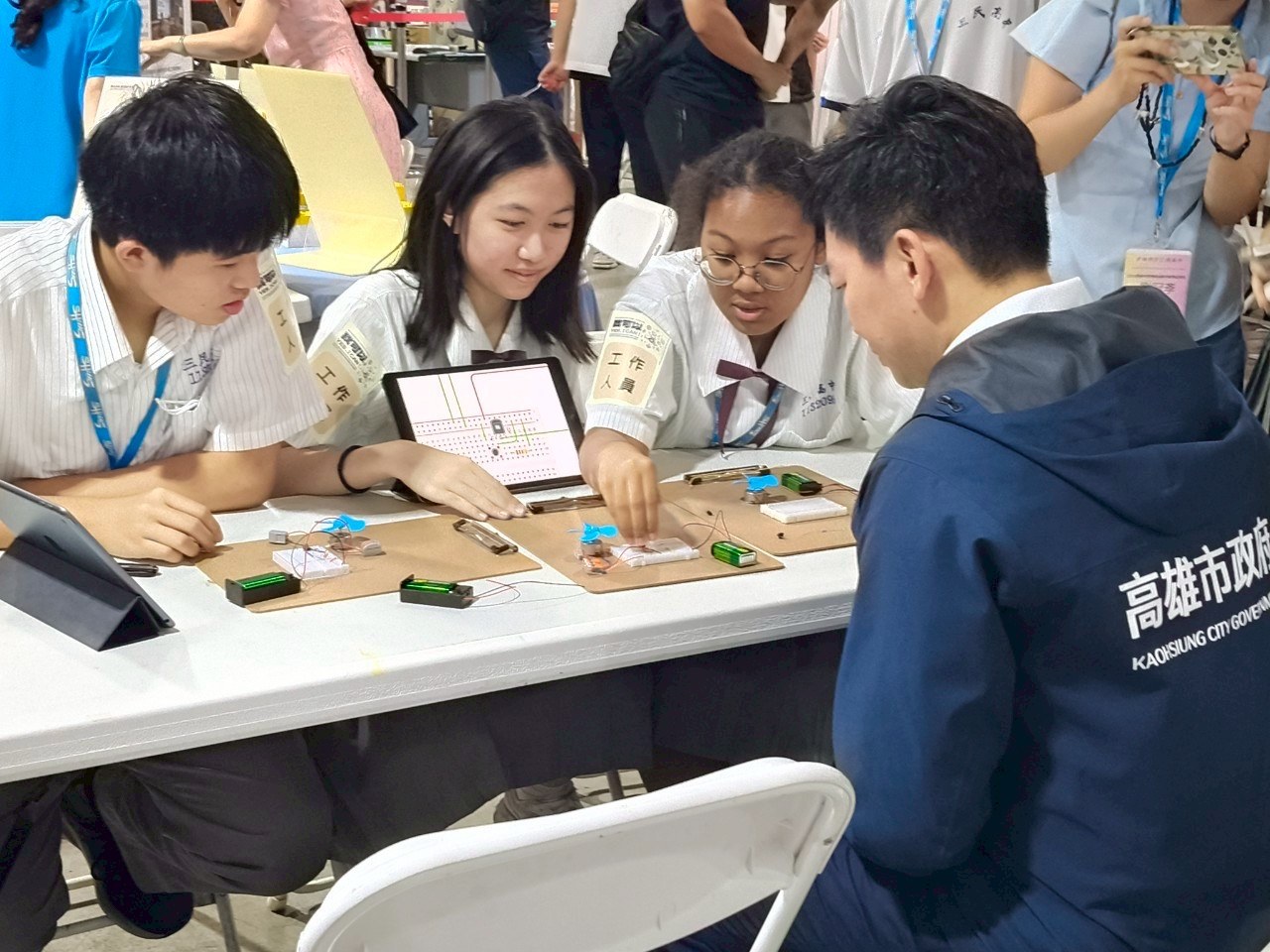
Hands-on makingnMOS switching experiments and Leakage-current testing, disassembling a Bluetooth speaker, Fritzing schematics, cost estimates; simulated in TinkerCAD then built on a breadboard: Interactive fan-speed control exhibit, the very one visitors turned by hand at the Education Expo booth.
The question that hit me hardestWhy phones overheat.The answer was the leakage current I measured myself — a transistor theoretically off still leaks current; multiplied by billions of transistors in a chip, that's the temperature in your palm.Textbooks don't write this — I measured it and connected it back to life before I truly understood it.FinFET wraps the channel with a 3D gate — solving exactly the same problem.
Industry insightthe CUDA platform, Intel/NVIDIA/TSMC revenue trends, and Analysis of NVIDIA's and Intel's declines and comebacks— analyzing not whose tech is stronger, but why a company misjudged and how it recovered. Another assignment was Writing to semiconductor professionals, that was when I first realized: what I want to know, I can just ask. Later writing to the website owner and designing interview guides were extensions of that move.
Grade 10, 2nd semester · coursework portfolio original: three habits I built in this courseTaking the initiative— thinking and trying first, then asking focused questions — a habit of “do first, ask later.”
Iterative optimization— treating challenges as growth opportunities and “failure” as part of adjusting strategy.
Problem-driven— not just running experiments, but first clarifying the user's or customer's real pain points, so every learning effort has a clear goal.That last one is why, a year later, I didn't invent my own topic for HERMES but first interviewed Taipower staff to find pain points. The habit didn't start with the capstone — it was written down in this course in grade 10, second semester.
In the classroom
Hands-on work done:The assigned theme was climate-adaptation and net-zero energy sustainability; used the Golden Circle to think why before what.
Concrete results:Produced the smart grid capstone; and formed my view of AI — the teacher's words: “garbage in, garbage out; but throw gold in, and maybe great gold comes out.”
Hands-on work done:Learned engineering drafting and built the geometric model of a Strandbeest linkage mechanism in GeoGebra, verifying proportions and angles segment by segment.
Concrete results:Completed the full linkage geometry of the bionic mechanism, with basic competency in mechanism design.
GeoGebra workspace
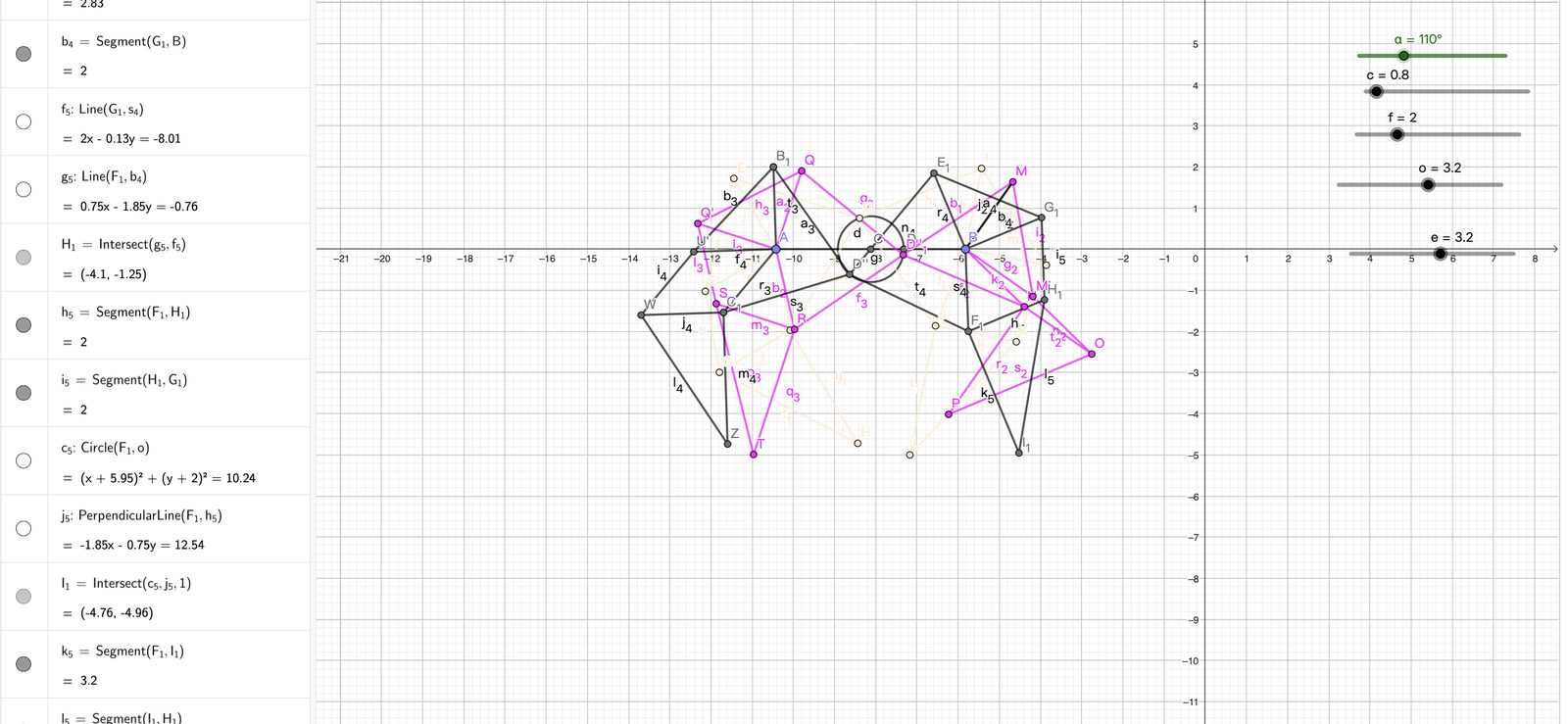
Reflection:Wrong steps or wrong parameter settings both lead to failure. I made alignment mistakes many times; repeated practice has fixed that.
Hands-on work done:Learned engineering drafting; the teacher scheduled exams to check our learning, with questions drawn from the Class-C draftsman license exams.
Setbacks:If I can't understand the question, drafting suffers. I need to break a question down first; otherwise the order of steps easily goes wrong.
My own drawings (Class-C draftsman license exam questions)
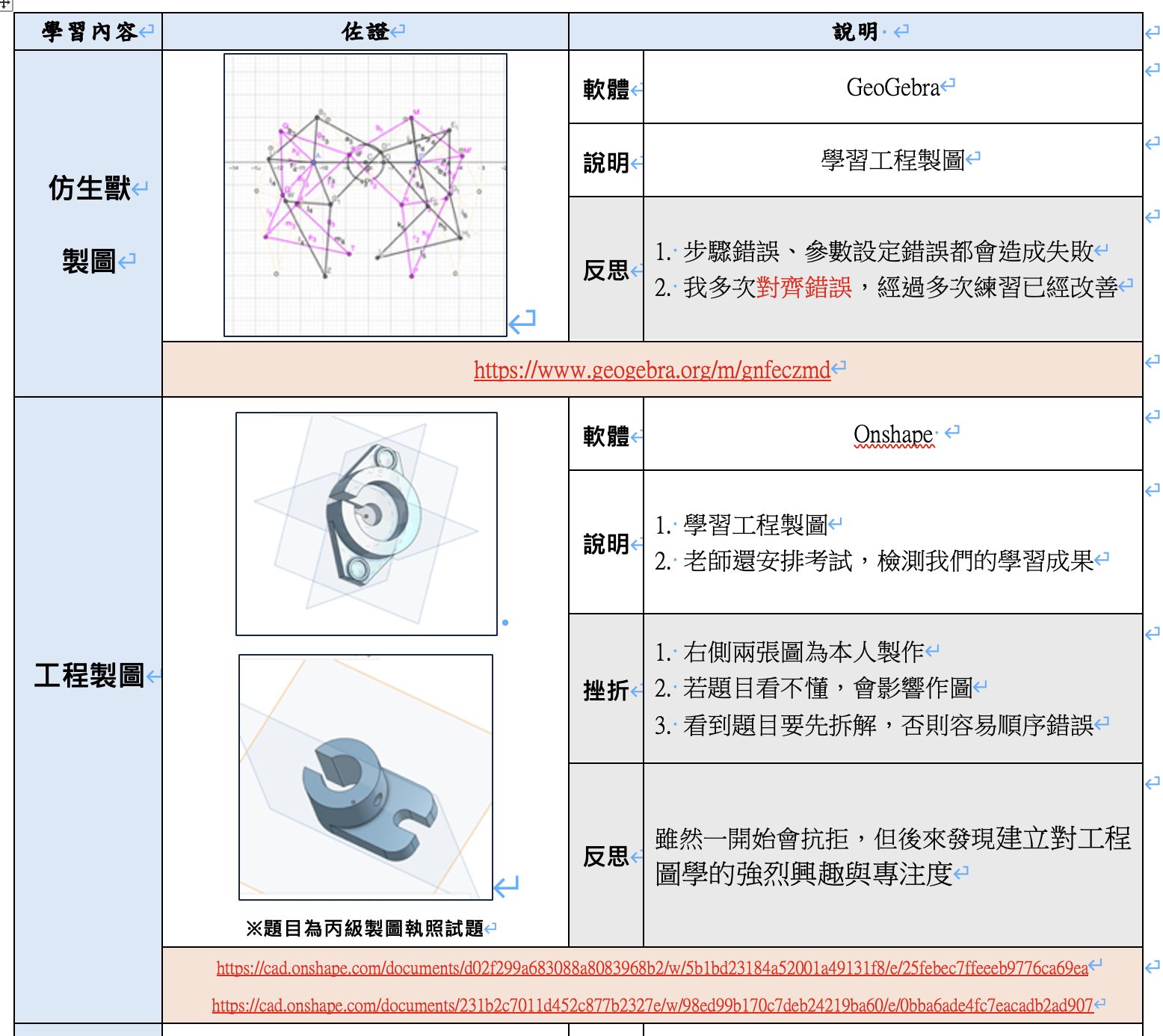
Reflection:I resisted at first, but later found a strong interest in and focus on engineering graphics.
Evidence (two Onshape documents):Onshape document 1 ↗, Onshape document 2 ↗
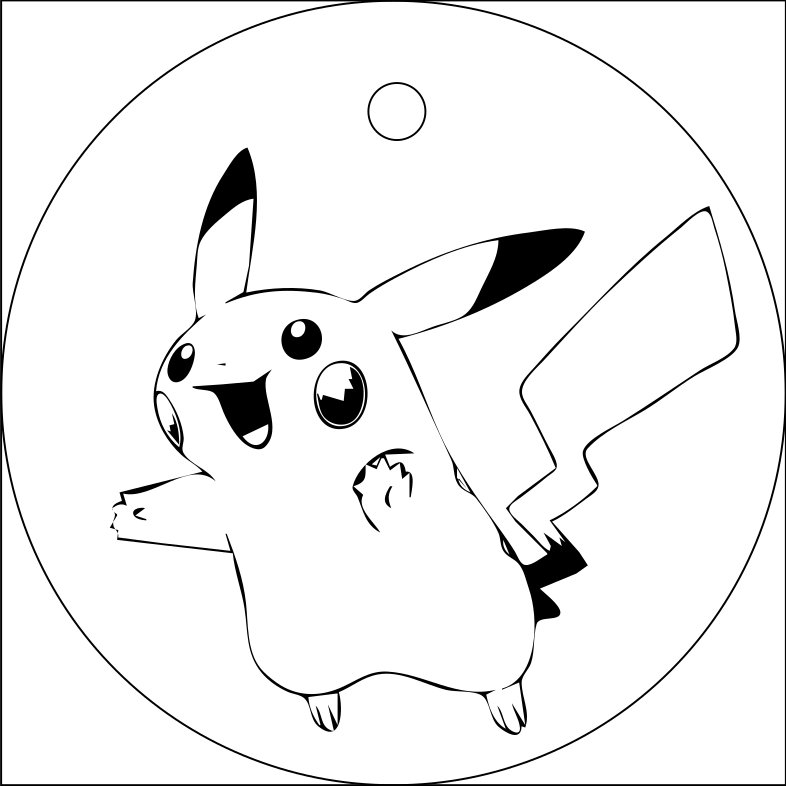
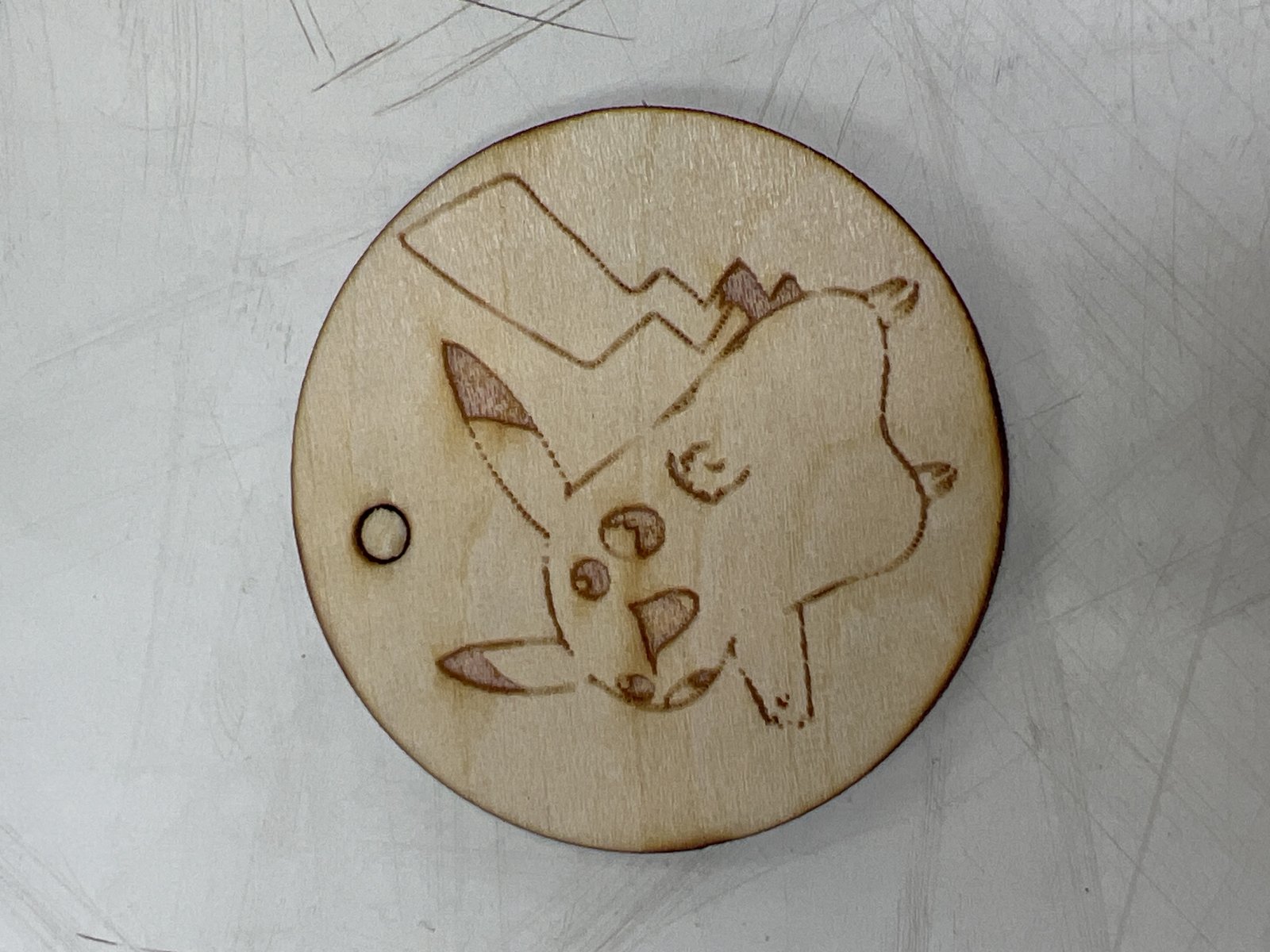
Hands-on work done:Experienced laser-cut drafting, from drawing the line art on a computer to fabricating the finished piece.
Reflection:The final step of removing the white border tests patience and care; after repeated practice I am fluent at it.
Inkscape computer drafting and laser-cut result
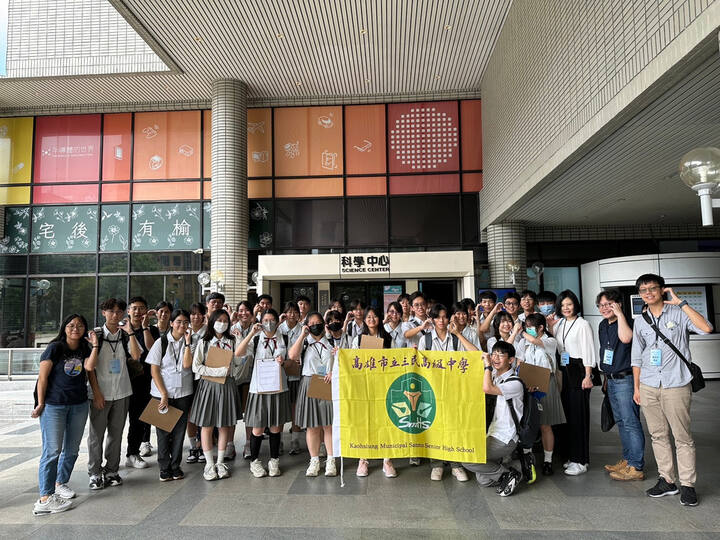
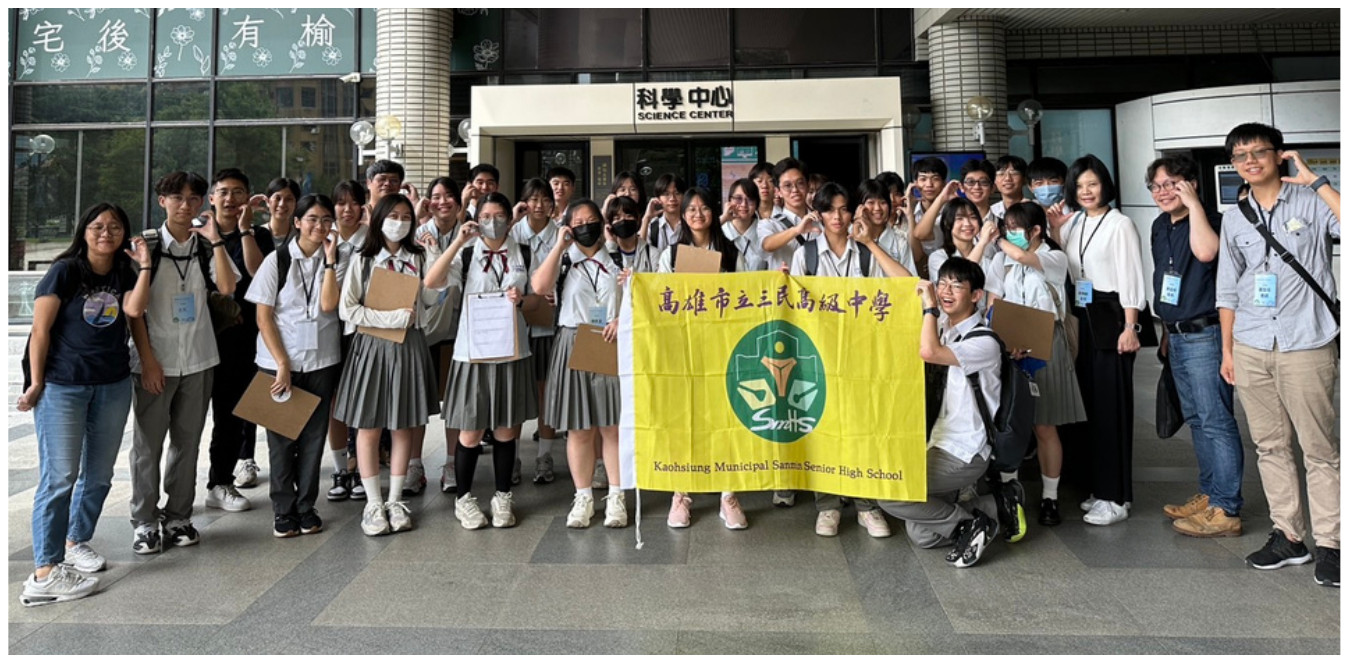
Six sites, each showing something different:
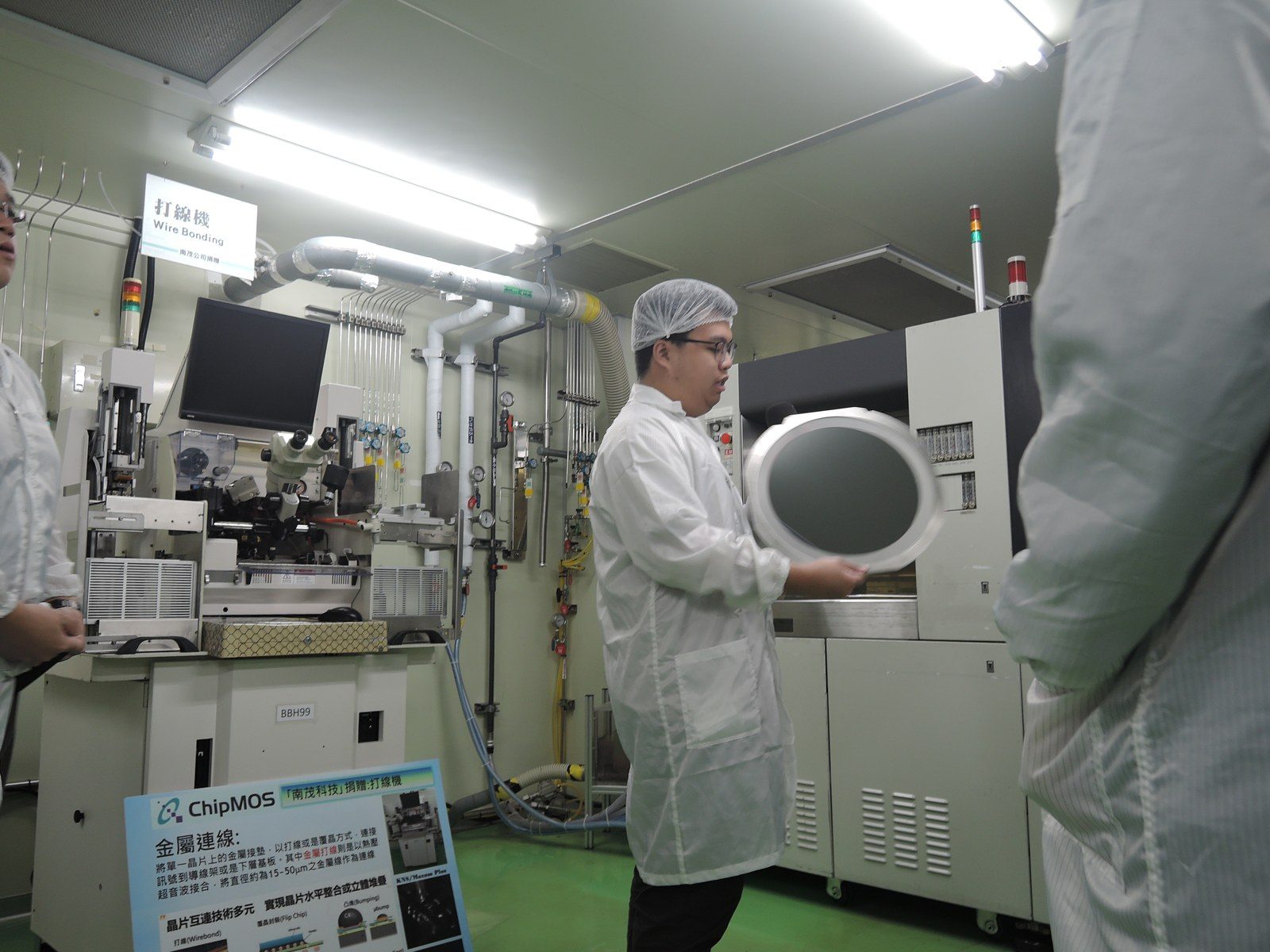
ASE GroupSeeing packaged chips, including a demo of Apple M2 packaging. My first time knowing a chip still has a long road after it's done.
STUST cleanroomEarly experience: gowning up, the air shower before entering. First time in a cleanroom suit, seeing the textbook wafer in person.Evidence ↗
NCKU Semiconductor Research CenterSaw equipment using TSMC's CoWoS packaging, testing instruments, andWhat students here research. It was the first time I realized the same topic draws different questions in a company than in a lab.
MacronixA sentence I heard inside a semiconductor company and still remember:Only once you've internalized it can you explain it.Later I relied on this in science-fair defenses and explaining at the Education Expo booth.
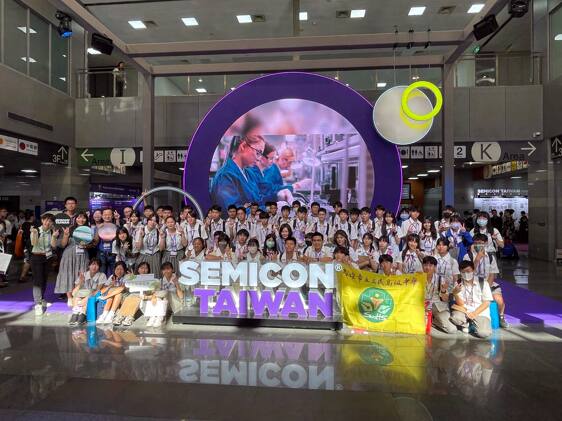
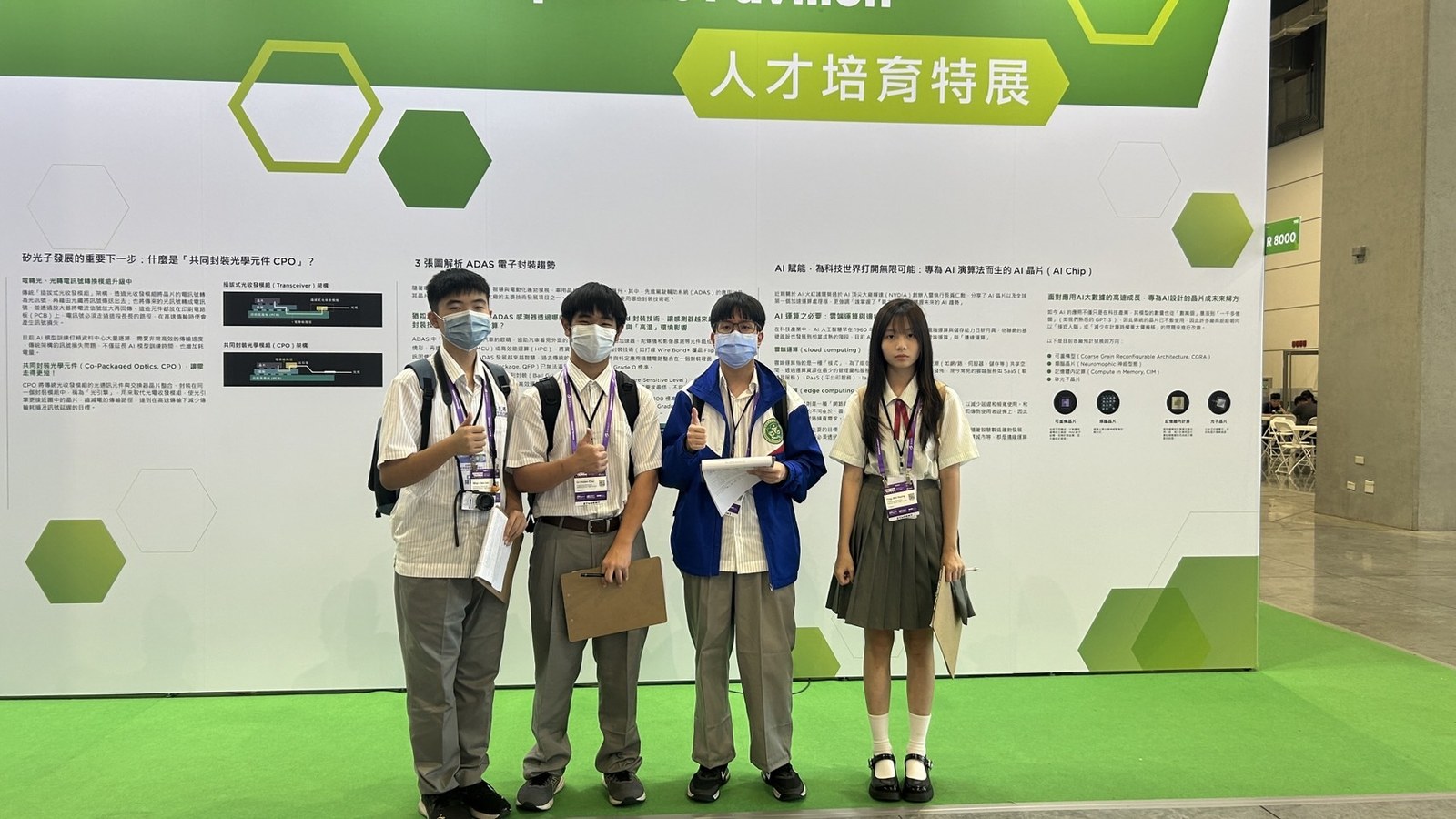
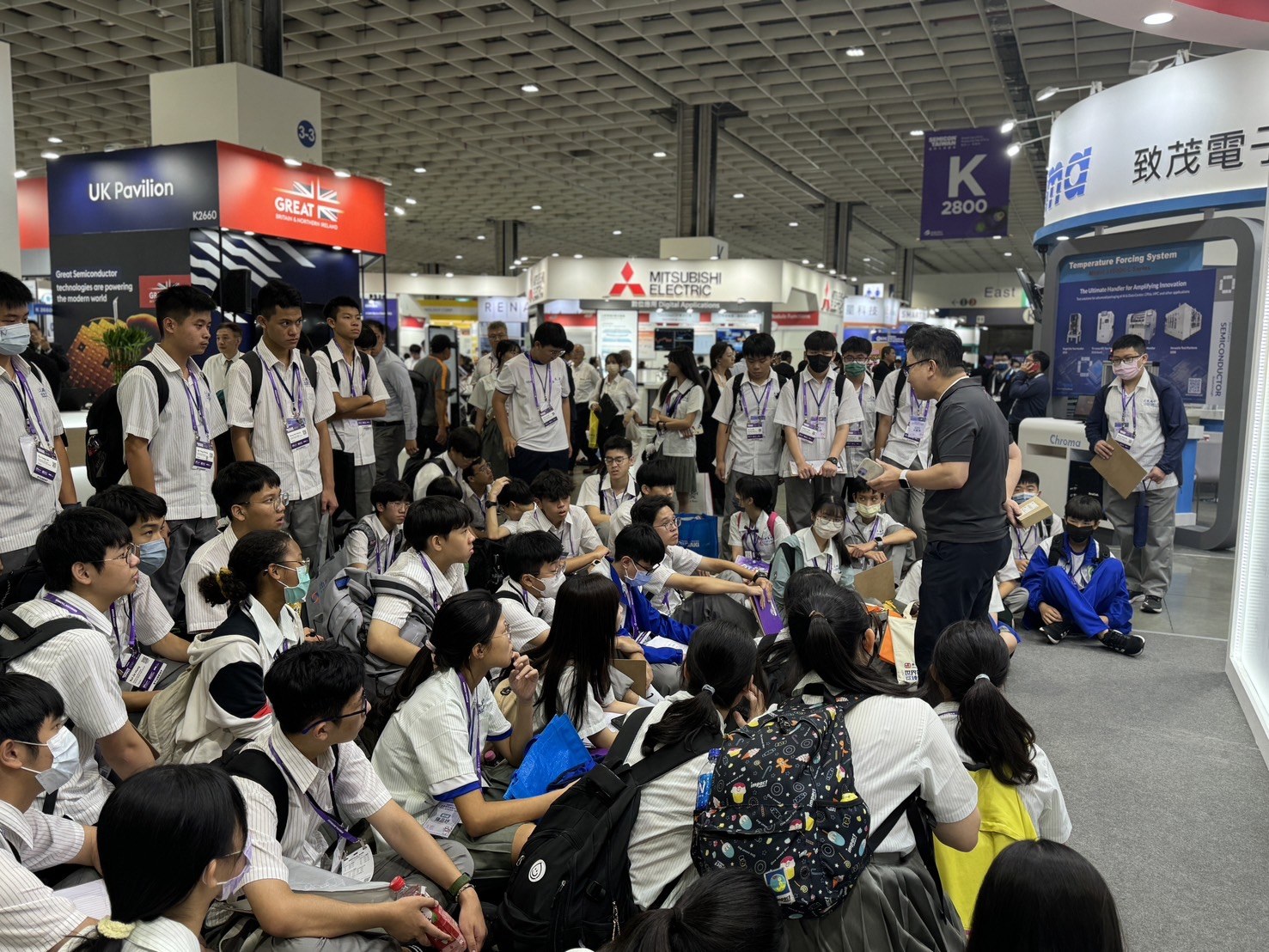
SEMI international semiconductor forum (SEMICON Taiwan 2024)Listening to experts on industry trends. My first time on the semiconductor industry's show floor — and my first time realizing that those textbook chapters are an entire industry out there.
“The World of Semiconductors” at the National Museum of Natural Science, TaichungThe grade-10 Advanced Semiconductors trip put the FET structures from class back into an exhibit context.Evidence ↗
Two industry engineers:One engineer each semester — one from TSMC, one from ChipMOS. What they gave me wasn't technology, but how to work. I recorded four lines in the official original.
Grade 10 · coursework portfolio original: inspiration from engineersWhen problems arise, proactively clarify the core.
Try it myself before asking others.
Treating difficulty as a growth opportunity, and “failure” as part of adjusting strategy.
Taking responsibility for my own output, and balancing work and rest to stay effective.That last line I didn't understand at first — why the engineer made a point of it. After finishing the smart grid's 19-week schedule I got it: in week 11 we found PM10 and PM2.5 metrics mixed up — an error invisible at 2 a.m. while coding, caught only the next day when re-verifying. A pace that keeps working is itself part of research ability.
My takeaways:“My horizons widened — I don't live in my own ivory tower.” My motivation for going to these places was simple:Seeing machines you normally can't.But after six sites, what I saw was really one thing: chips with different functions and components from different processes all end up packaged, interconnected, and integrated into a system that runs reliably.“Integration” is itself an engineering discipline requiring solid training— that image has shaped how I view my own work ever since.
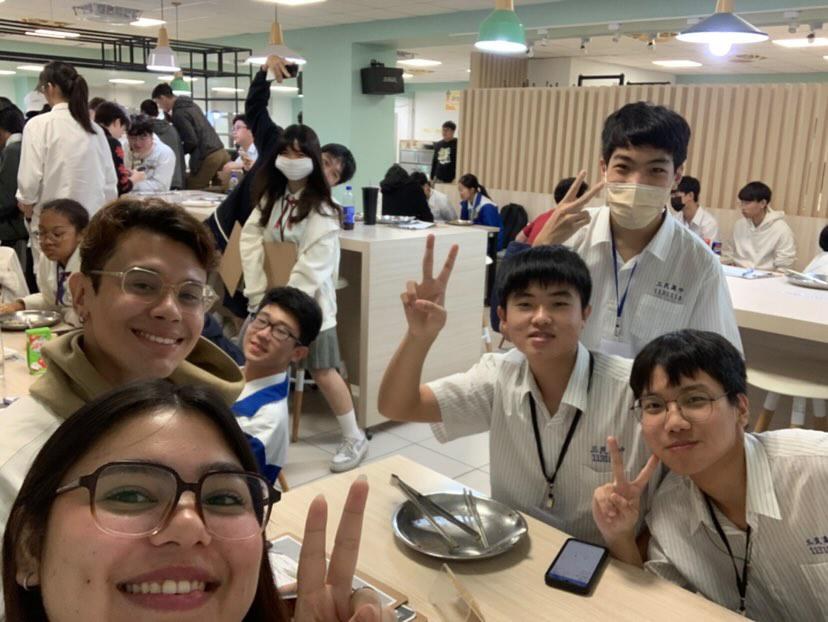
One more thing outside the tech column:The teacher led the visit in Chinese and English — my first time using English in a real situation, not a classroom role-play. Later I could explain transistors to the public bilingually at the Kaohsiung Education Expo; that started here.
Semiconductor courses, experiments, and visit sites
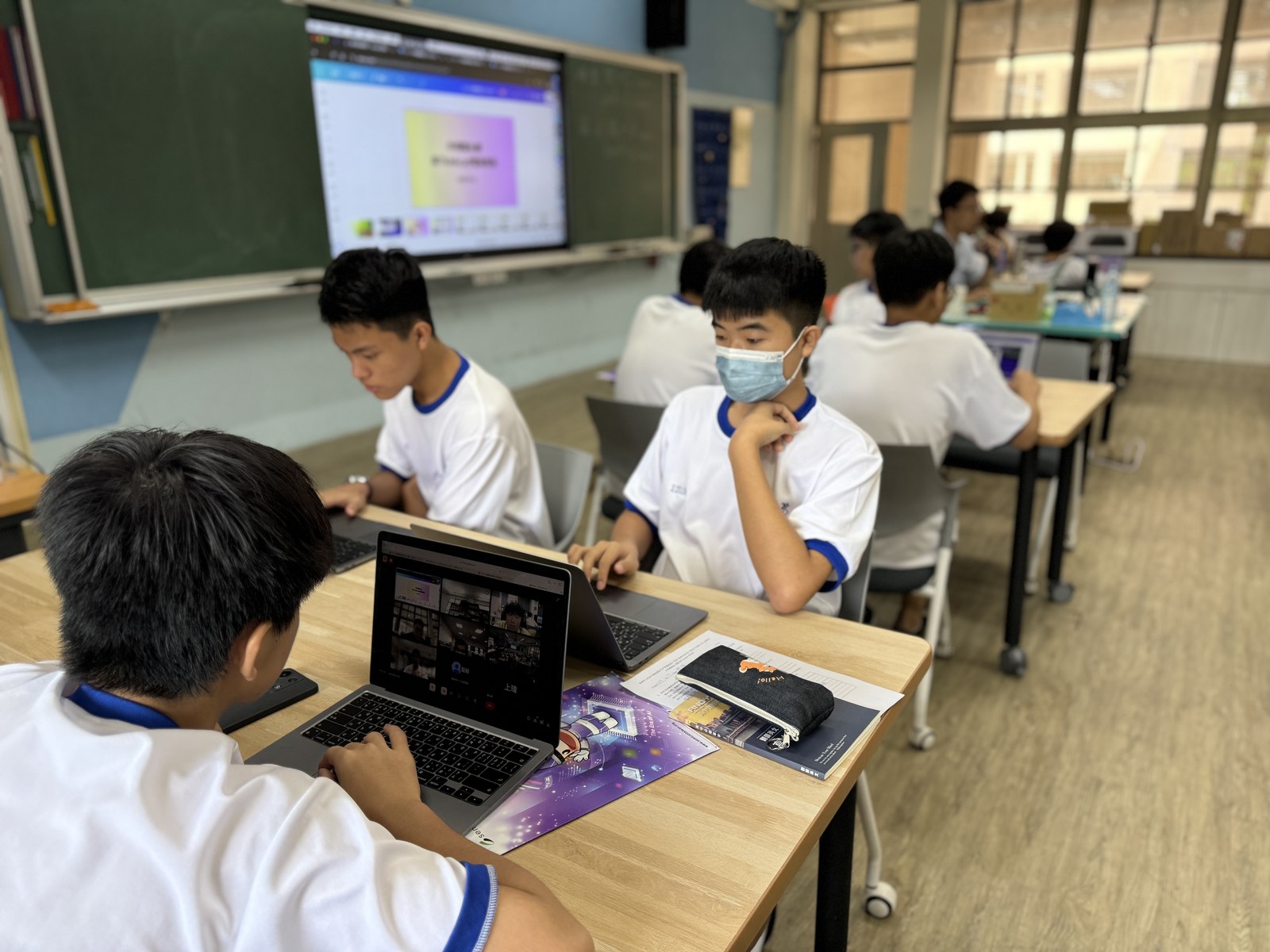
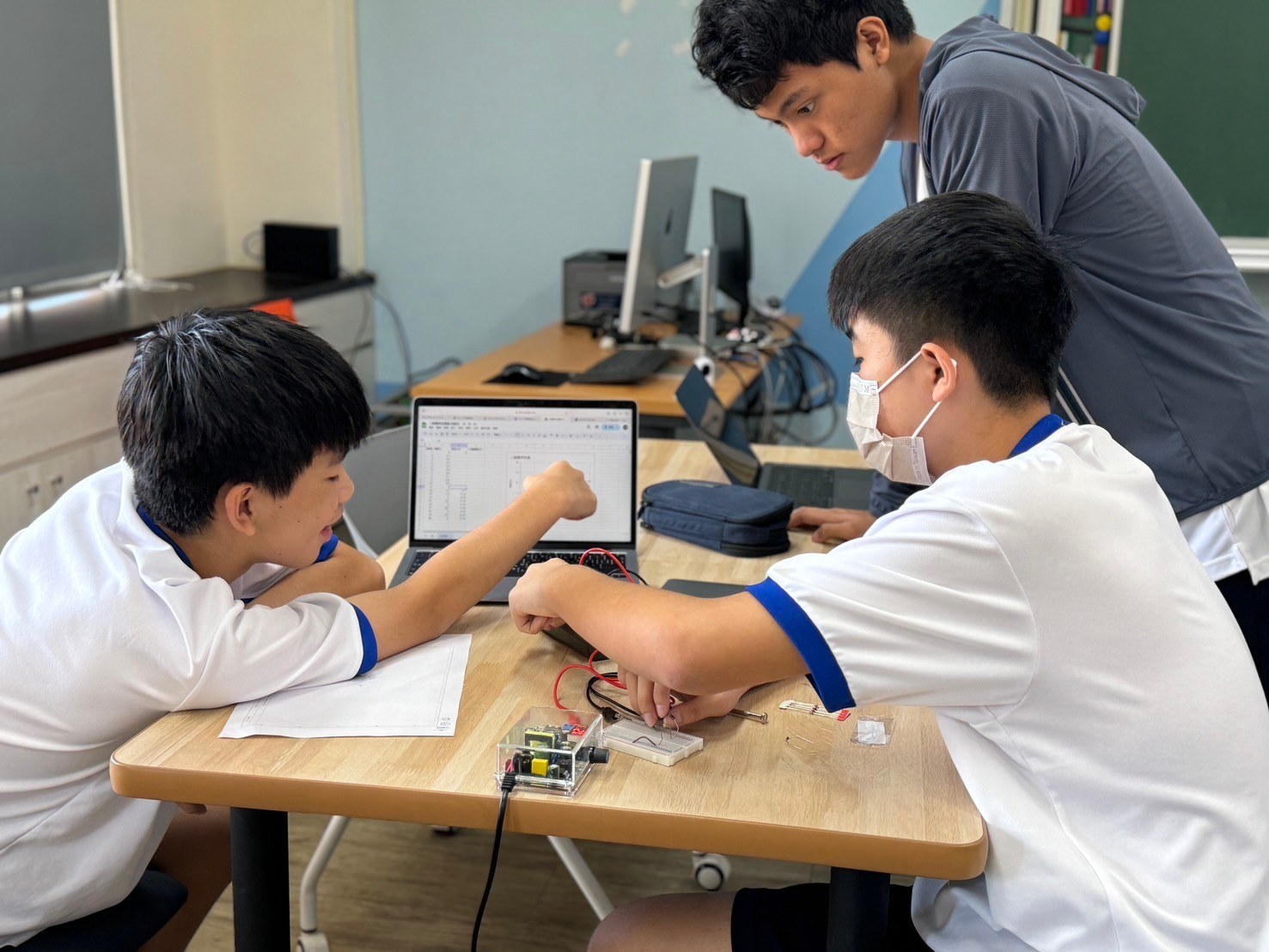
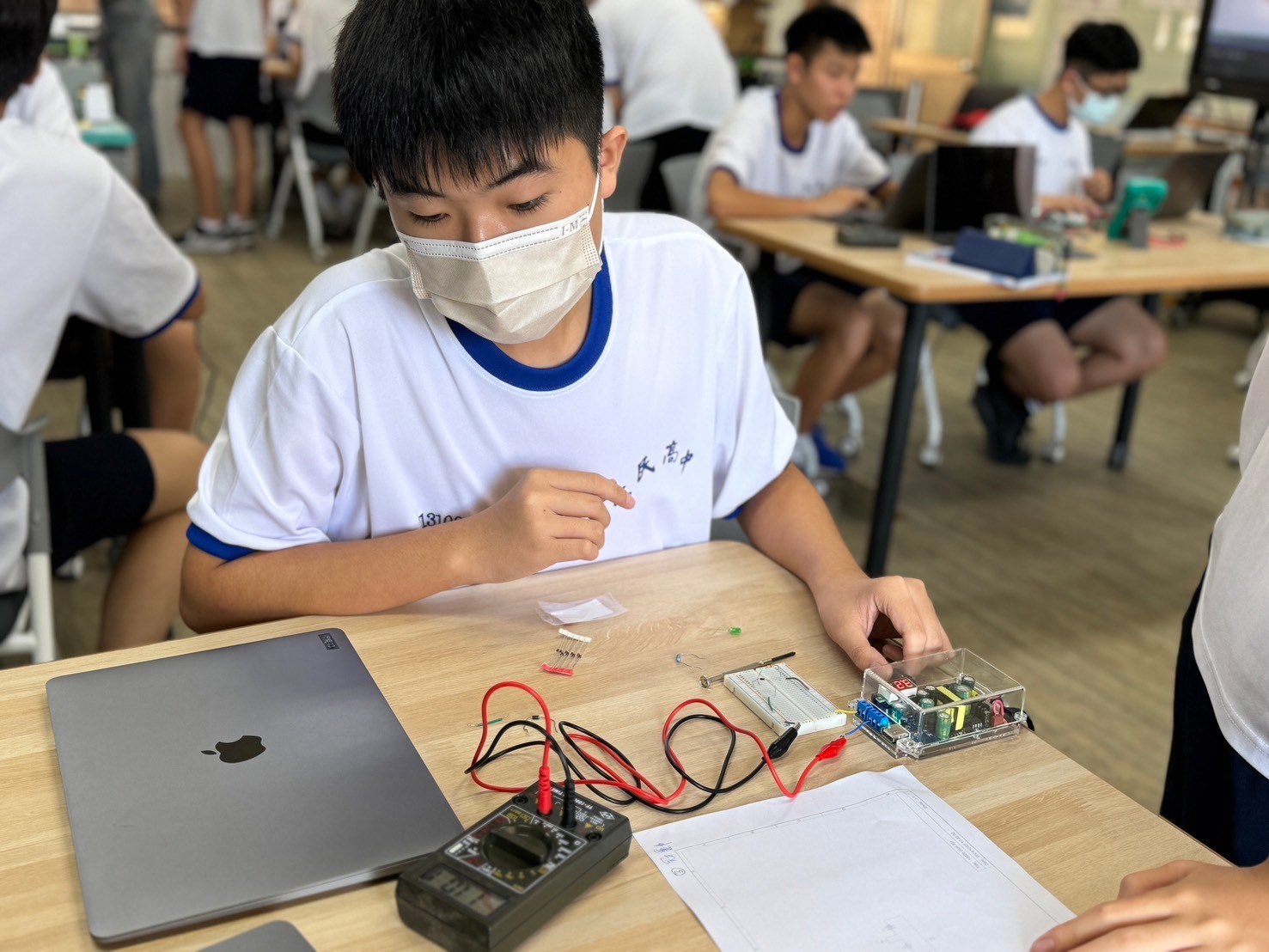
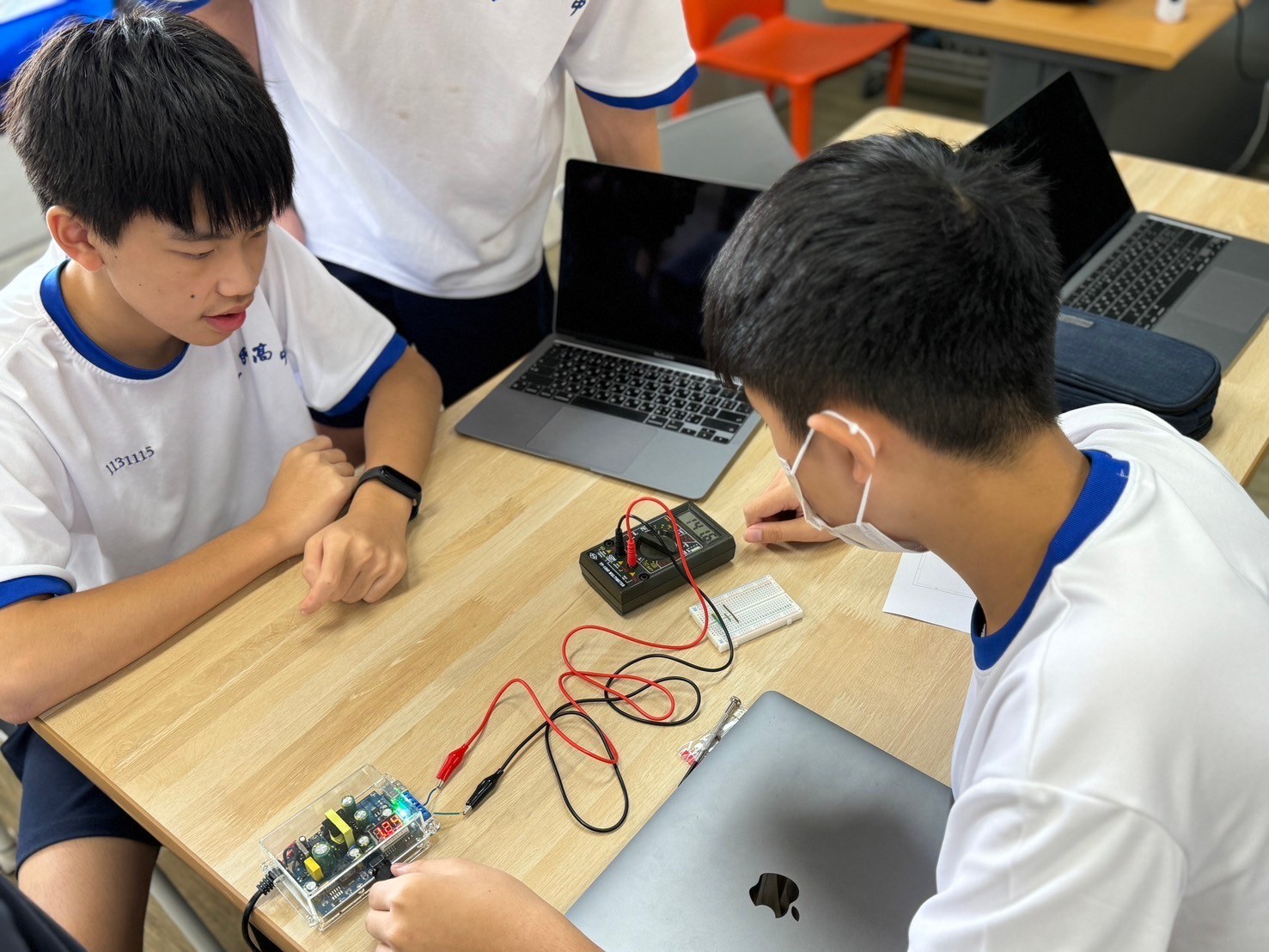
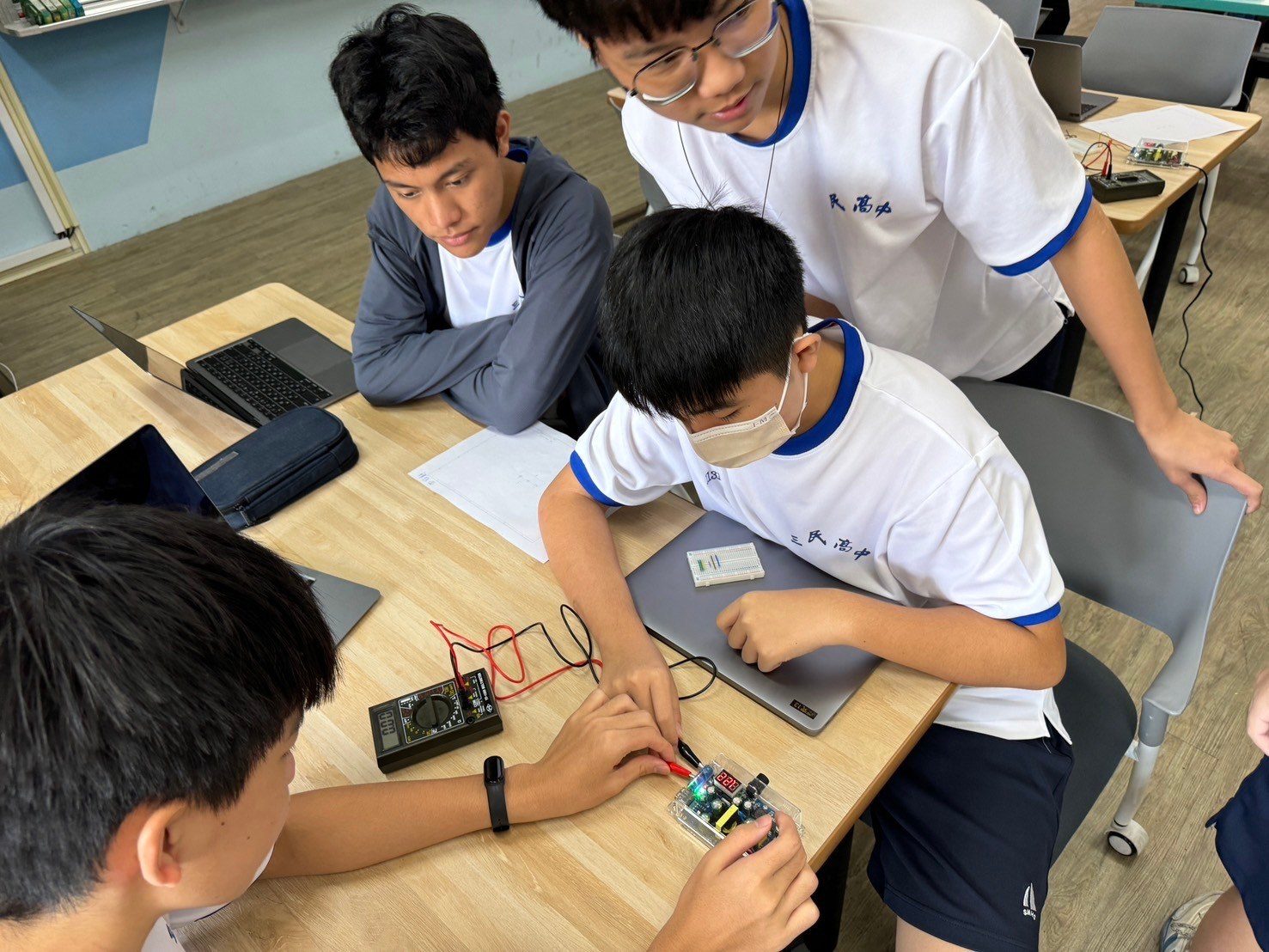
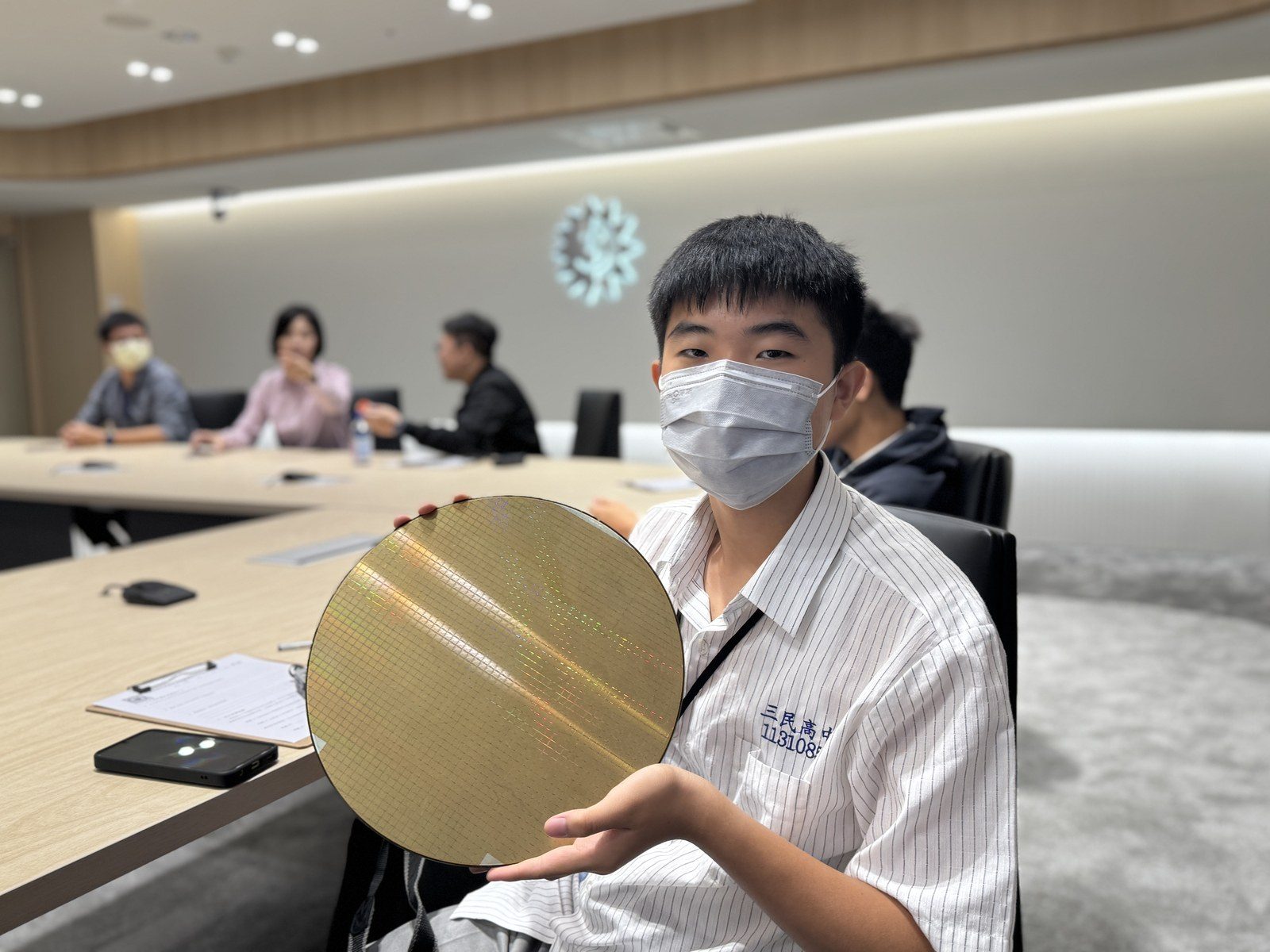
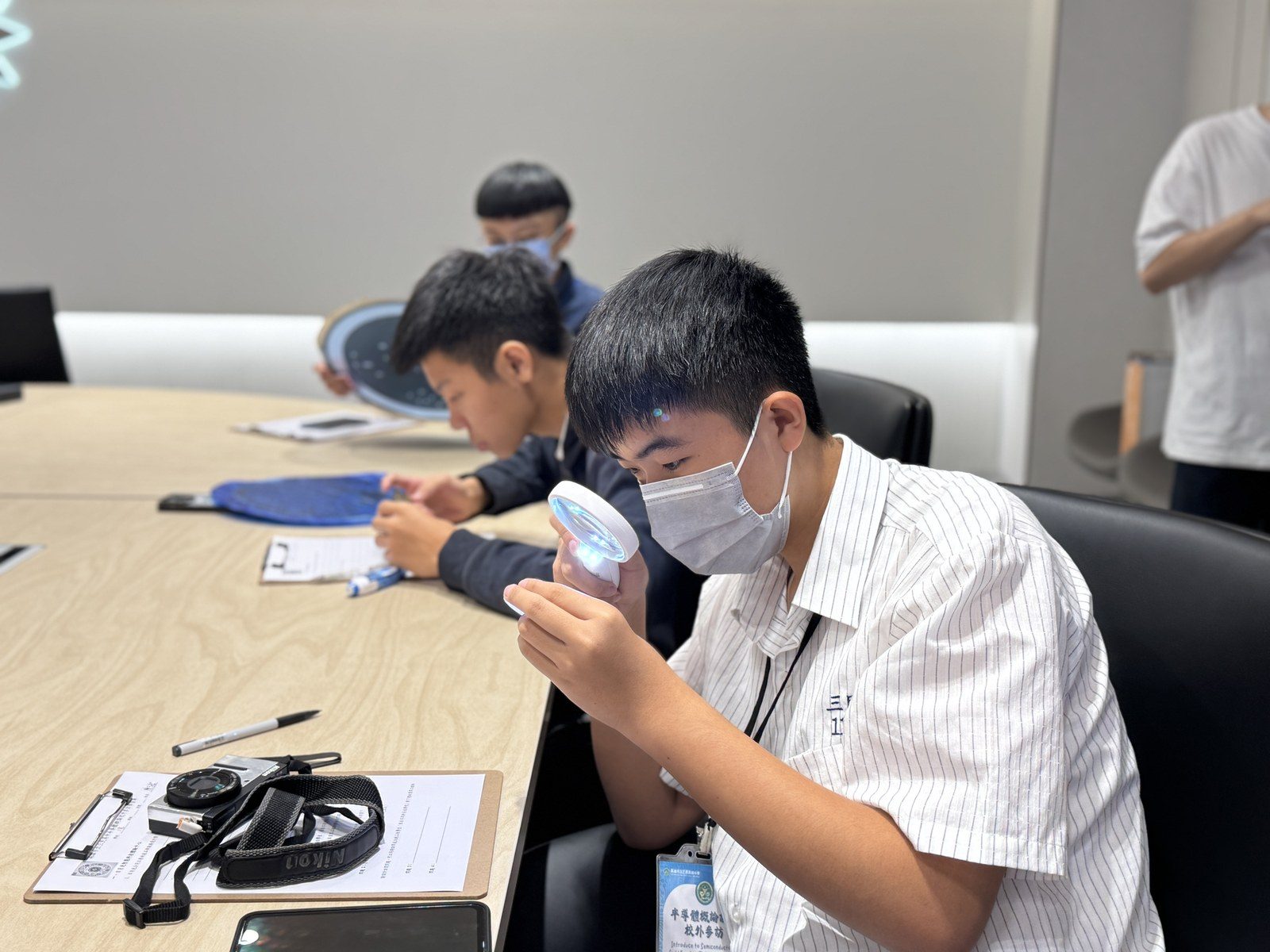
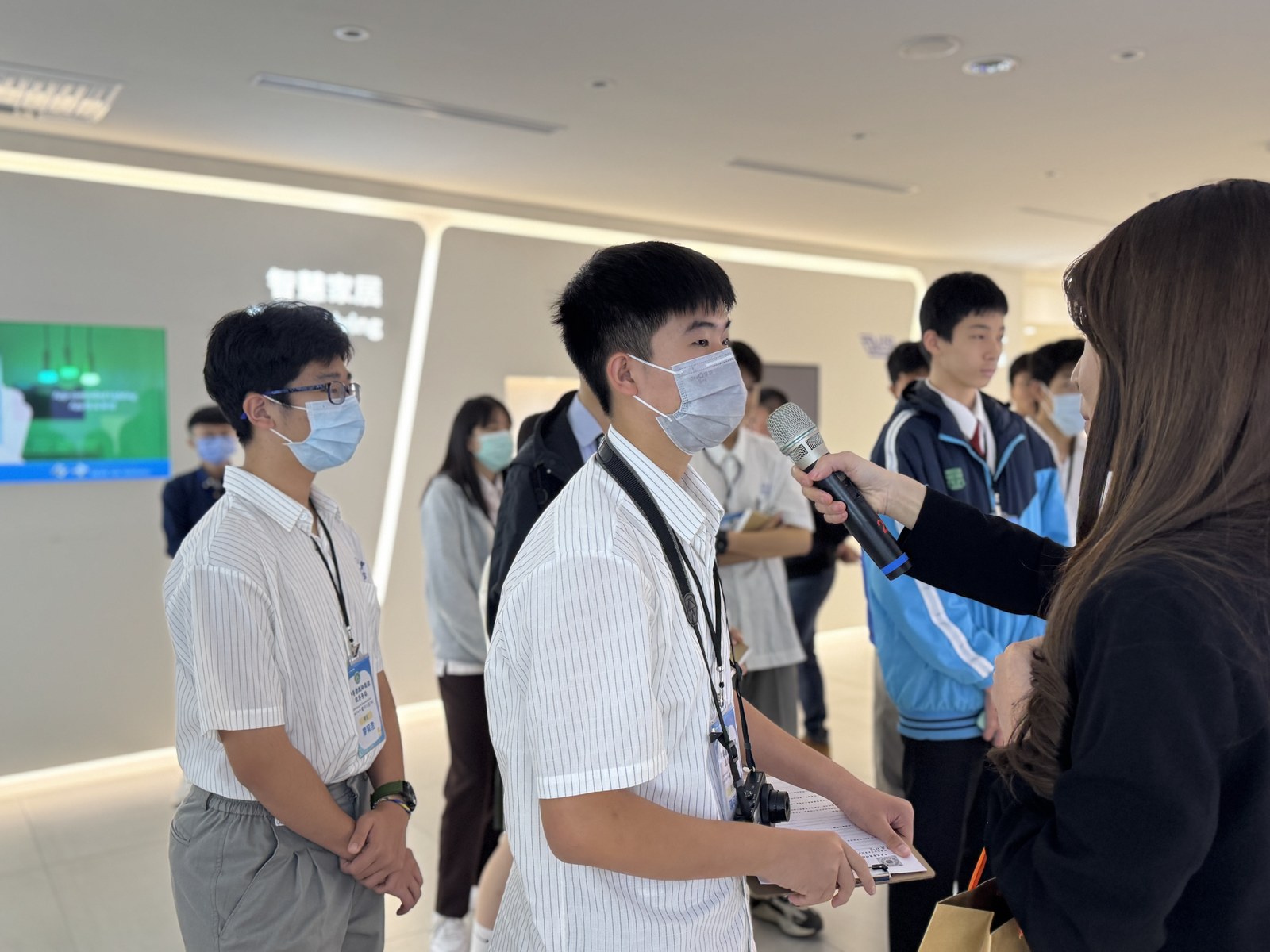
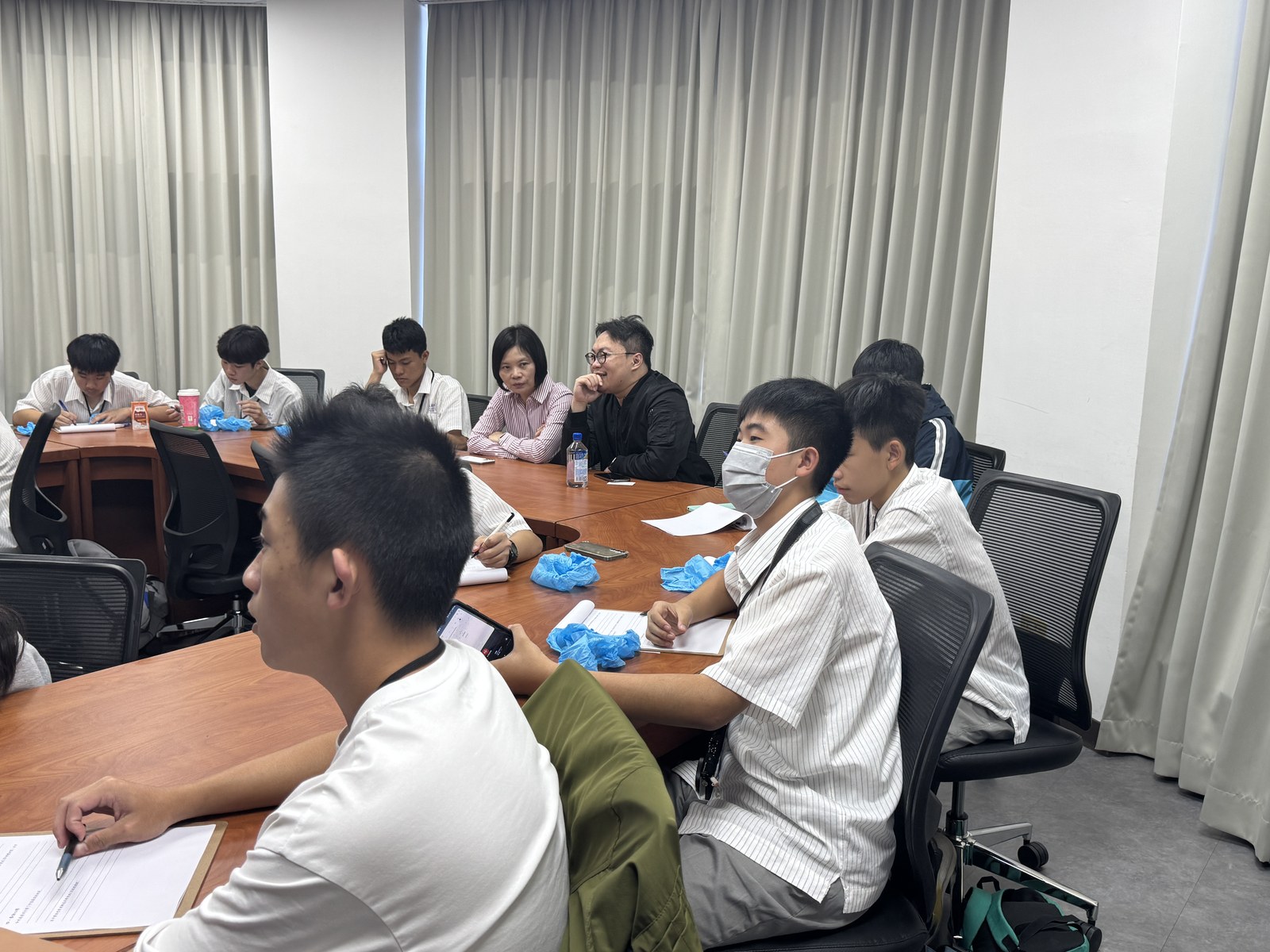
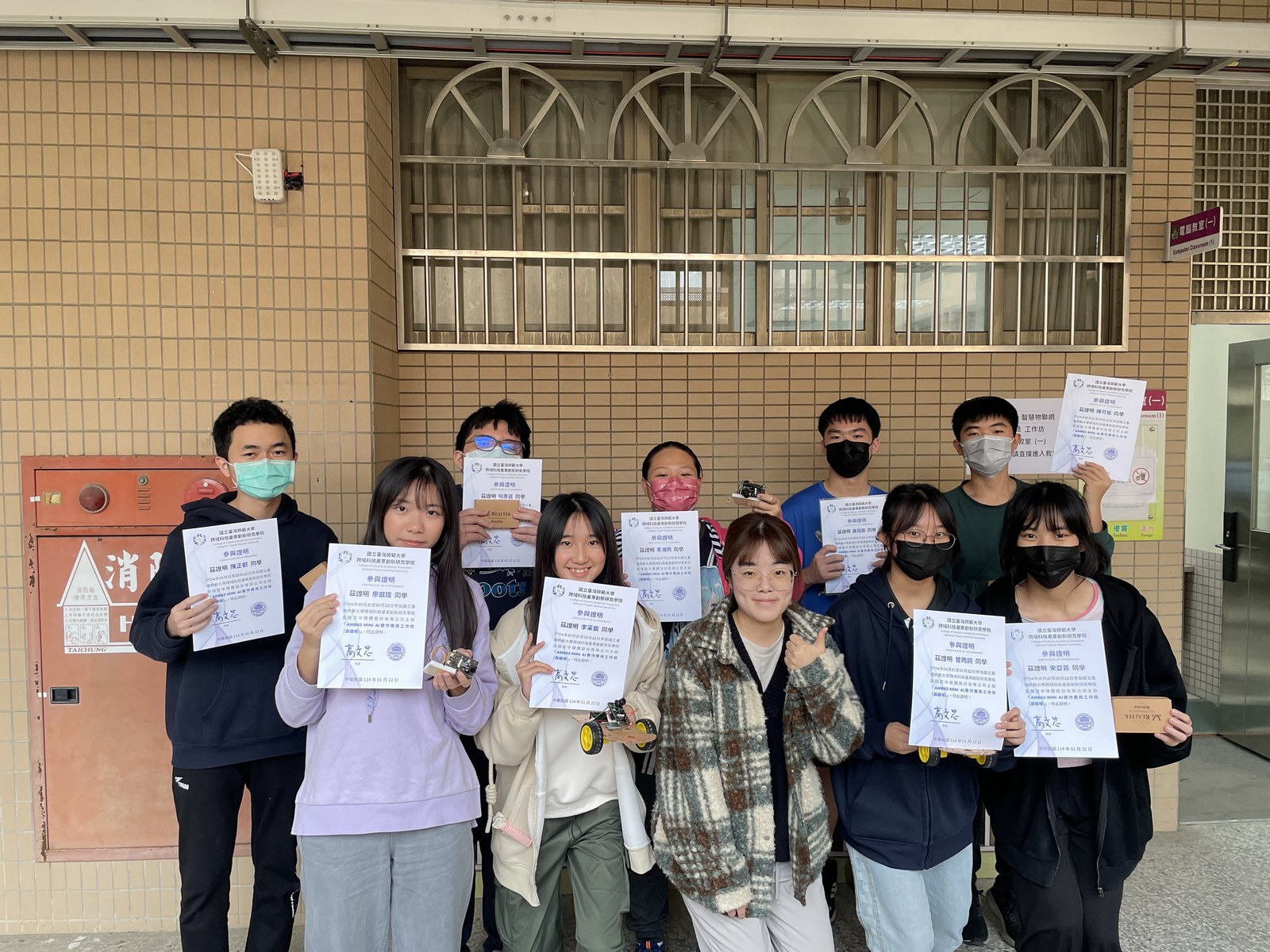
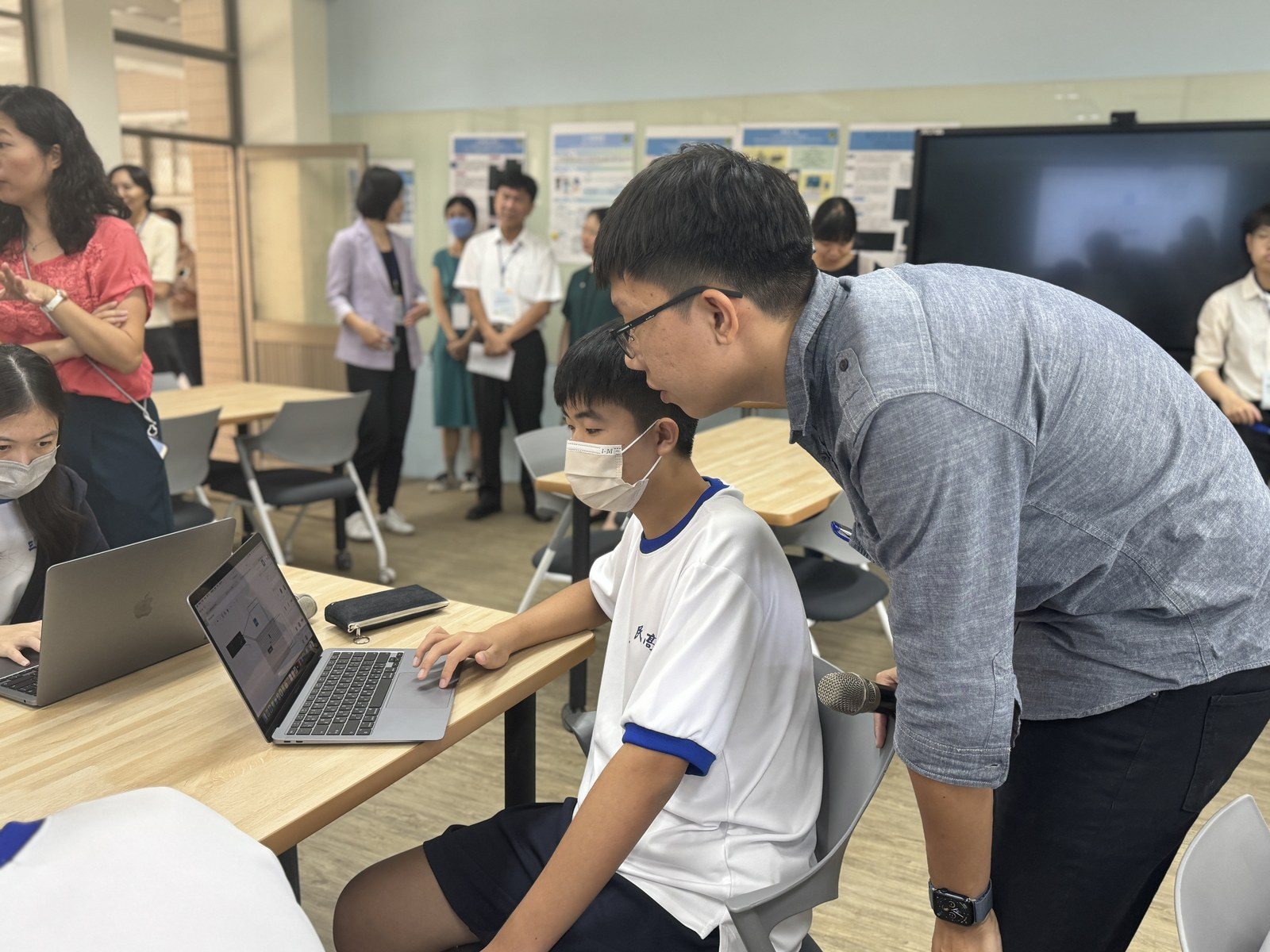
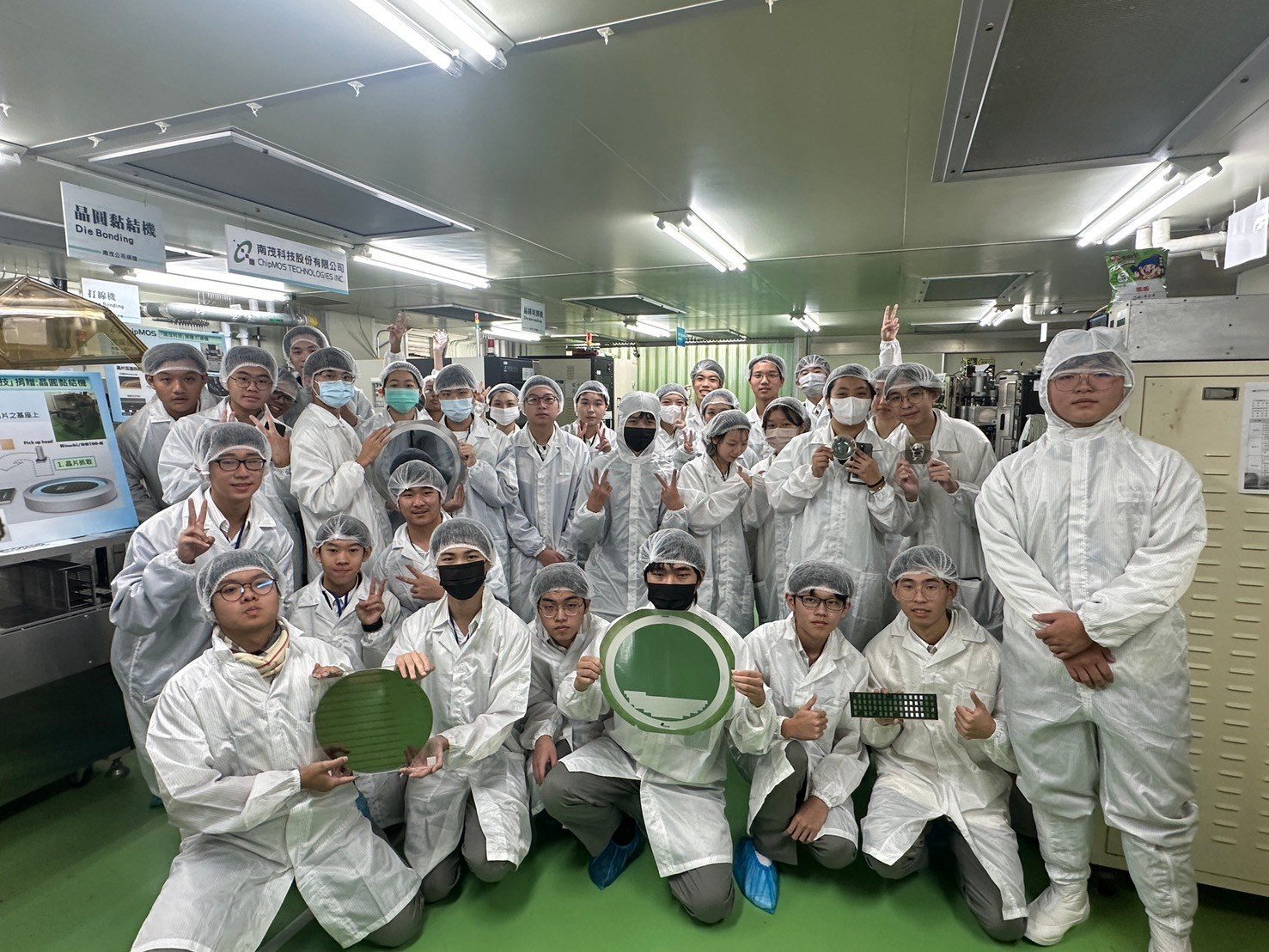
One sentence
A grid simulation system that ranks dispatch priority by social external cost. The problem awareness:The health damage from pollution isn't reflected in electricity prices。
Nature of work (honest statement)
This work isRules-based scale-model proof-of-concept, not a real grid prediction system nor an AI prediction model; both generation and load areSimulated values, not real sensor data.
Awards
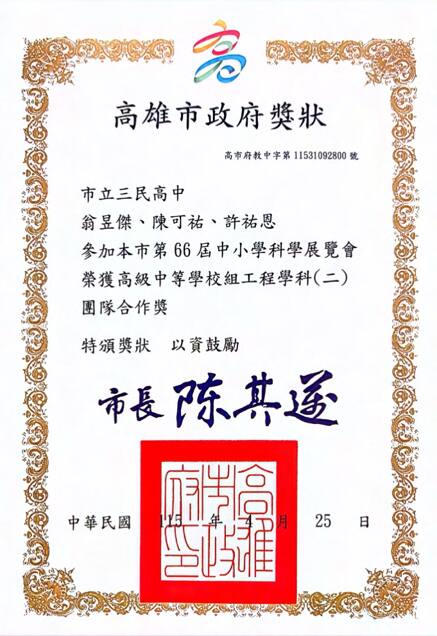
Proposed the direction, led the team and assigned work, supervised progress, revised and produced the written report and poster, built the Node-RED site, implemented the circuit boards and Node-RED code, consolidated information.
Division-of-labor evidence:The official team division-of-labor table lists me (team lead) at 55%, with teammates Weng Yu-Jie and Hsu Yu-En contributing jointly.
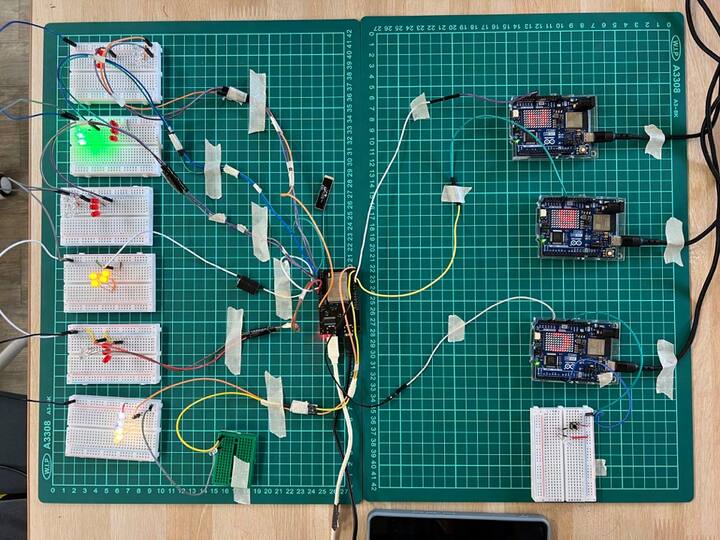
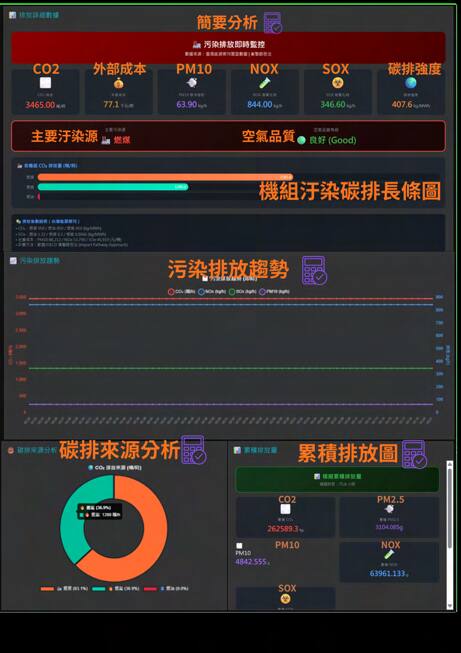
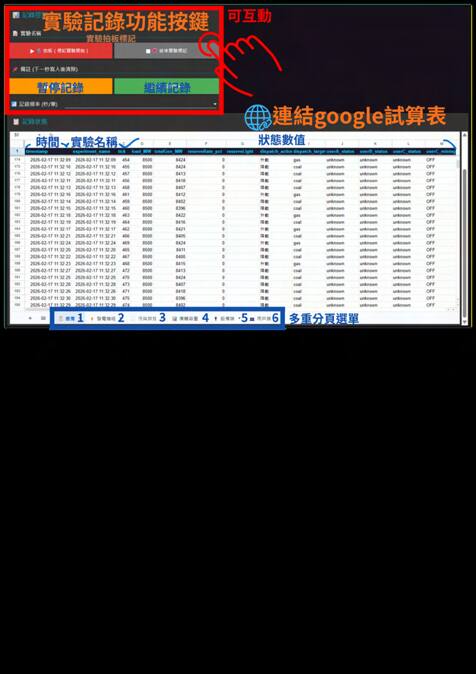
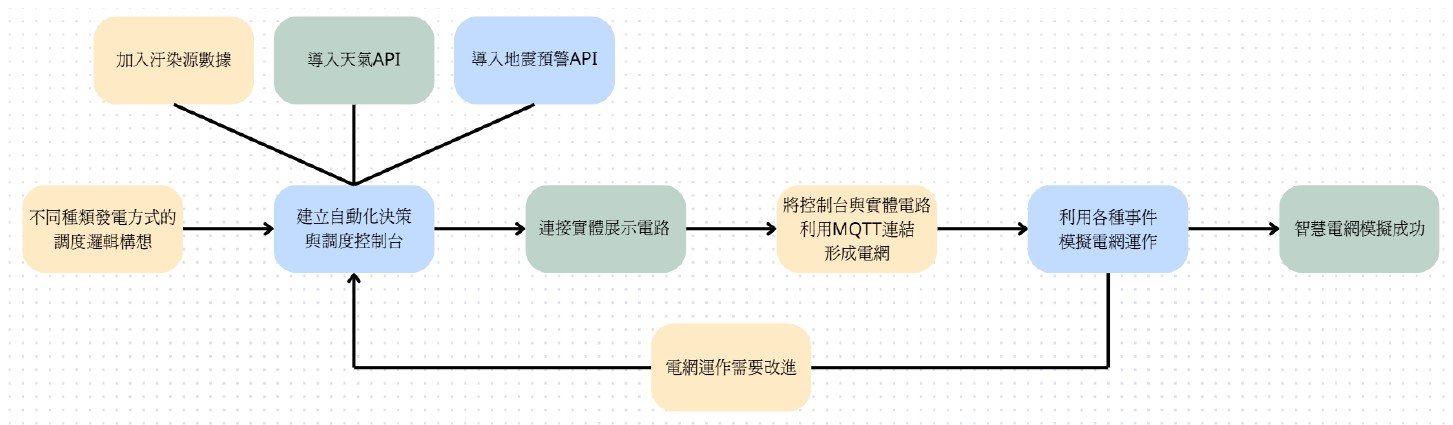
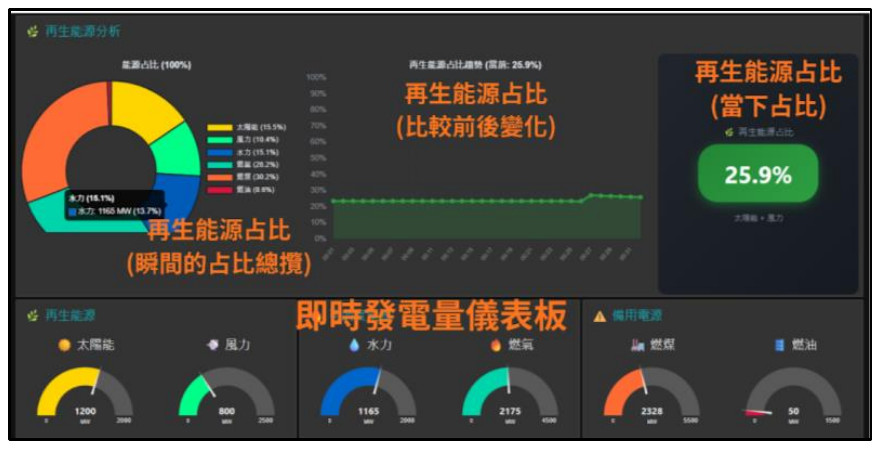
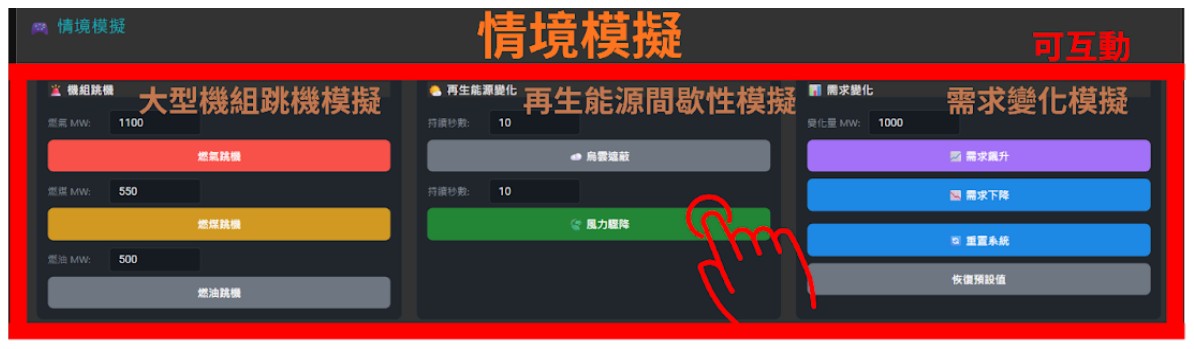
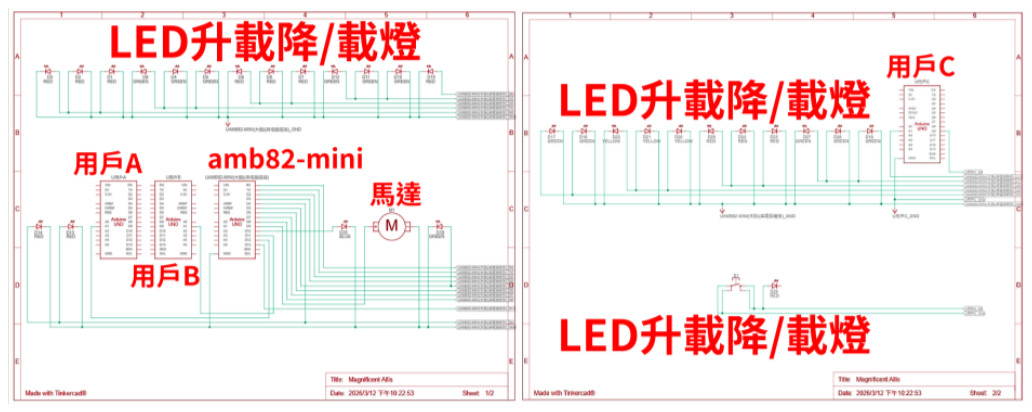
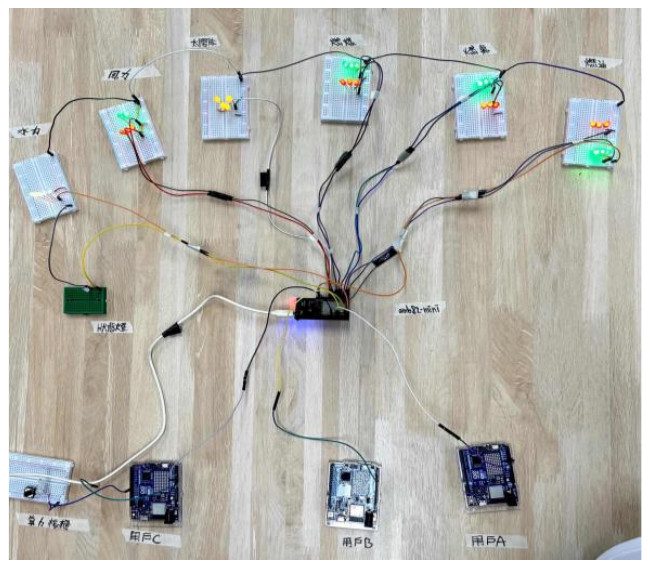
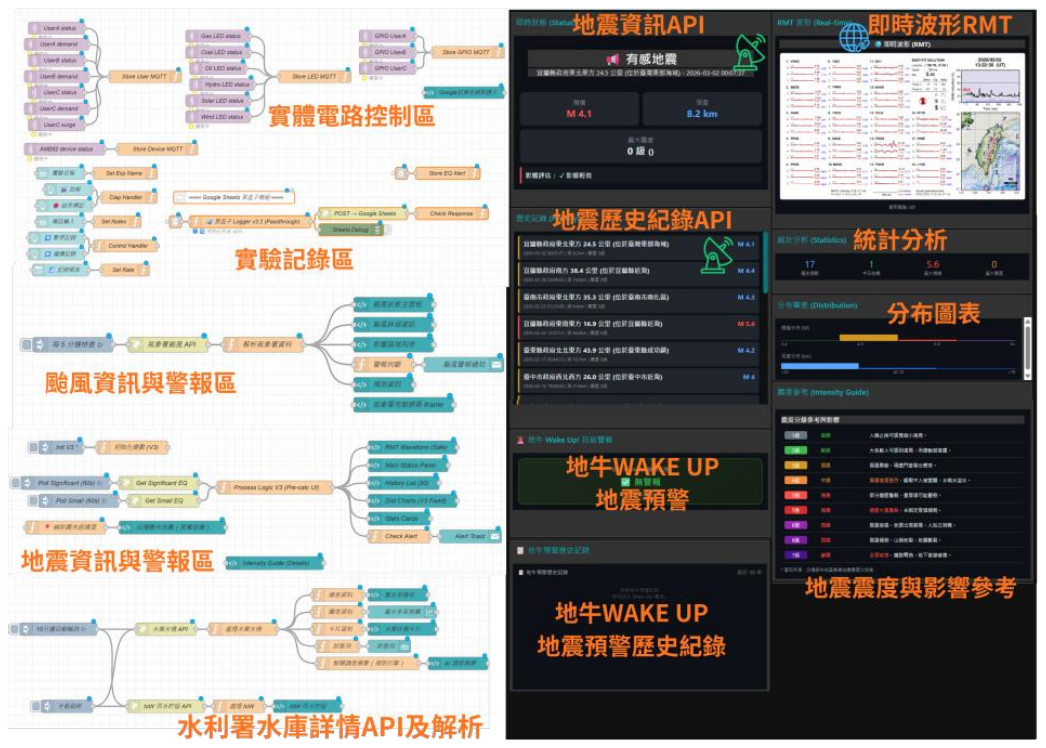
Architecture: simulated inputs → Node-RED rules-based decision layer (dispatch priority ranked by social external cost) → MQTT → cloud logging and light-signal alerts; hardware shown at scale with Arduino and breadboards.
Two design judgments worth explaining: (1) I included real ramp-rate differences (coal 5.5 MW/min vs. hydro 33 MW/min), because dispatch feasibility depends on whether units can keep up; (2) the load-shedding order was fixed as industrial → commercial → residential,Residential always last — that's a value judgment, not a technical one。
System hardware and screens
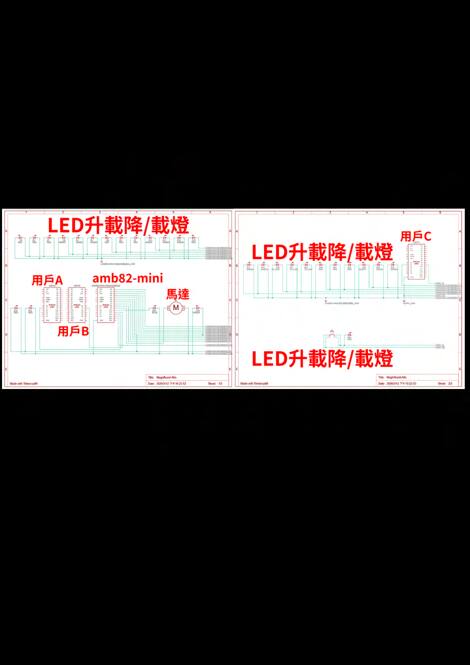
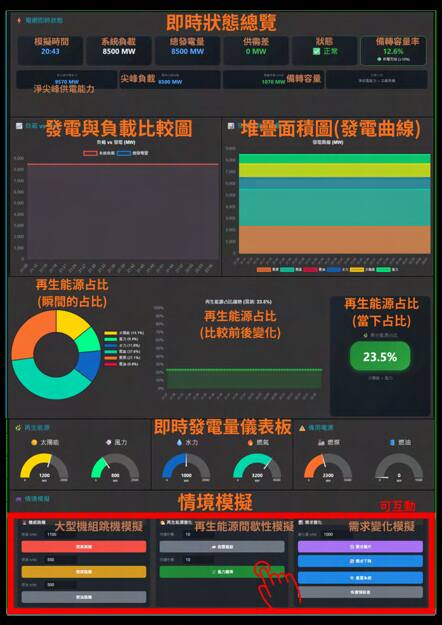
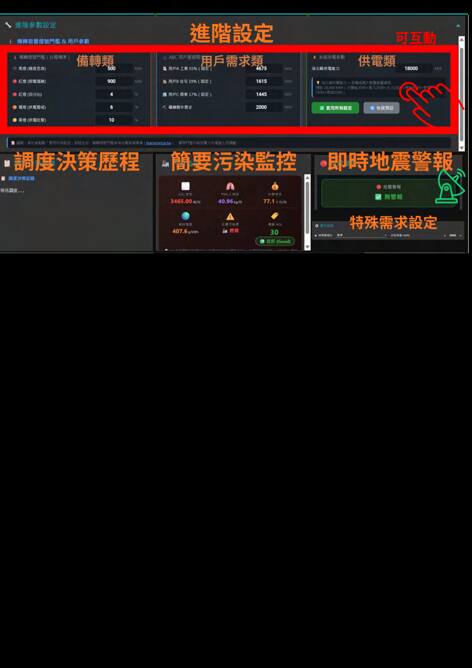
Used the Impact Pathway Approach (IPA) — the bottom-up monetization method recognized by the EU NEEDS/ExternE projects and the OECD; four steps: emissions inventory, atmospheric dispersion modeling, dose-response functions, monetization.
Sources include the Taiwan Energy Journal's external-cost analysis of coal-fired health impacts and Academia Sinica RCEC estimation formulas.Every self-made table in the appendix is labeled “drawn by the researcher” with the original data source attached.Evidence ↗
Data sources and records
| Stuck point | Final choice and reasoning |
|---|---|
| Message middleware | Switched from ActiveMQ to Mosquitto — installation and debugging costs were too high |
| Protocols | Measured HTTP sending 100 messages with only 50 received — data would be lost; switched to MQTT for guaranteed delivery |
| Notification channel | Switched from LINE Notify/Telegram to SMTP Email due to service policy changes and unstable connections |
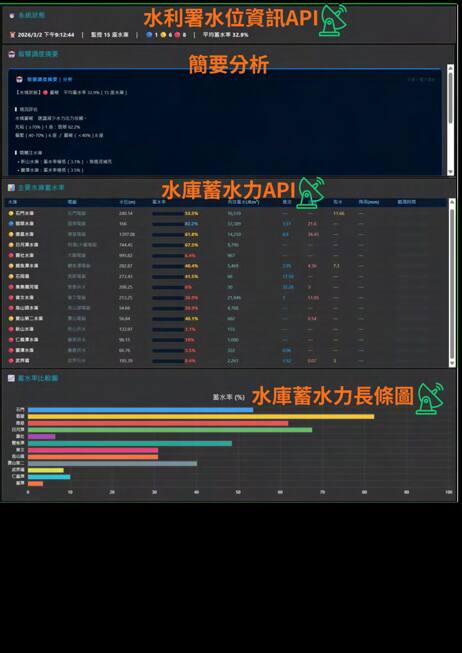
Earthquake, typhoon, and reservoir panels deliberately do not auto-control the grid, for three reasons: mismatched time scales, incomplete information early in a disaster, and “whether to preventively shed load” being a risk trade-off requiring human judgment.
It's the same judgment I later held firm on in HERMES: AI responsibility boundaries.
Code generation can go to AI, but “how the system should be architected” and “whether the dispatch logic matches the grid's physical reality” are human responsibilities.
The team called this principle “80/20 Vibe Coding” in official documents; the ratio describes effort allocation, not a quantified metric.
The initial direction was “two-way distribution communication and load allocation” on the consumer side. The advisor challenged: “renewables fluctuate constantly — you can't control the generation side.” In team discussions I also said, “two-way communication is a dead end; I can't figure out how to do it.”
Finally, in oneAn hour-long team meetingIt pivoted toward real-time dispatch on the generation side, with three decisions: positioning around a “decision brain”; flipping the traditional “ Thermal-first, renewables-support” logic; and making “transparent decision-making” the key differentiator.
In late development I led cross-debugging with AI, using a “plan review” mechanism: code given to multiple models for debugging simultaneously, then reviewed item by item by me. In week 11 we found PM10/PM2.5 metrics mixed — a fatal problem — and immediately fixed it and refactored the Node-RED formulas to PM2.5-specific social-cost coefficients.
This error wasn't caught by my eye — AI repeated cross-checking found it.This taught me that academic citation isn't just plugging data into formulas — you must clarify the definitions and limits behind the data.
When the project needed Taiwan's real-time generation data, I found a third-party site organizing Taipower's open data clearly and in real time. On behalf of the team I wrote to the site owner under my own name requesting iframe embedding, and volunteered four commitments in the letter:
- Display only, no modification of content
- No commercial use
- Clearly citing sources in project documentation and oral presentation
- Never treating the results as developed by our team
Approved the same day (2026-02-12).Evidence ↗
System screens and physical circuits
Stretch depth vs. launch height
Five sets of variables, 10 repeated measurements each — this is one of them. Group experiment.
The key finding was a counter-intuitive reversal:3 cm flies farthest (84.0), dropping to 74.8 at 4 cm and 66.0 at 5 cm —There is an optimal range — deeper isn't farther.Evidence ↗
What I wrote at the time
“When facing outliers, we chose toKept and annotated, not deleted, because these ‘failure’ data points revealed the experiment's weaknesses.”
I additionally listed five experimental flaws myself: slight floor tilt, reading errors, fatigued rubber bands not replaced, etc.
Radius vs. spin time
Four variable sets, 10 trials each. Unit: seconds
Increasing the radius raised spin time from 8.30 s to 14.97 s,Consistent with moment of inertia。
Center-of-mass height vs. spin time
Skewer length above the pivot W₁. Unit: seconds
Raising the center of mass dropped the time from 14.97 s to 11.37 s. Same conclusion as the last report:“Experiments have an optimal condition, not a more-is-better rule.”Evidence ↗
VI. Diverse Activities
Things I did on my own outside coursework
Six categories. Open the one you want — details and on-site photos expand inside.
One sentence
Taking a power plant's major overhaulTag judgments that existed only in senior staff's heads, turned into a chain of responsibility the system records, can find, and can trace.
Ability boundaries (honest statement)
The system isA working prototype, demonstrated online, with an intro video and a promo page; not yet trialed in a plant, nor commercialized. The implementation was done through repeated back-and-forth with AI (Claude Code), reviewed line by line before adoption — I don't claim line-by-line handwriting. System design, interview planning, and team direction were all led by me.
System screens, on-site photos, and the semifinal deck
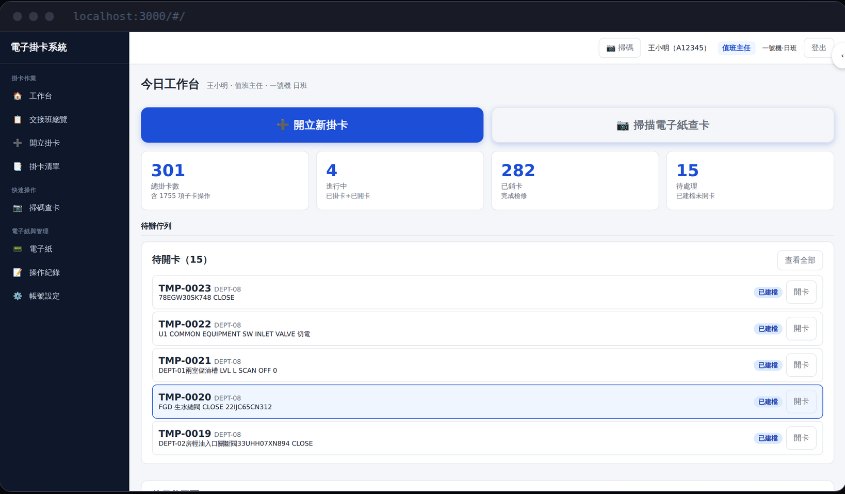
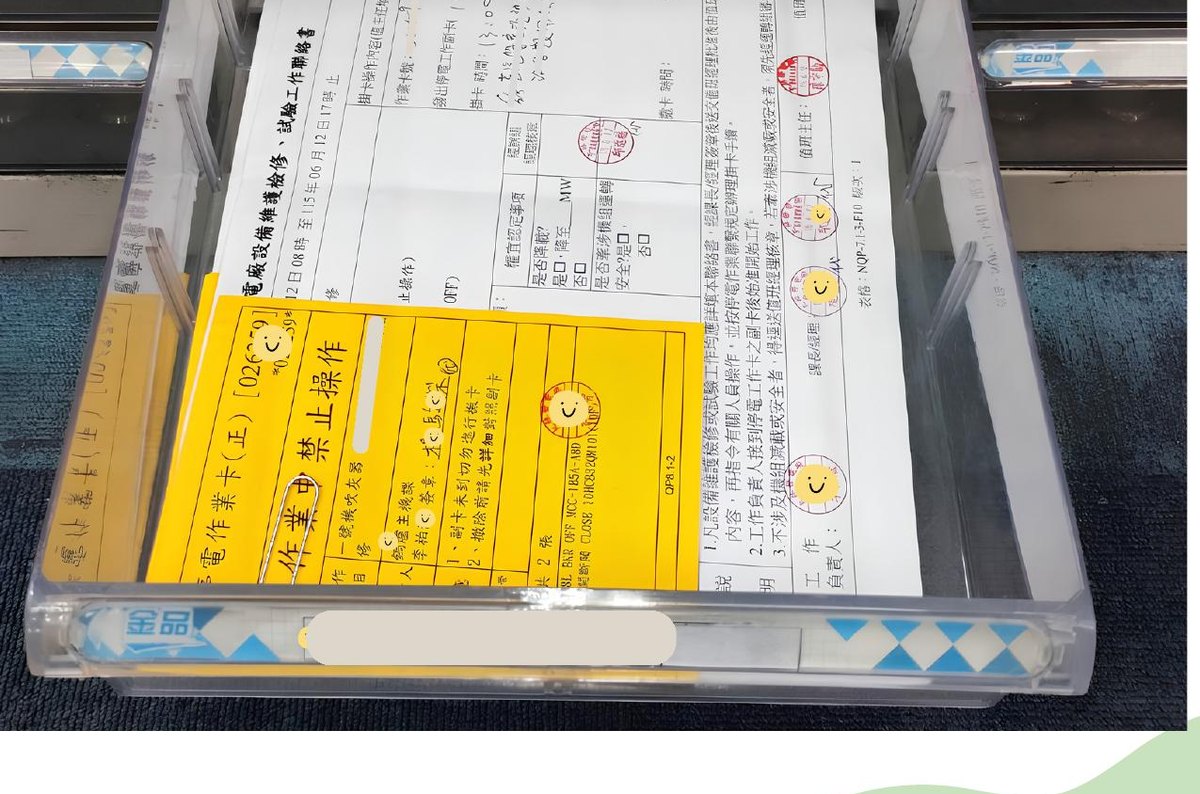
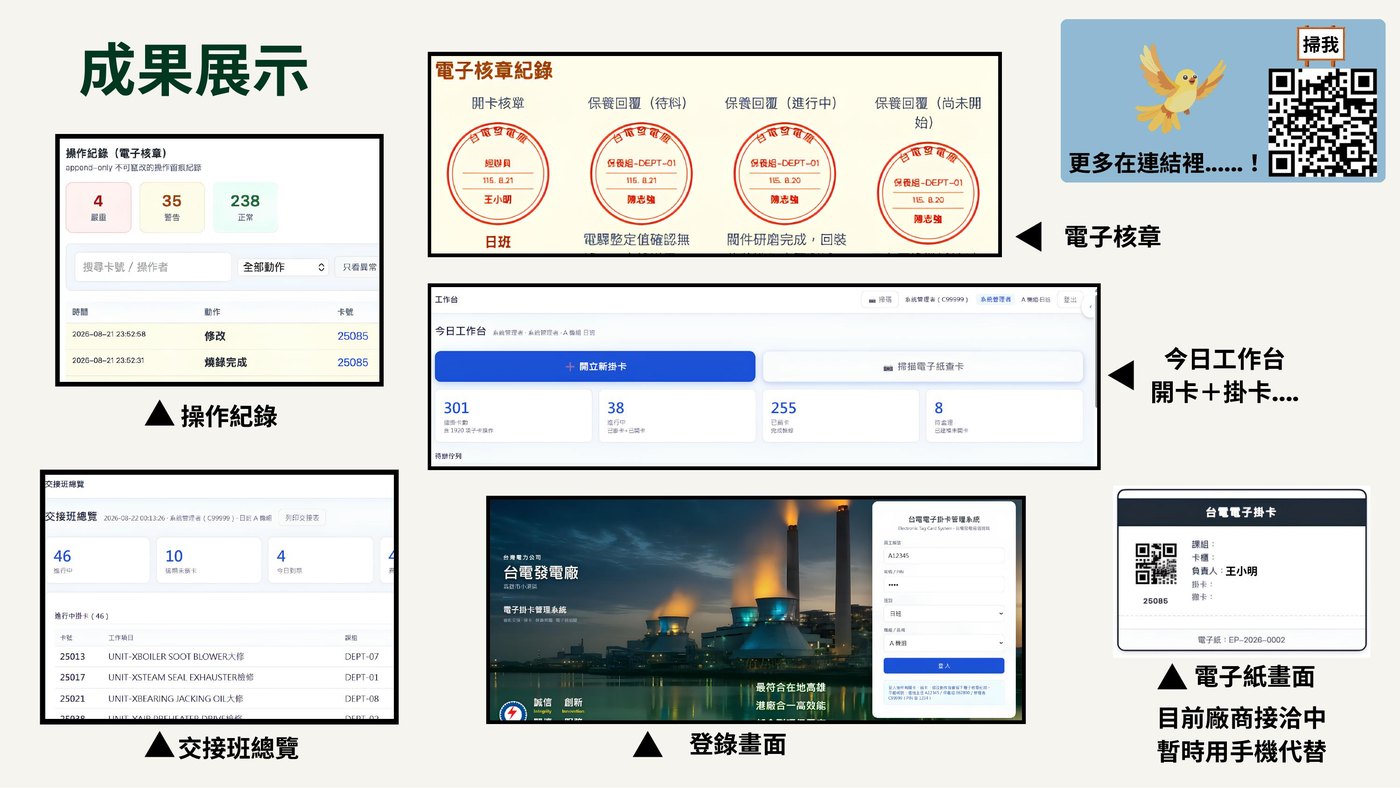
Problem scale:One thermal power plant's major overhaul involved 275 primary tags、1,717 isolation operations、15 sections working simultaneously, with paper tags scattered across 40+ tag cabinetsin. One missed entry could become a risk.
The “tag” (work permit / equipment isolation tag) process during a thermal plant's major overhaul originally ran on an Excel workbook full of VBA macros plus physical paper tags scattered across dozens of cabinets, spanning 10+ sections working simultaneously.
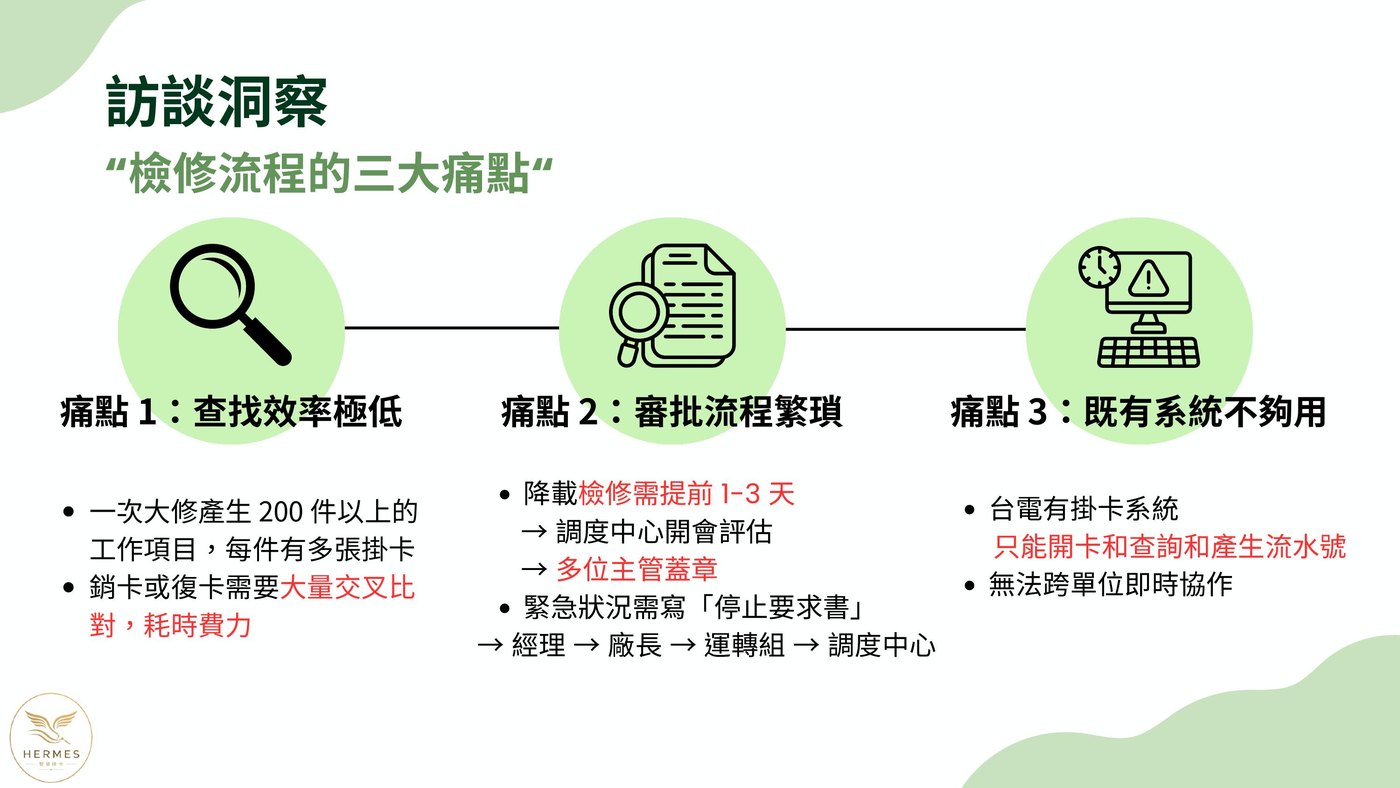
Taipower already had a tag system, but it only opened, queried, and generated serial numbers — no cross-unit real-time collaboration.
| who got stuck, and when | How it was originally done | What behavior the system changed |
|---|---|---|
| The incoming shift needs to find a tag | Flipping through dozens of cabinets and hundreds of paper tags, drawer by drawer | Scan the QR or type the tag number to jump straight to it.Finding a tag no longer depends on “who remembers where it is” |
| Tracing back “who did this step” afterwards | Handwritten signature — handwriting and timing are hard to verify | The e-seal logs operator, role, shift, time, and before/after states,The chain of responsibility became a readable record instead of memory |
| Someone pulling the card counted as done | Drawing a card counts as closing it | Closing a card requires double verification and is limited to the shift supervisor,Making explicit “who has the authority to close this” |
What these three things share isn't technology — it'sWhere knowledge lives. The process ran on judgments held in senior staff's heads; newcomers could only learn by shadowing and word of mouth. What I did was move those judgments from heads into a system — searchable, traceable, handover-able. I later learned this has a name: Knowledge externalization。
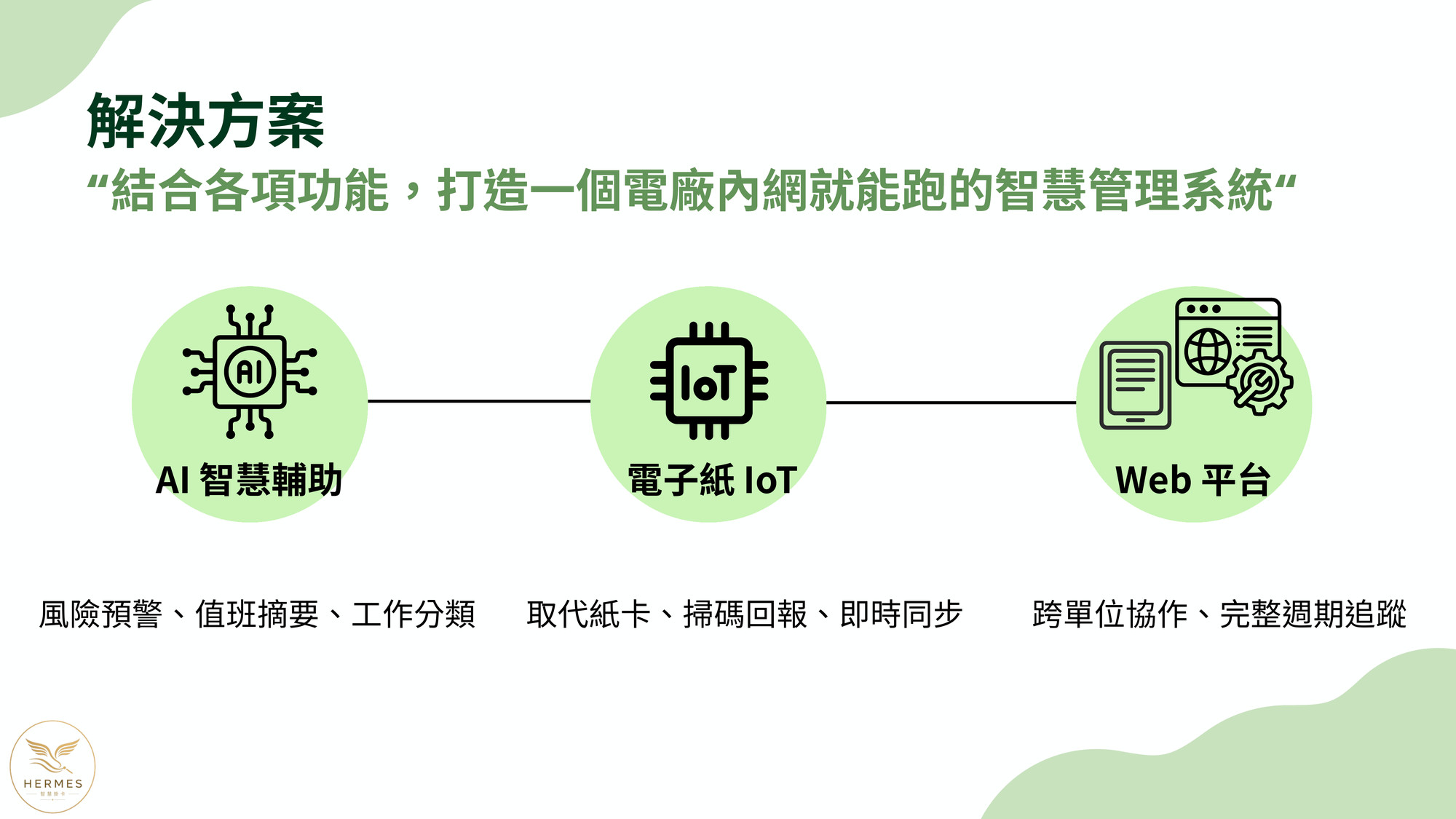
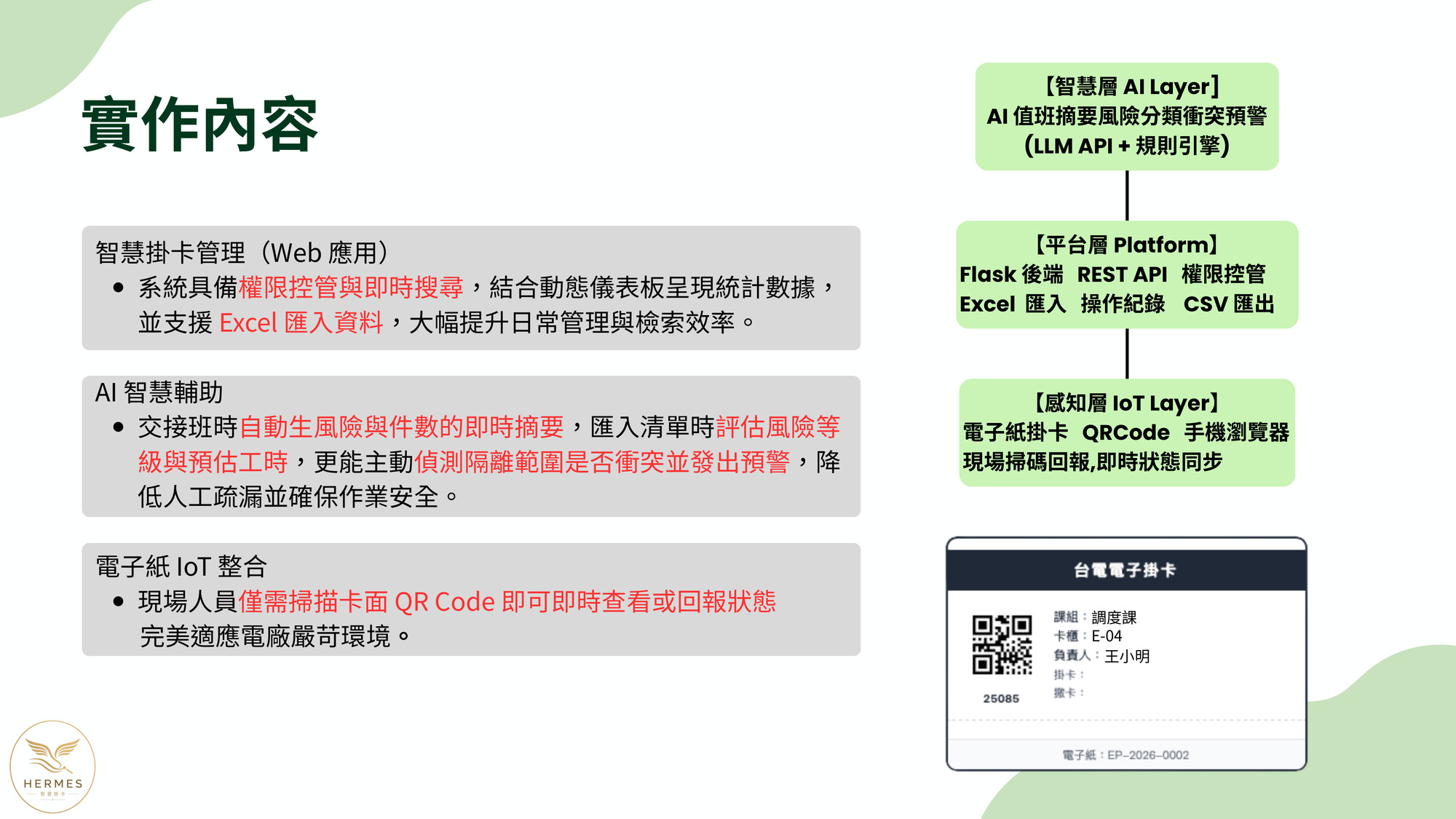
The field side is an e-paper tag (Spectra 6, 4.3″) with QR-scan reporting; the backend is a web service with access control and a database.
AI intelligence layerLLM API with a rules engine for shift summaries, risk classification, and conflict alerts
Platform layerREST API, access control, Excel import and CSV export, dynamic dashboards
Sensing layerE-paper tags, QR on-site scan reporting, real-time sync on phone browsers
The technical stack: a backend with SQLite serving a browser SPA; qrcode[pil] for QR generation, an xlsm→JSON import script, packaged as a Windows desktop app.
A deliberate design:The e-paper front uses a QR-encoded task ID; the back is laser-etched — if the screen fails, the physical tag is still traceable. I proposed this fallback, because the site doesn't stop working just because a screen dies.
Requirement 1
System resilience
I required the system to remain usable even if the AI service failed. The final design: without a key, on timeout or failure, the AI shift summary silently falls back to the rules-engine version, so it can demo offline.
Honest statement:The fallback's concrete design was produced with AI collaboration; I set the requirements and did acceptance.
Requirement 2
AI responsibility boundaries
AI conflict alerts only notify — they never block work orders. The final call stays with the shift supervisor.
In settings with safety consequences, the system provides information; people decide.
| User feedback | My revisions |
|---|---|
| After binding the e-paper, didn't know how to write content | Added a flashing workflow: preview → write animation → confirm result |
| Menus are hard to use on a phone | Redid the hamburger menu and added a slide-out sidebar drawer |
| Dashboard numbers were sometimes inconsistent | Moved the computation to the backend, the frontend no longer computed separately |
| Need to export reports | Added CSV export and access control |
After these four fixes it really did work better,But I couldn't explain why they worked, and I don't know if there's a more systematic method to get it right on the first version. Right now I only have the level of “users say it's bad, so I fix it” — no evaluation method at all.This is the gap I most want to fill after entering university.
- The whole project de-identified externally: site, unit numbers, staff names, and equipment codes all replaced with fictional values
- Also created a separate “Security Audit Report” as the single source of truth, and wrote an idempotent cleanup tool
- Demo accounts created by the system, passwords hashed with werkzeug; in production mode, startup is refused without SECRET_KEY
- Audit technique findings:The first three audits found no sensitive strings — the root cause was that Chinese in .xlsm is stored as XML numeric entities, so direct Chinese matching always returned zero. The correct approach is to decode first, then match. This round of cleaning 2,433 site
Replaced single-use paper tags with e-paper for resource circularity; and made a magnitude-level estimate (noted in the deck as “magnitude estimate, not precise”) for the causal chain: tag errors → equipment misoperation → unplanned unit shutdown → extra fuel for replacement load → higher emissions.
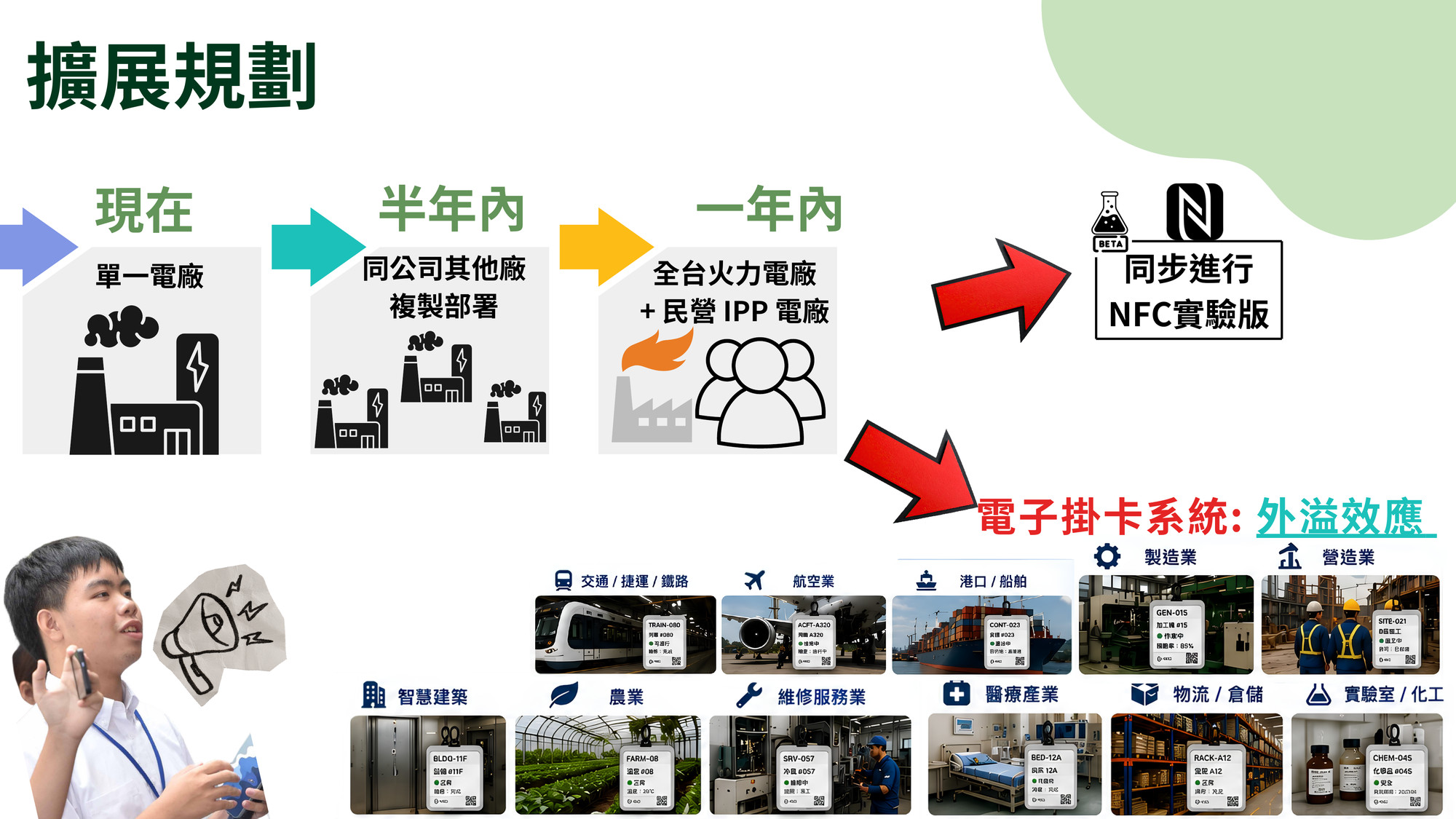
Expansion planning:Single plant → replicate to sibling plants within the same company in six months with an NFC pilot → extend to thermal and private IPP plants within a year.
For the competition rules and five technical claims, I verified each against official primary sources and proactively overturned or corrected three of my own statements: a wrong belief about scoring weights, one e-paper use case with no traceable original news source, and one spec number sourced from a third-party reseller page rather than the manufacturer.
Interview boundaries:Two interviews (2026-07-18, 2026-08-09): the first (dispatch center) conducted by a teammate in person with my guide design and post-interview synthesis; the second (plant side) conducted by me alone.Evidence ↗
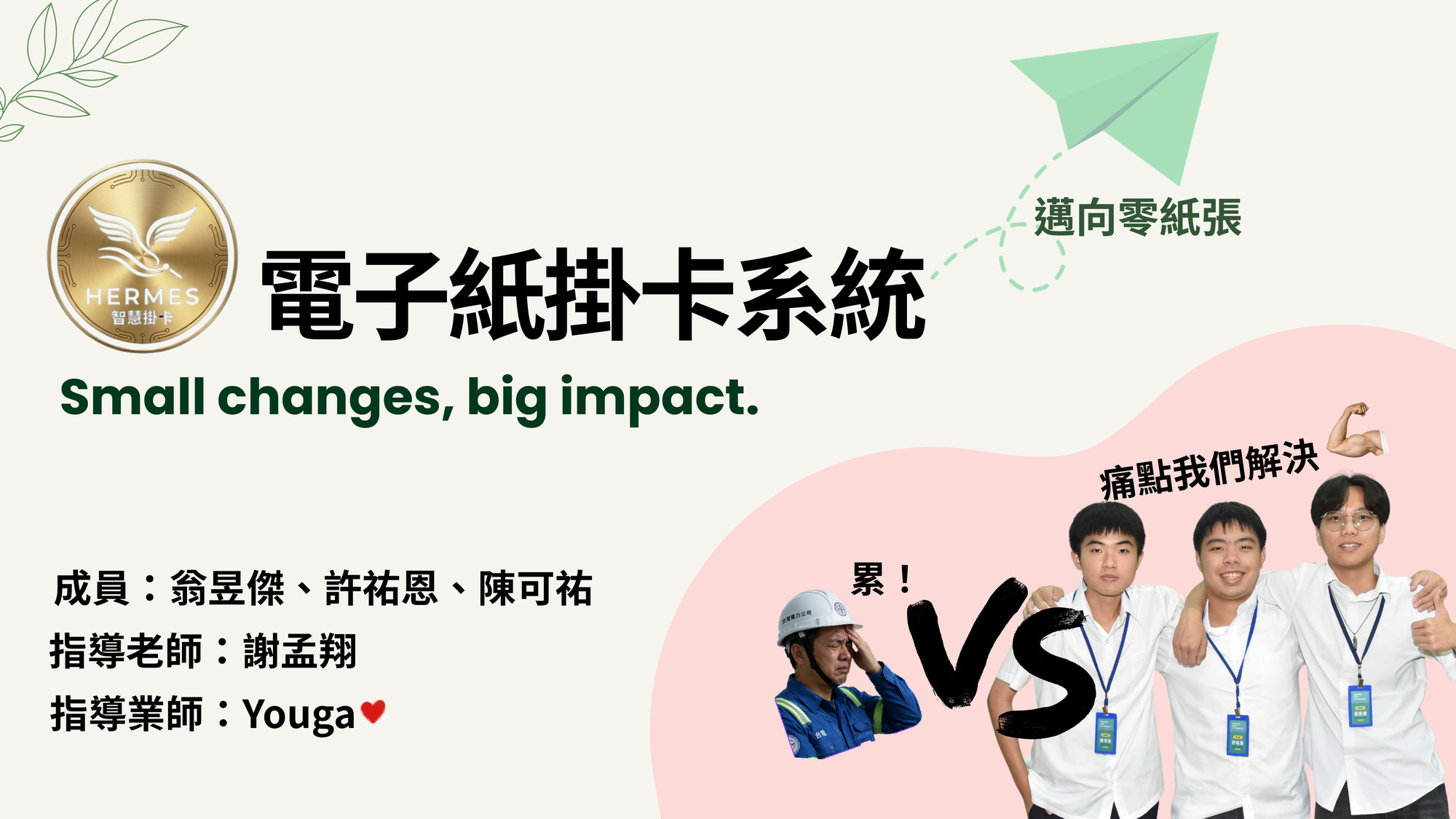
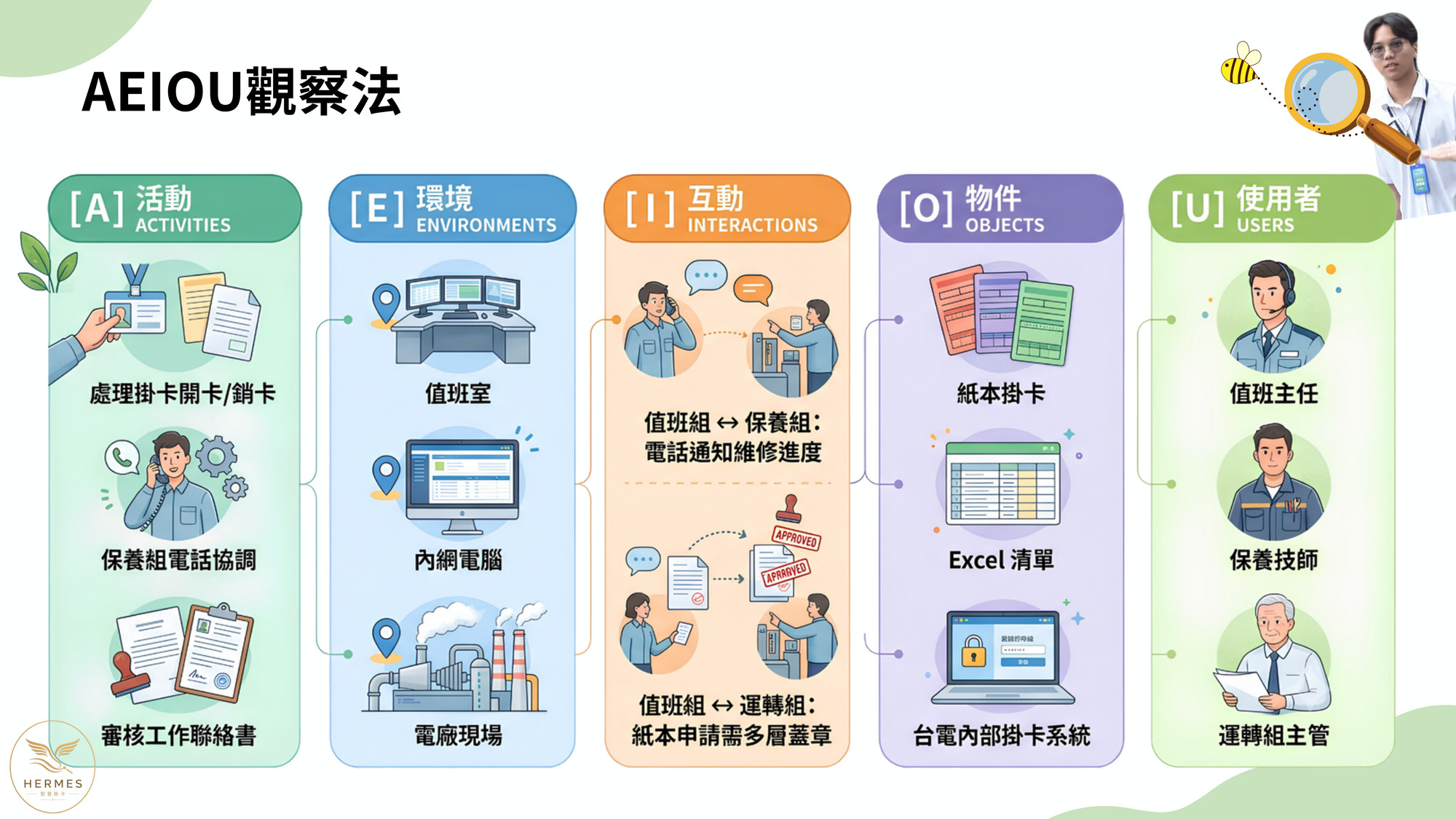
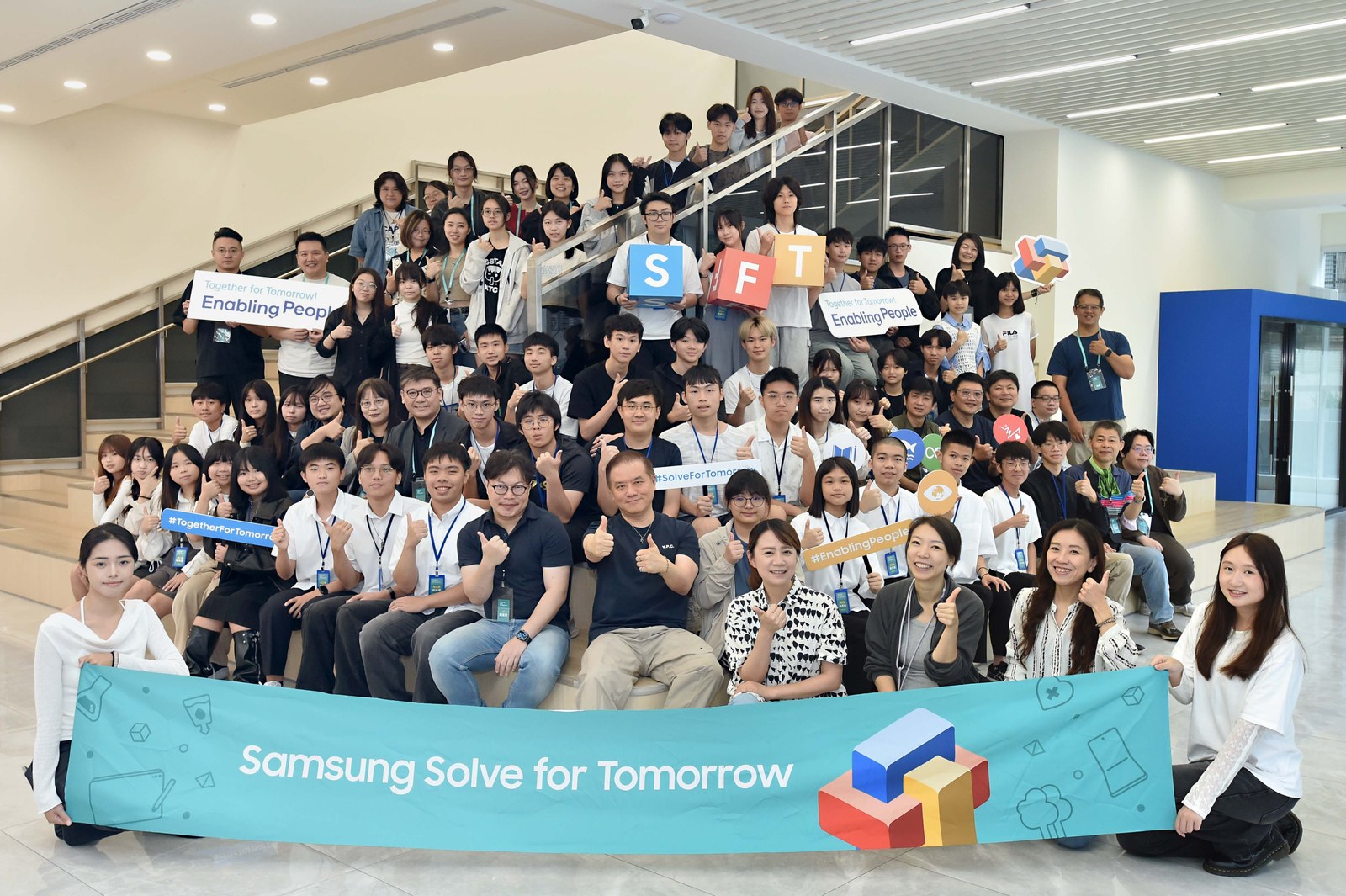
Deck contents and the finals venue
8Major brands
30+models
21folder partitions
70+sub-prompt
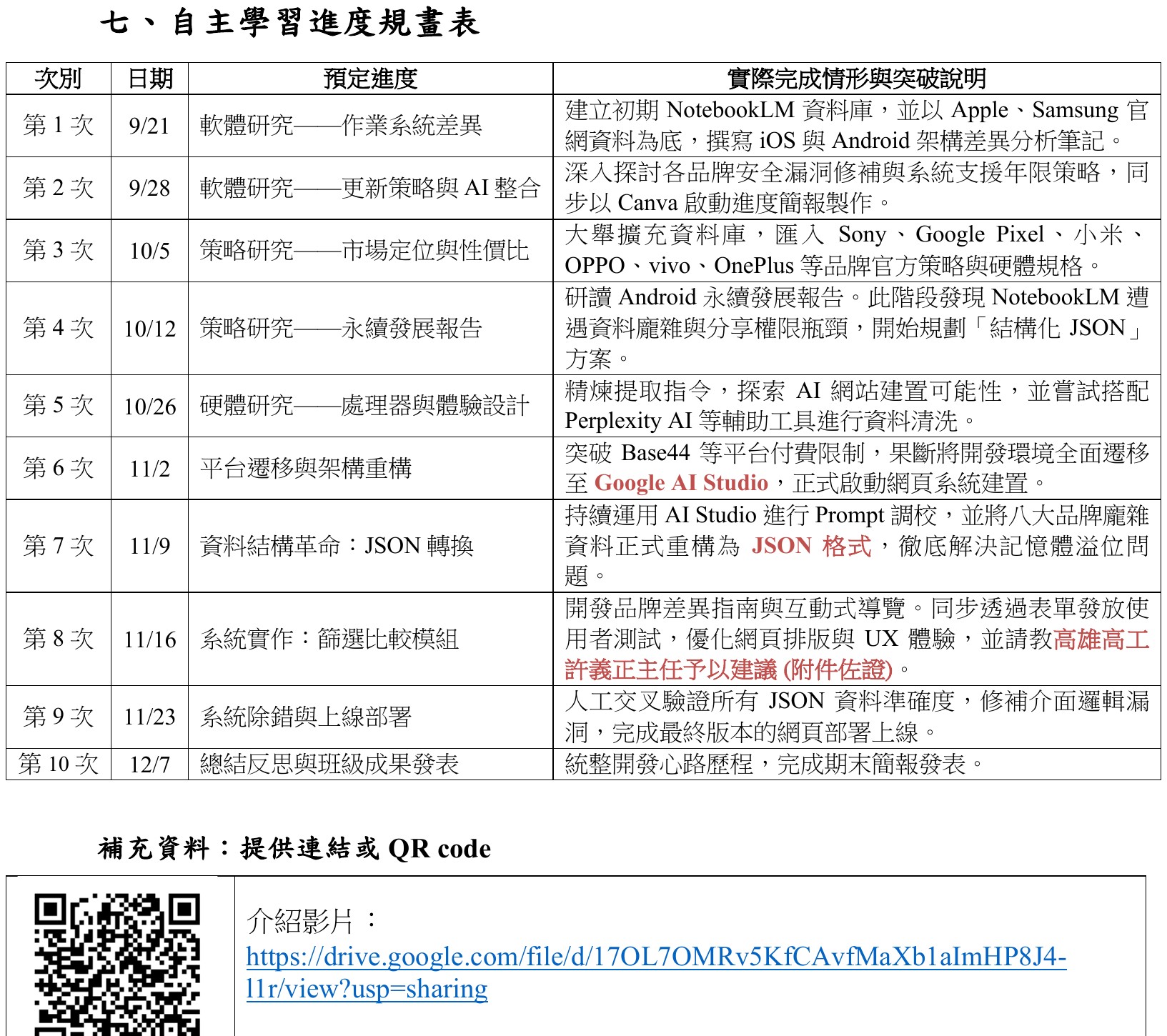
Brands: Apple, Samsung, Sony, Google Pixel, Xiaomi, OPPO, vivo, Poco | 12+ hours invested across 5 version iterations (official figures).Evidence ↗
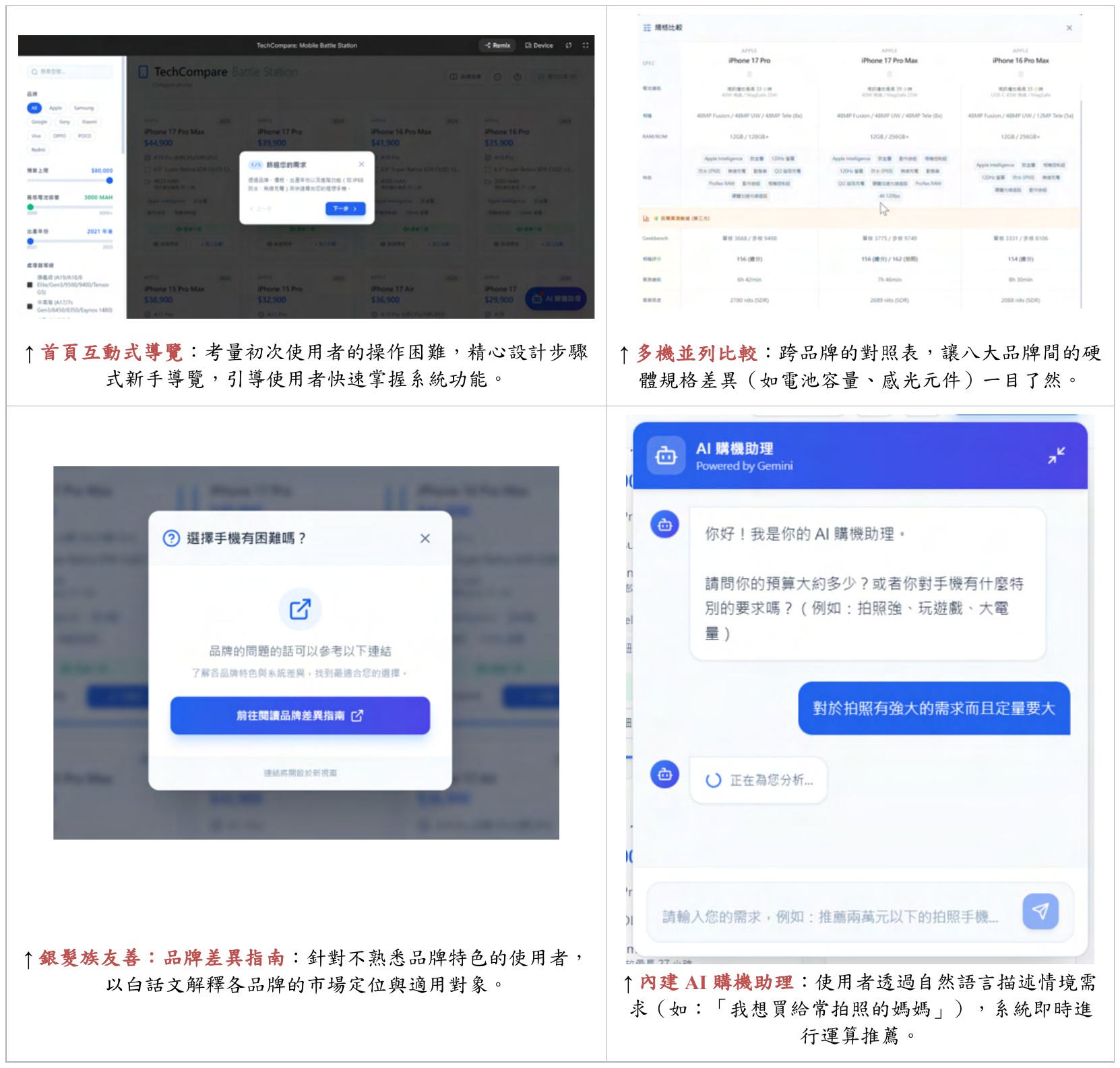
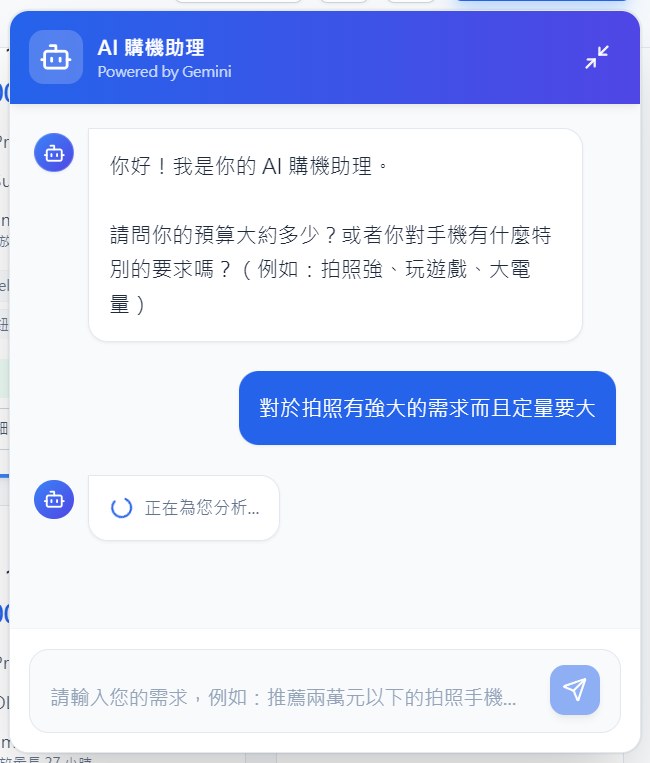
Three layers of problem awareness: information asymmetry, digital inequality for disadvantaged groups, and resource waste from mismatched demand (violating SDG 12). The problem came from real observation — salespeople in a group-chat screenshot who “couldn't even explain the processor” yet “enthusiastically recommended.”
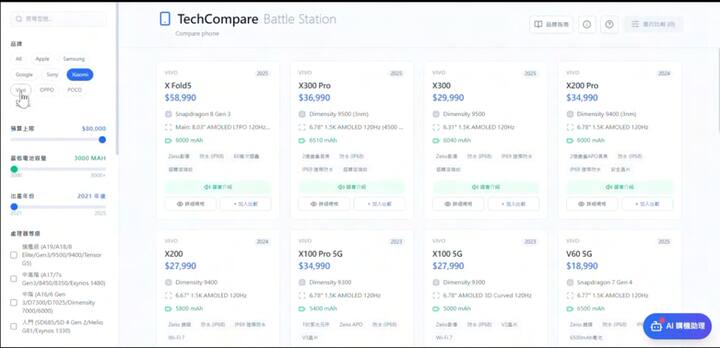
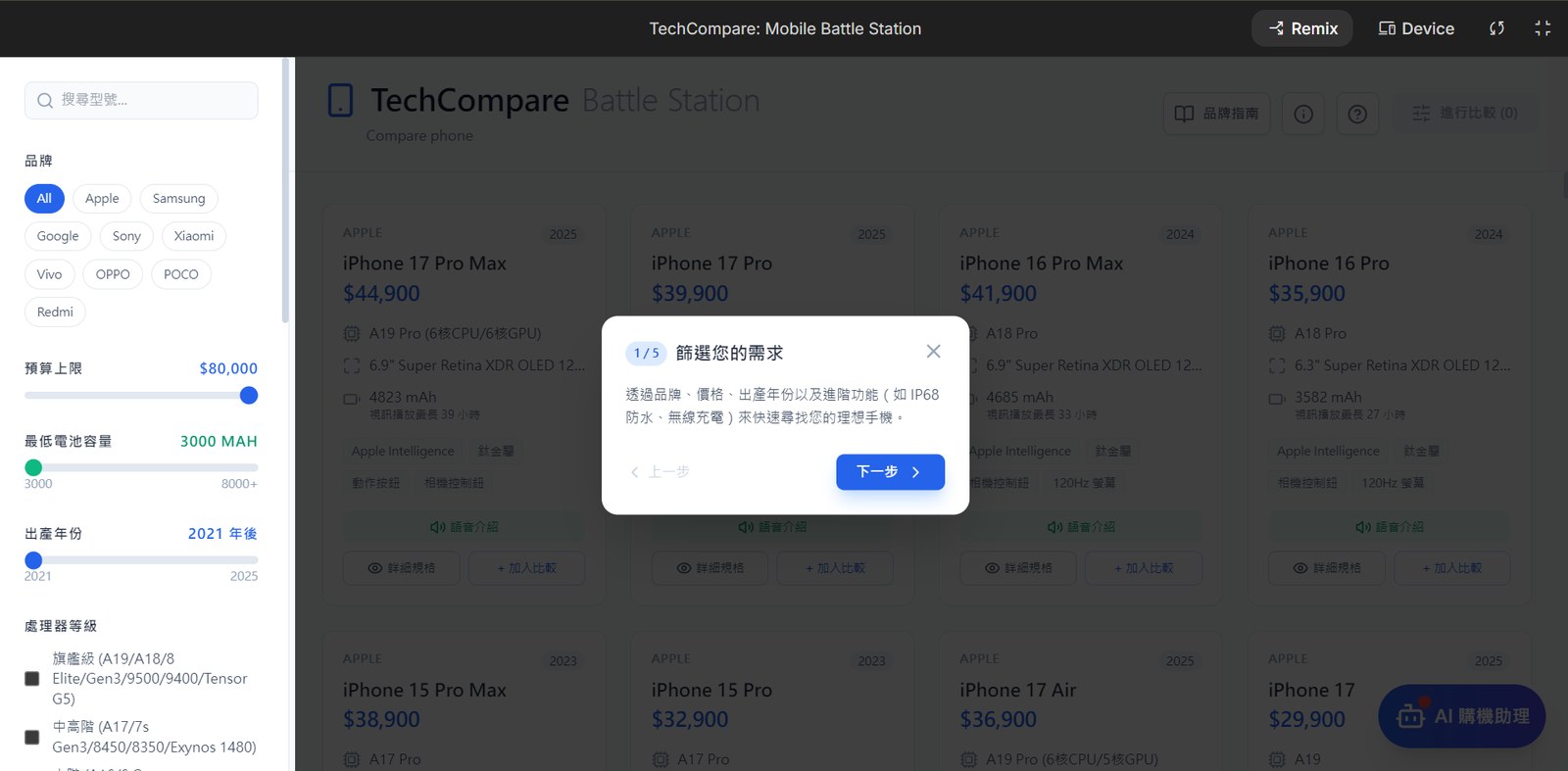
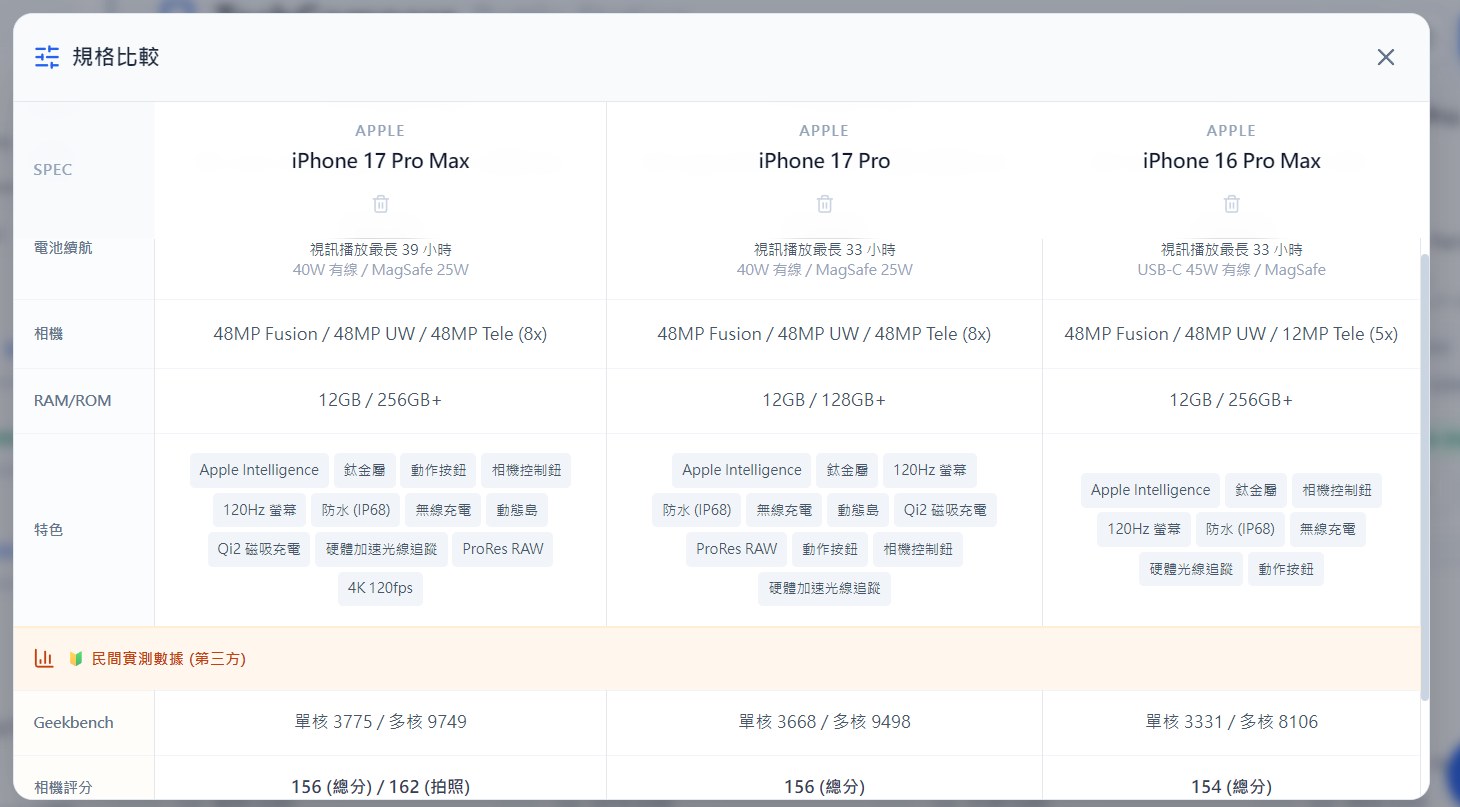
The countermeasure wasA “spec translation system”Not a price-comparison tool: turning 120Hz into “smooth scrolling,” so non-tech people can search in everyday language like “clear photos of my grandkids” or “no lag in games.”
System screens
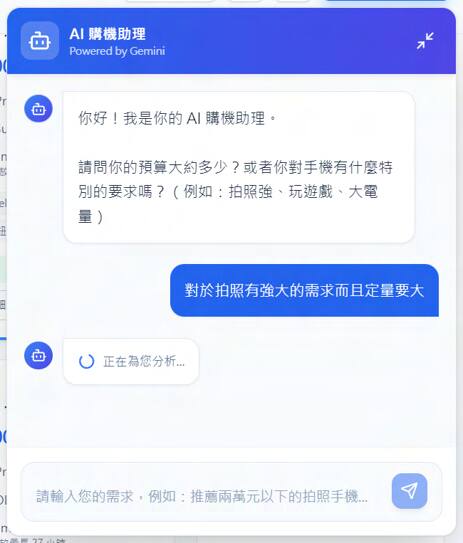
Architecture decision 1
From “making AI read” to “making AI look things up”
Structuring the data into JSON.
Architecture decision 2
Partition strategy
LLMs tended to restructure the whole dataset, losing data. The fix: brand partitions plus tiered structure (flagship / mid / entry under each brand).
- The original “AI-generated pros/cons” feature: testing showed the LLM cited unofficial forum reviews that deviated from official specs,Deleted the feature outright
- Found that brands' “battery life” test standards differed; settled on a single credible third-party review siteUnified metrics
- Four-model cross-validation process: asked the AI assistant to list all specs in the database → copied the output → gave it to four other different models to cross-check → manually verified and corrected the questionable points
Official application AI-disclosure field: “This project used Google AI Studio to assist with coding and debugging. To ensure originality and correctness, four AI models were cross-checked with two rounds of human review, and auto-generated analysis from unclear sources was proactively removed.”
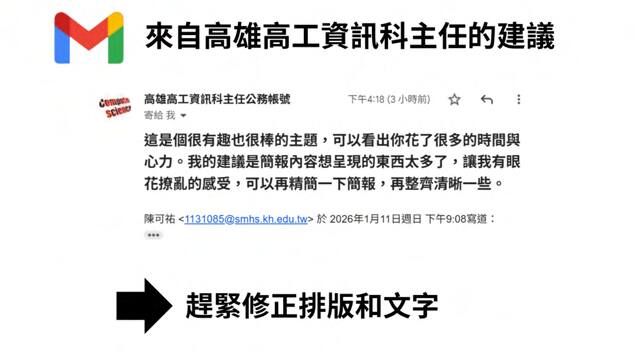
Prof. Tsai Meng-Fang's “don't be so scattered — focus on one point and take it to the extreme” was this work's most critical external feedback. Plus review comments from industry professionals on site and the head of Kaohsiung Industrial High School's computer science department.
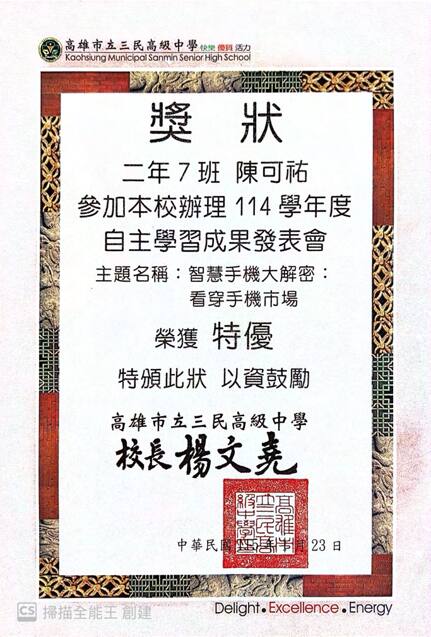
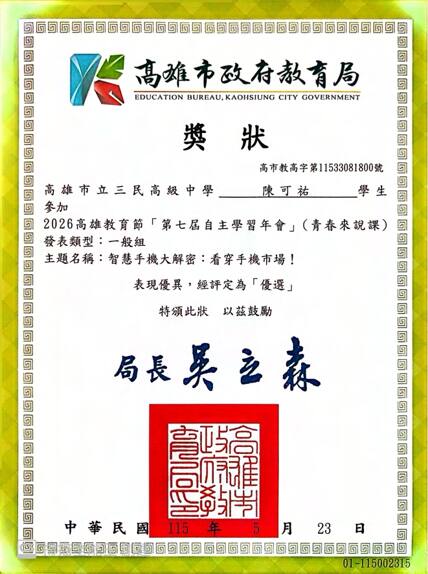
Certificates and external review
Before submission, a Google policy change removed the old model and the system briefly couldn't connect to the API; I presented the results with a screen-recorded video instead.That was my first realization that technology selection must consider long-term access, not just what works now.
18-week self-directed learning checklist:I logged progress, self-assessed completeness, and reflections weekly, including weeks that fell short. The point of including this table isn't to prove diligence — it preserves my own criticism of myself that week.
System screens, presentations, and awards
Camp 2025/1/21–22
Realtek AMB82-mini AI maker camp
Co-organized by Realtek and a university. Controlling the AMB82-mini with Arduino, training with Roboflow annotations, deploying a YOLO cup-recognition model on Google Colab — the full pipeline from data collection through training, evaluation, and deployment.
I observed first-hand that changing light angles sharply drops recognition accuracy. My original line:“This course showed me that AI can do far more than chatbots.”
Club | junior high to senior high
Photography club
I joined the photography club out of love for photography. Only after getting my first DSLR in senior high did I seriously study aperture, shutter, and ISO, and run a photography IG: after each post I read the backend analytics, inferred the problem, and adjusted the next post's caption, layout, and viewing rhythm.
That process is the same as what I do with systems: build, look at feedback, then revise.
Portfolio:@kergue_photo215(five selected works in the autobiography chapter)
Officer · since grade 4
Class equipment officer
Served as equipment officer from grade 4 through junior and senior high (four semesters in senior high).
In the official publication I wrote: “Serving as equipment officer from elementary through senior high familiarized me with computers and grew my passion for technology.”
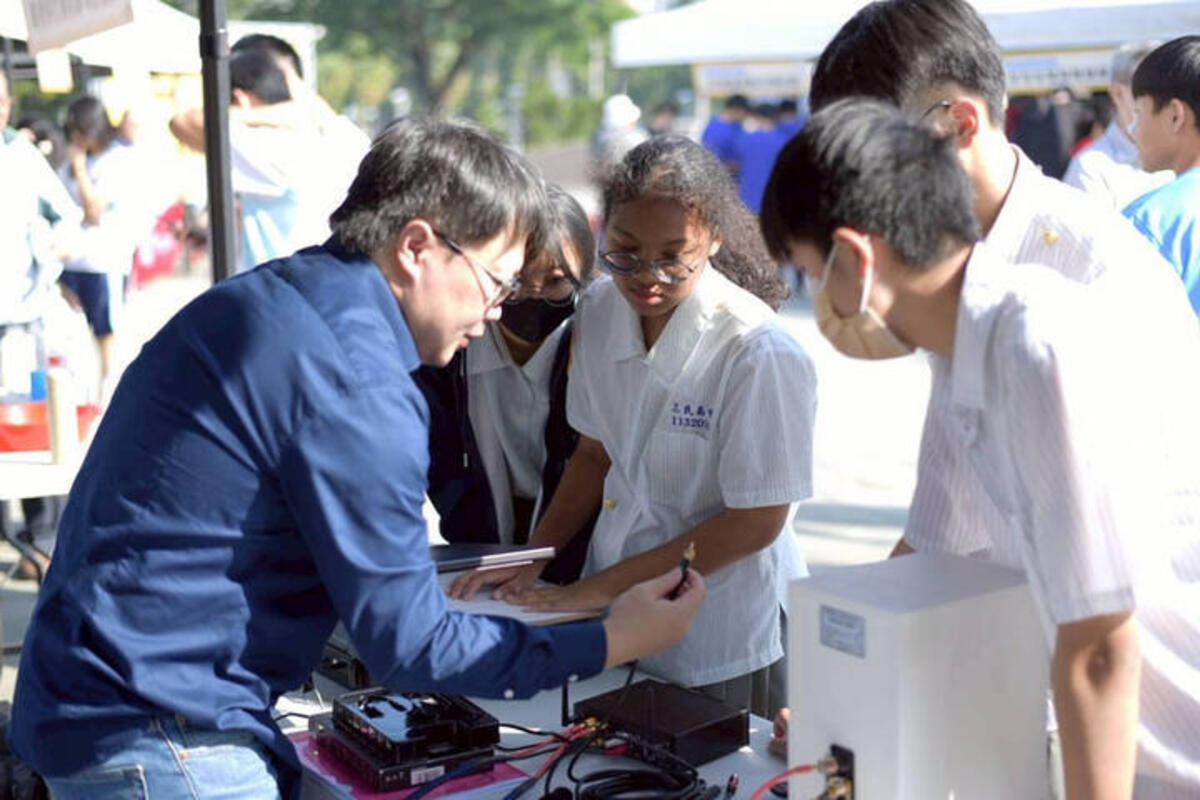
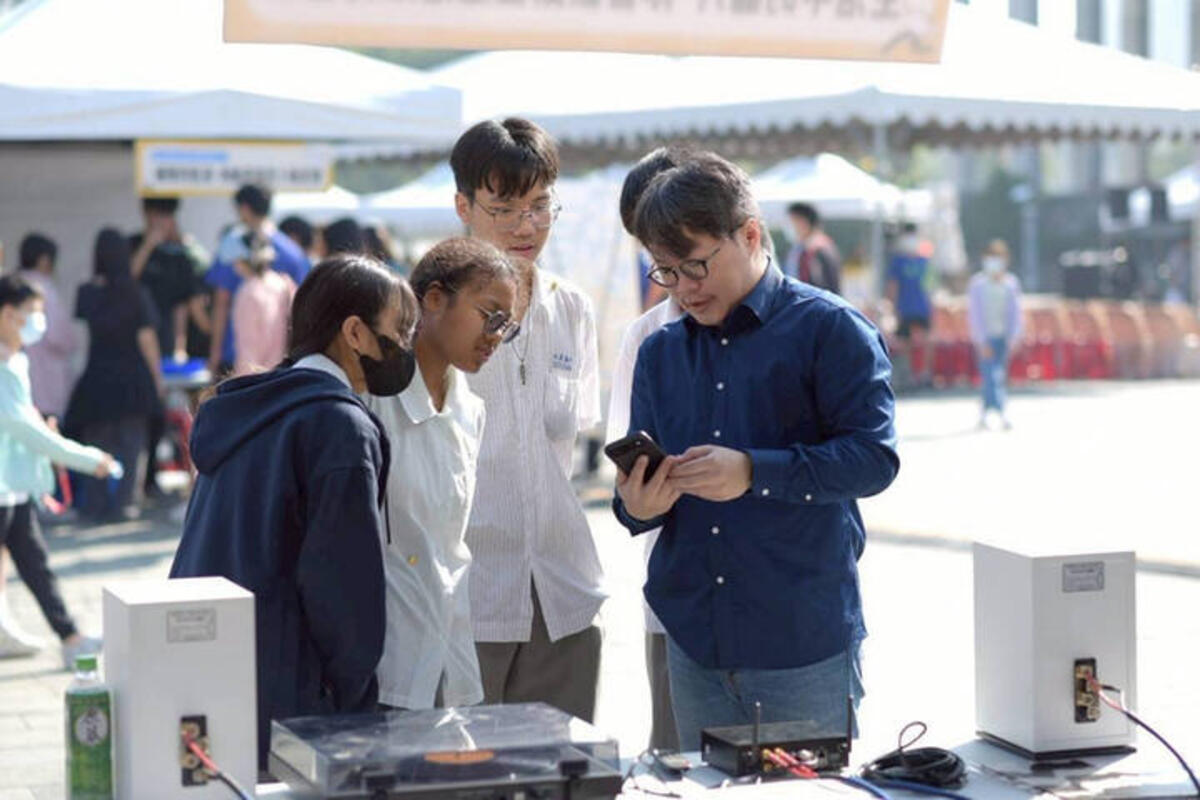
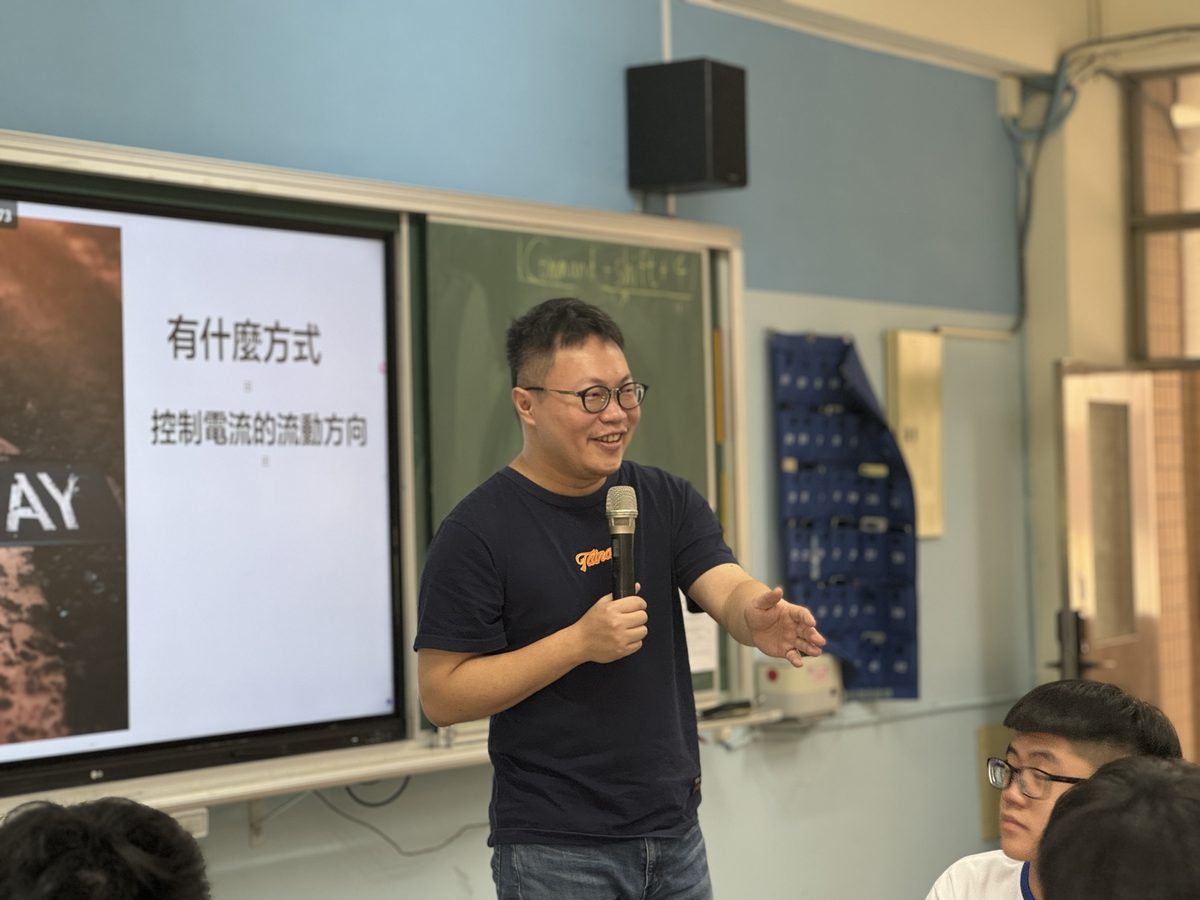
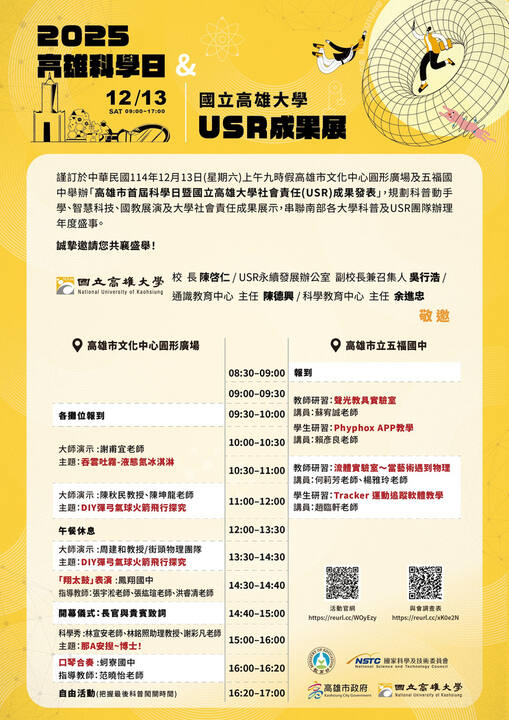
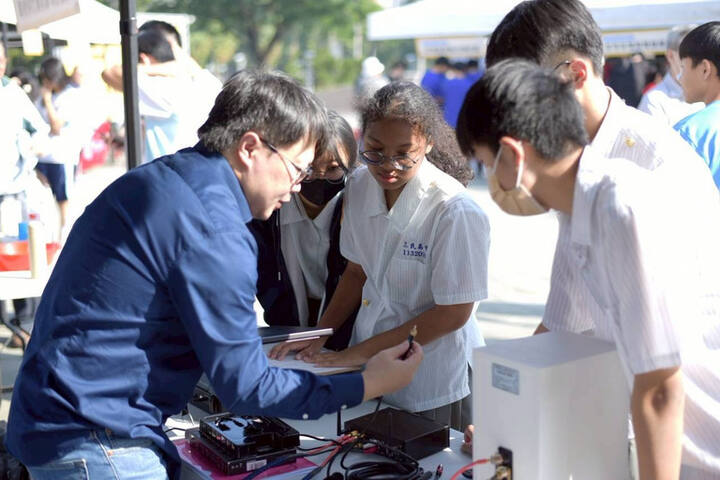
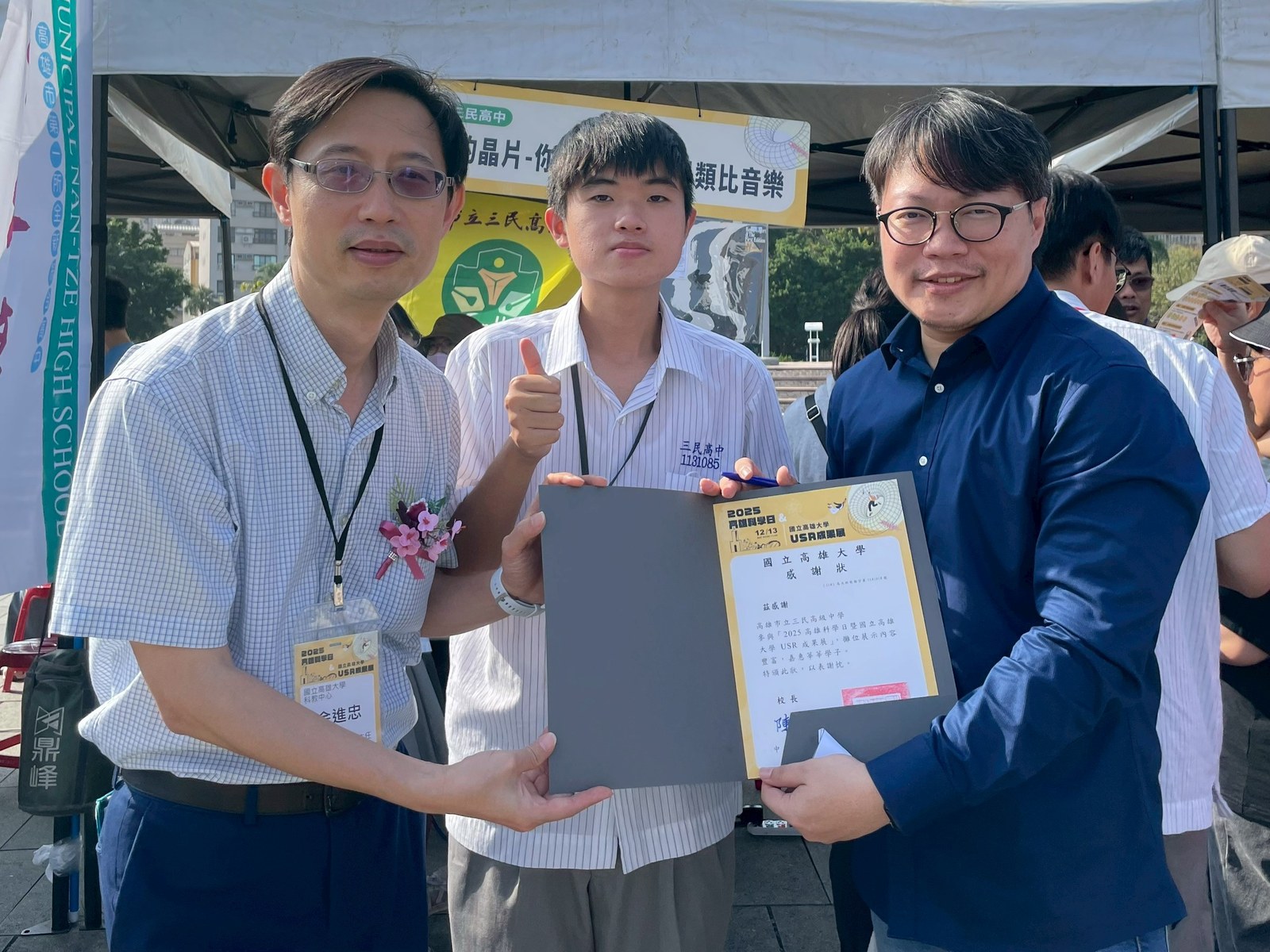
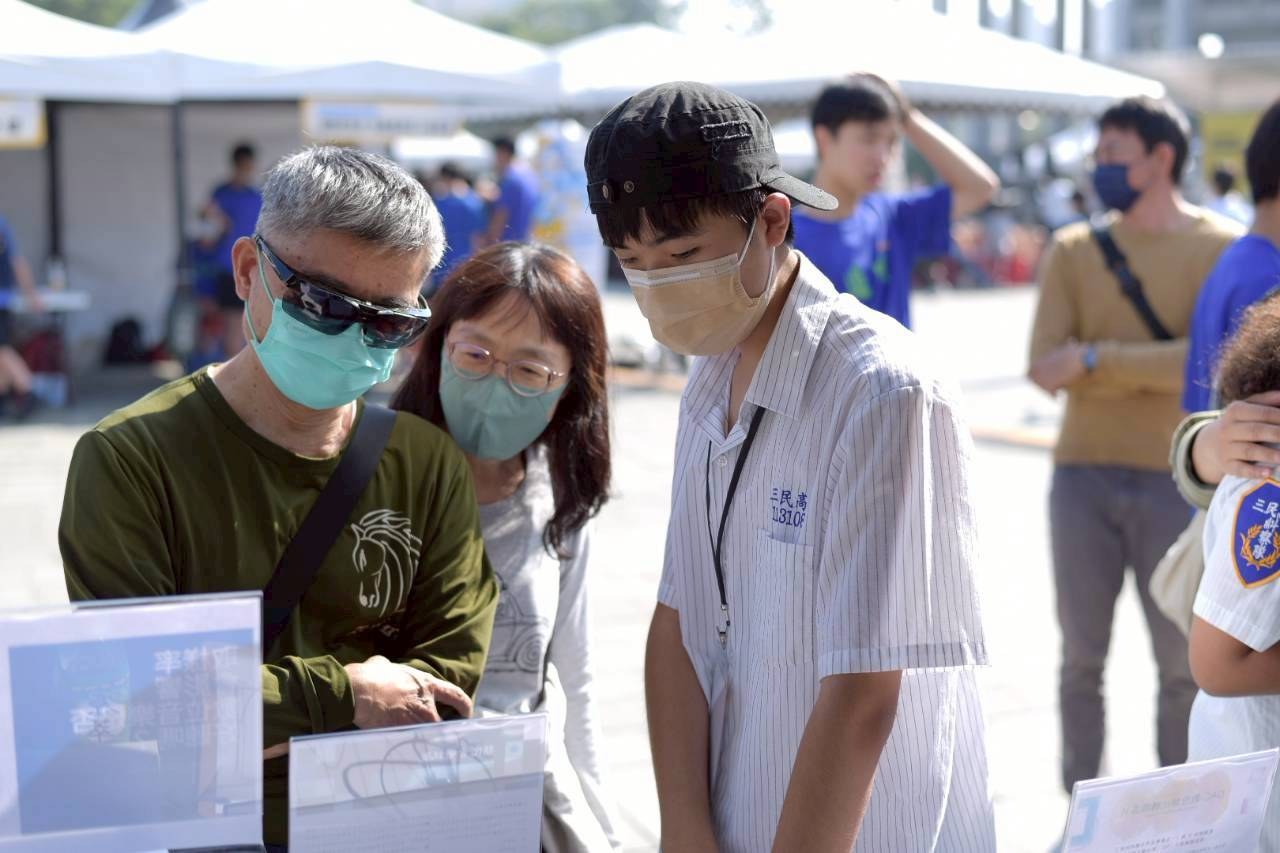
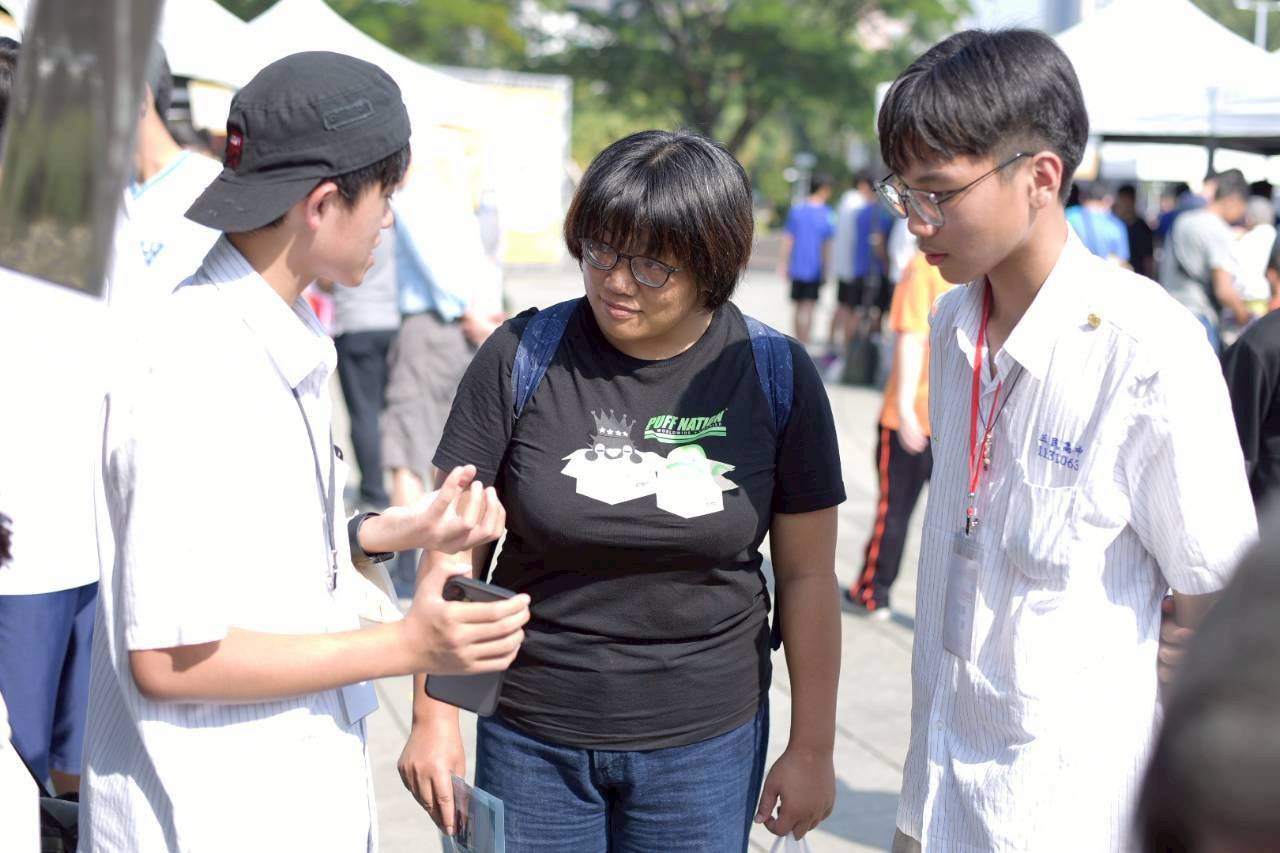
What I did:Explaining transistor principles to the general public, in Chinese and English.
What I learned:Explaining the same principle in two languages forces me to confirm I truly understand it.
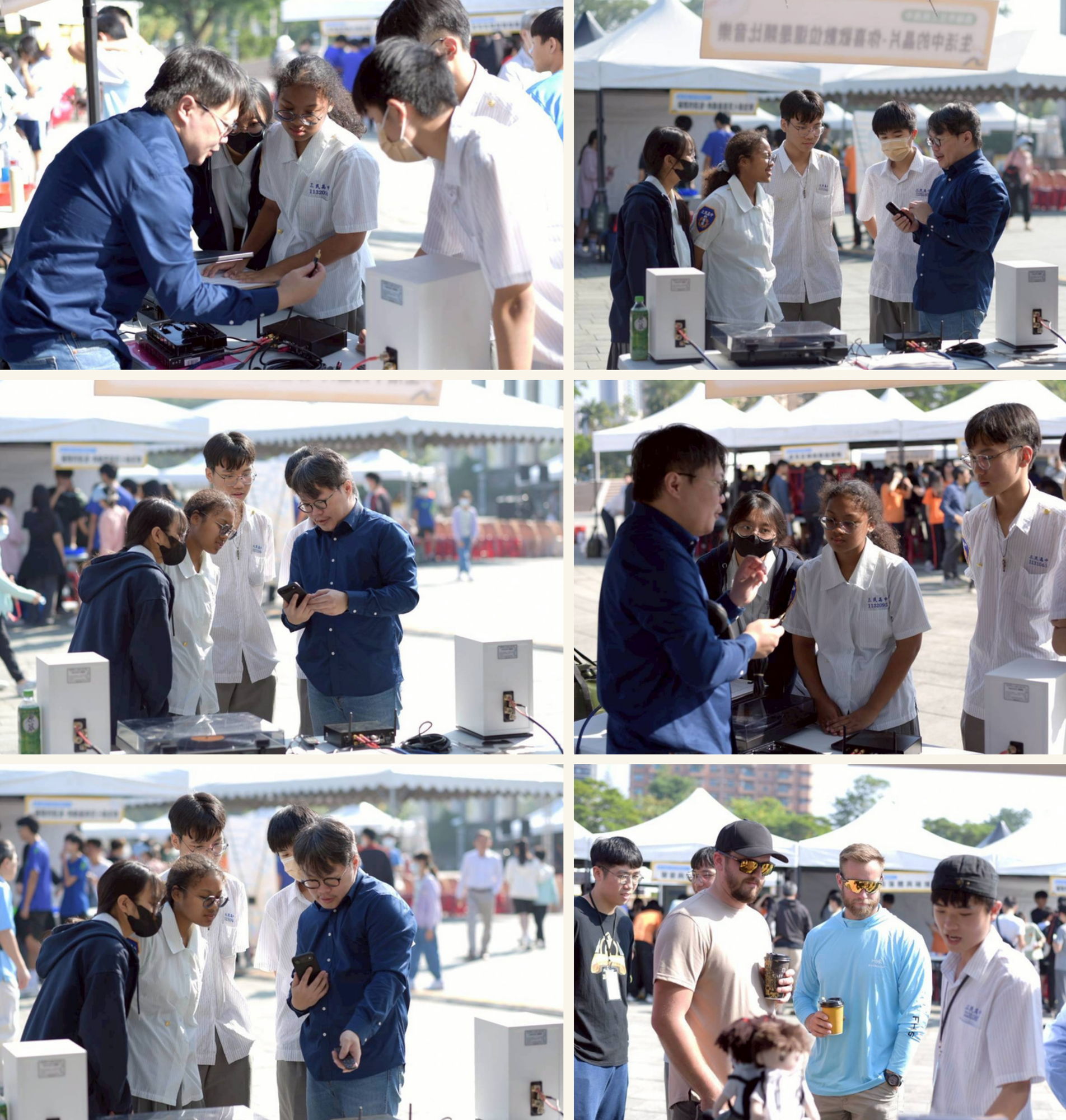
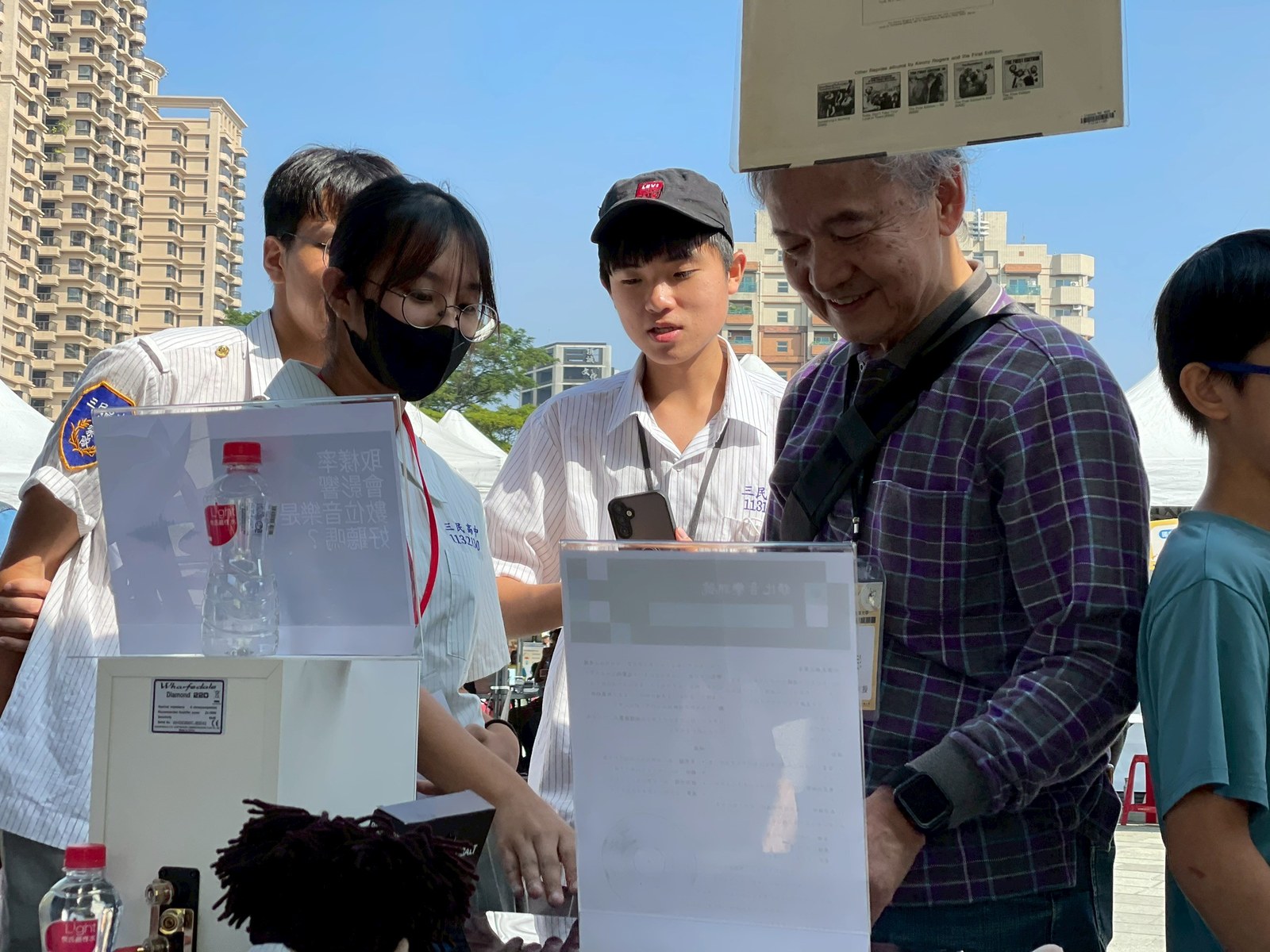
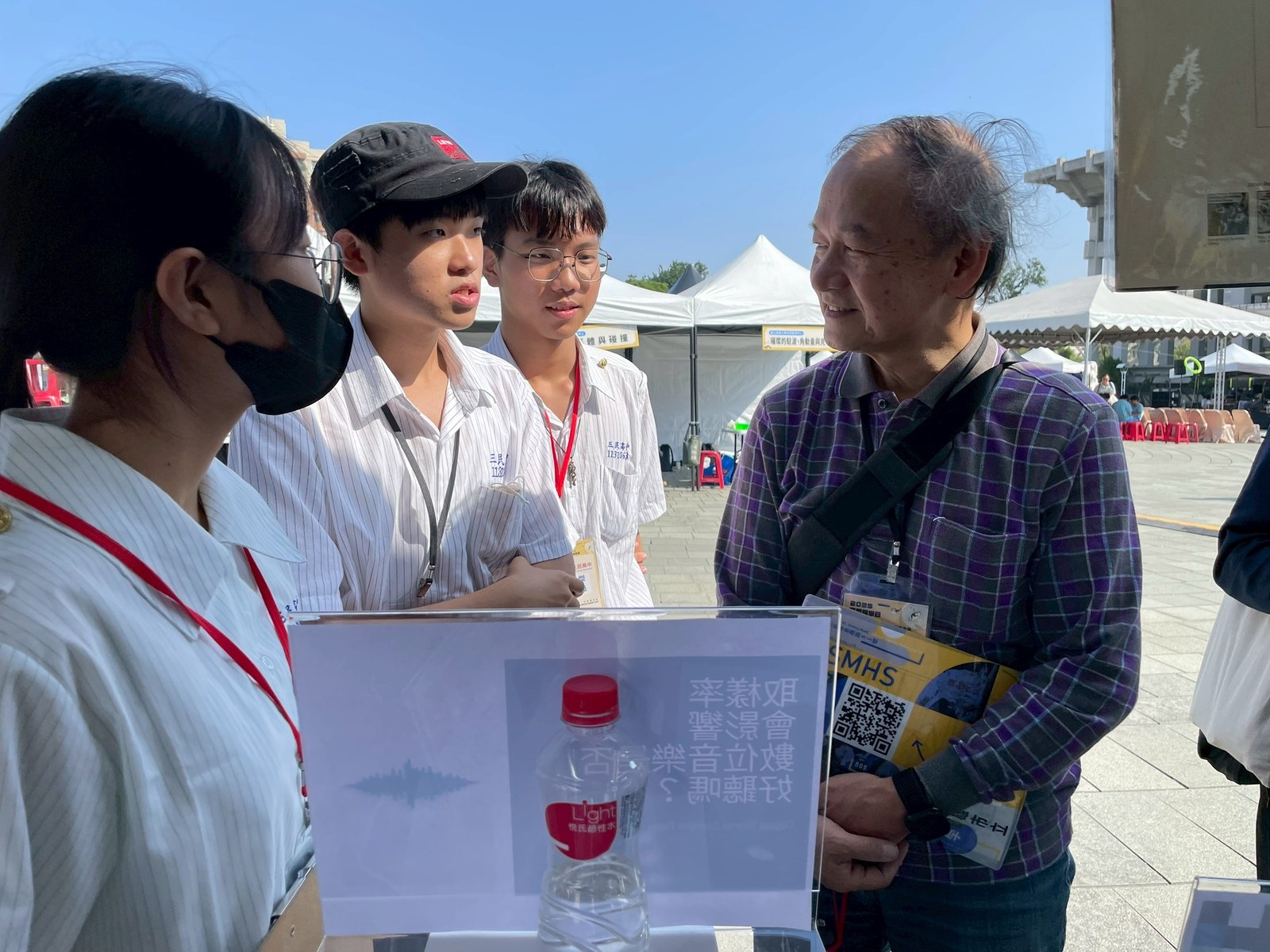
What I did:The booth theme “Exploring Digital & Analog” — explaining that digital is “selective sampling” and analog is “continuous existence,” and using a high-end DAC chip to let listeners hear the gap between lost detail and true reproduction.
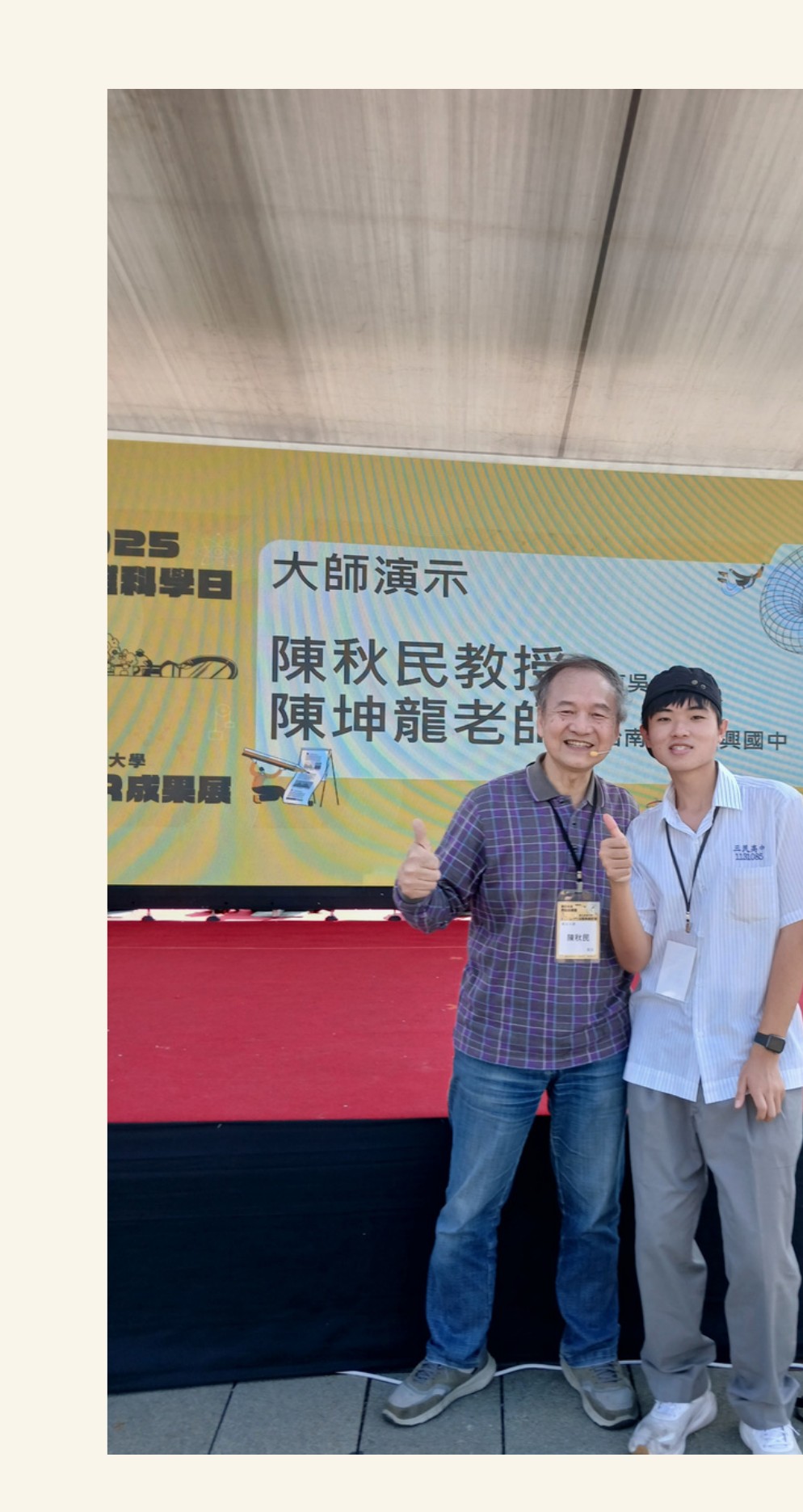
What happened:I had assumed vinyl worked via up-and-down grooves, and was corrected on the spot by Prof. Chen Chiu-Min of Soochow University's Physics Department — vinyl works via lateral displacement, and stereo comes from the difference in induced current between the coils on both sides of the stylus. He even wrote out the derivation on the spot.
“In the past I might have feared embarrassing myself in front of experts, but this time I found that making mistakes is the fastest way to learn.” That was the first time I didn't take a single source as the conclusion. Being corrected means my blind spots are being patched.”Evidence ↗
On site that day
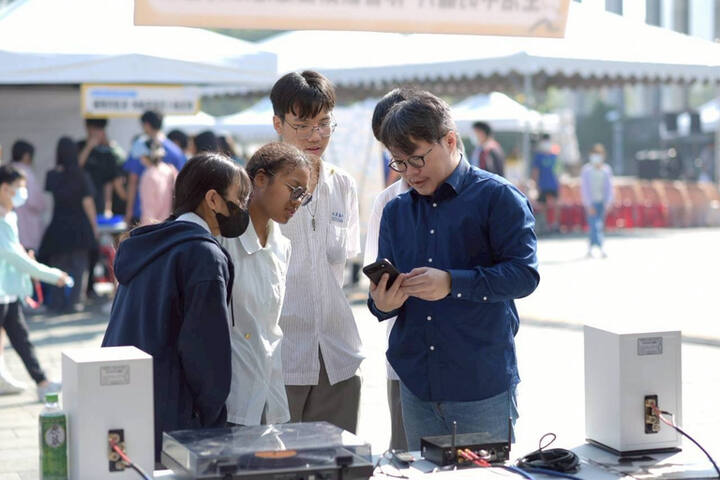
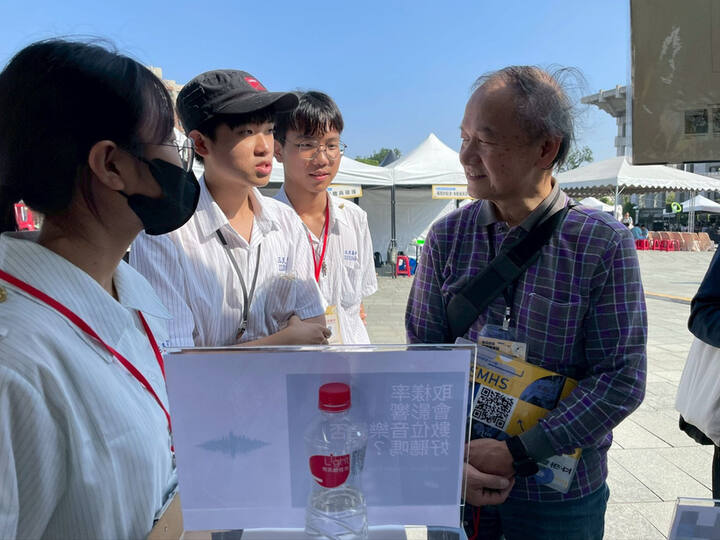
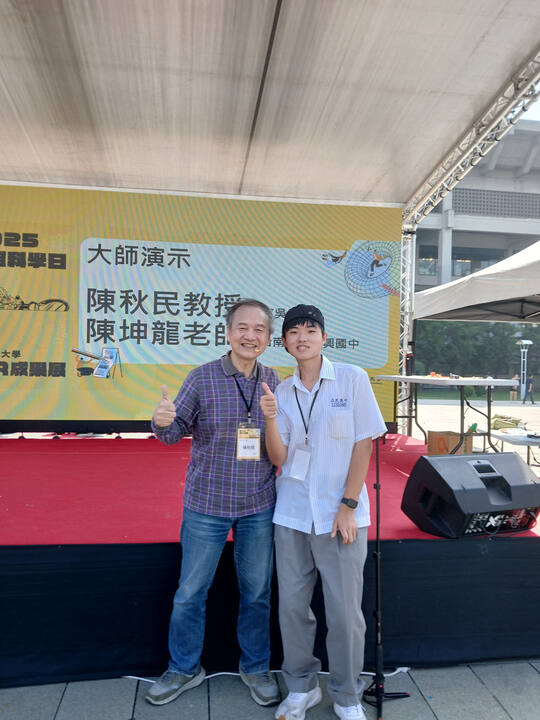
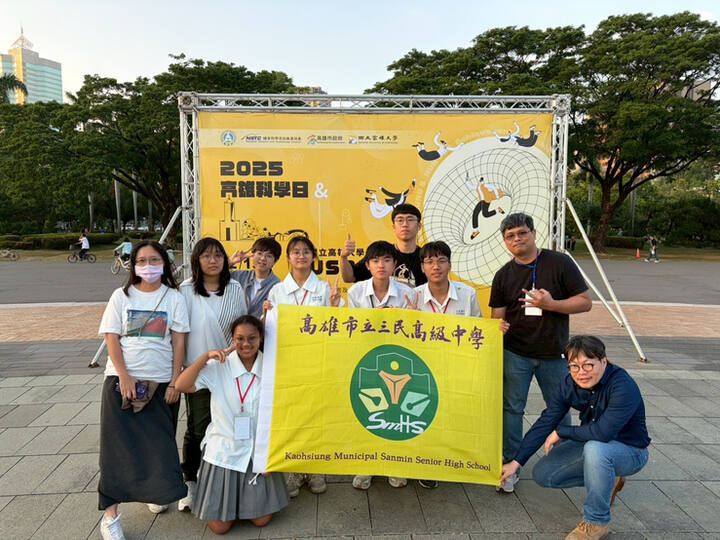
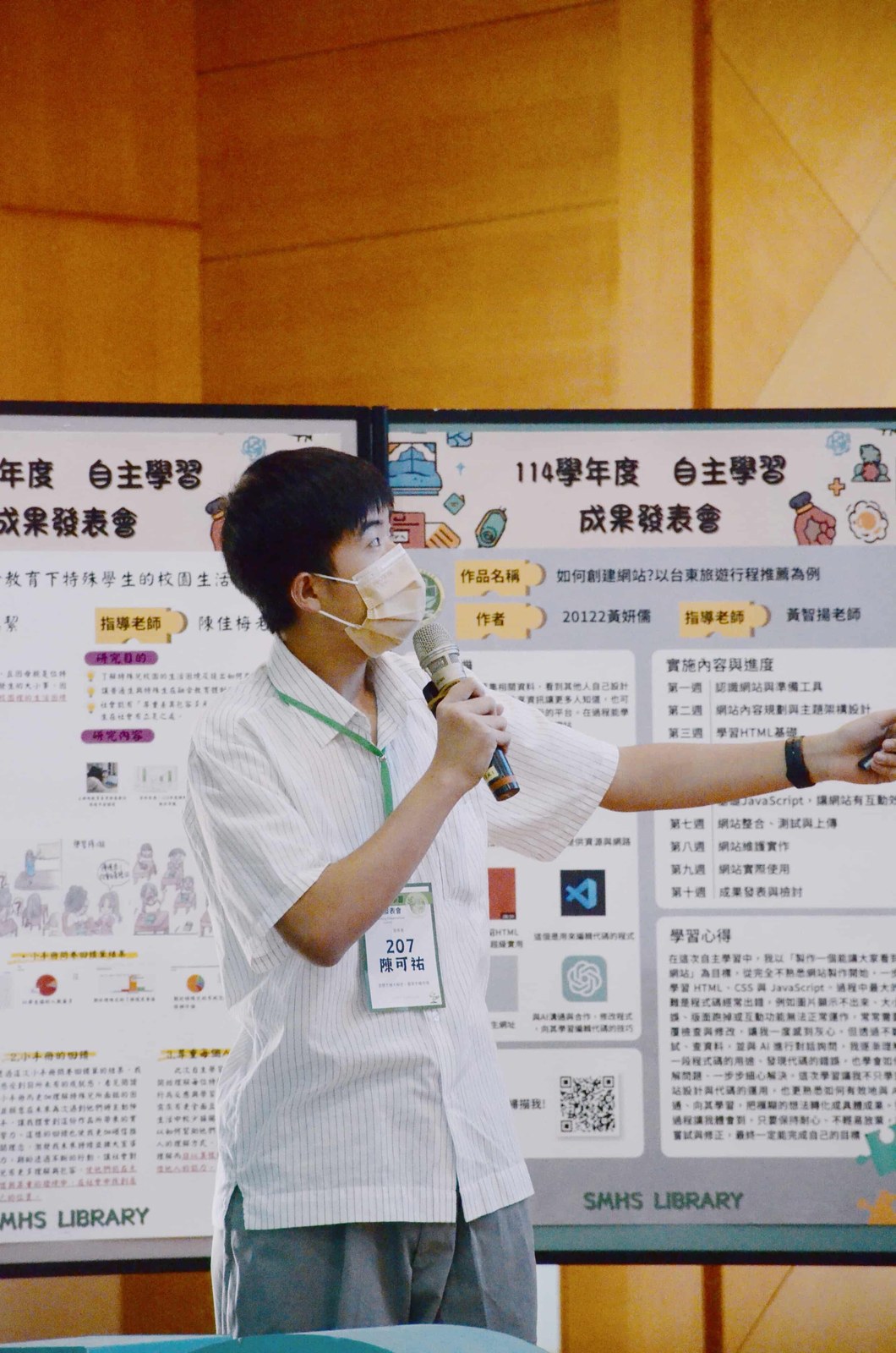
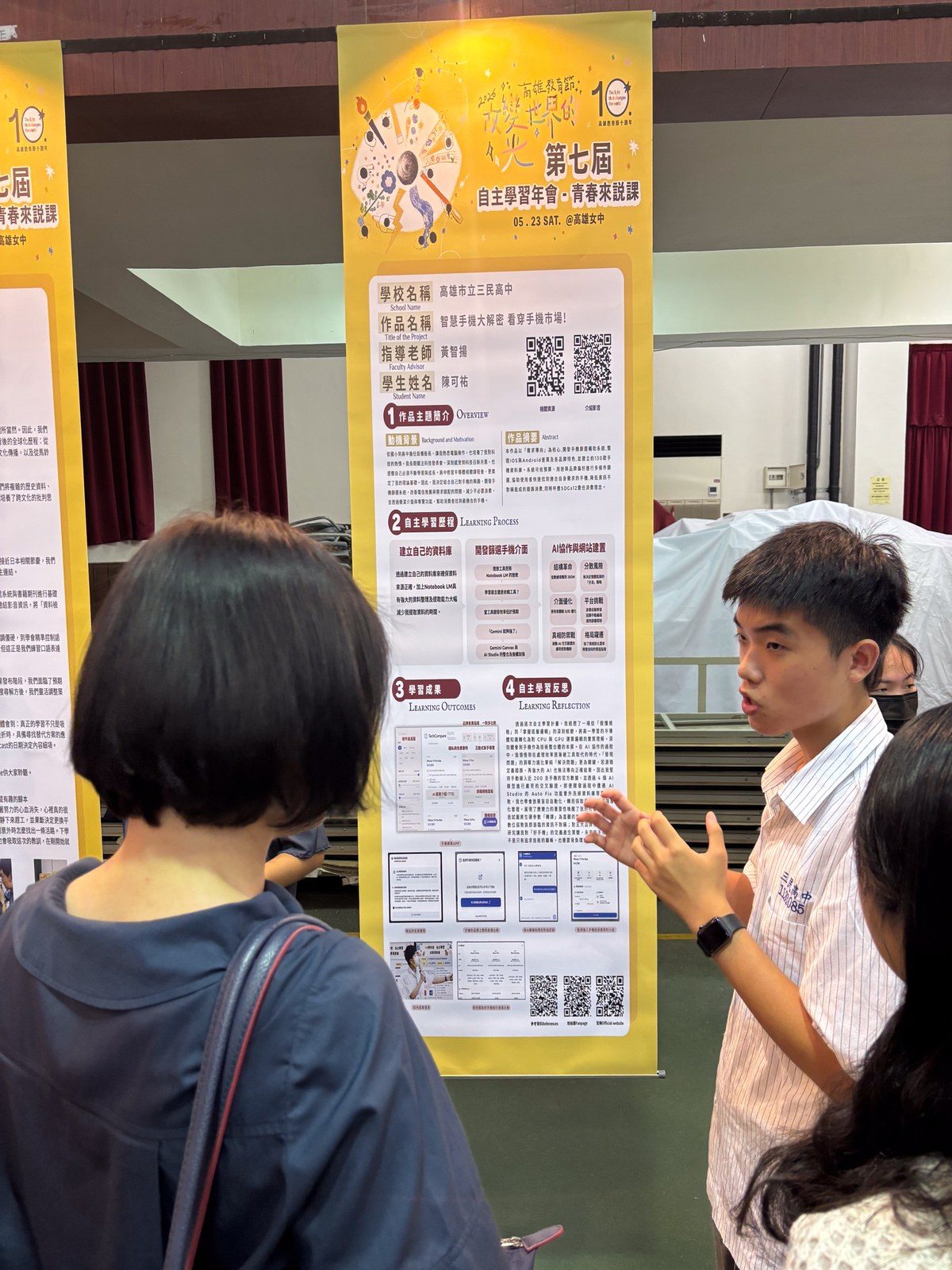
What I did:inKaohsiung Education Expo self-directed learning annual meeting (Youth Talks)Presented the phone-selection system in a speech-based competition format, to Bureau of Education judges and the audience.
What I learned:Turning a technical project into a lesson anyone can follow.Evidence ↗
Public outreach and science communication on site
| Works | Contents |
|---|---|
| The safe I made Elementary school | Made with hot glue and bamboo skewers; my father helped buy the lock and hinges. My own assessment: “although it had essentially no security” |
| Earthquake alert device v1 Grade 10 | Inspired by the 0403 Hualien earthquake: a shake-triggered circuit made of popsicle sticks, binder clips, magnets, and a bucket lid |
| Earthquake alert device v2 Grade 11, 1st semester | Revised after learning the AMB82-mini: used motion detection to judge suspended-object shaking, uploading photos to the cloud via IFTTT and sending Email alerts |
| Electric train | Mimicking a train pantograph contacting the overhead wire — hand-built car body and current collector |
| Converting a quadcopter | Disassembled a broken unit; the motor first became a boat in a cookie tin, then powered a Styrofoam plane |
| Laptop cooling stand | Made from leftover art-class materials, zero cost |
I developed a methodology kit (53 files, 12 version iterations) that turns “one-sentence customer needs” into spec documents and go-to-market plans, by repeatedly having AI build while I gatekept.
What's really worth telling is the hard rule I set inside: AI may never fill the “actual results” field; with no data, KPI fields stay blank — no guessing from impressions. I wrote at the time:“‘Pending verification’ in practice isn't honesty — it's pre-emptively pushing responsibility into the future.”
Honest statement:This toolkit currently sits “built and shelved” — not yet used for any real client or delivery. I studied requirements-specification and go-to-market as business methods; I don't claim mastery.
AI is responsible for
Generation and acceleration
Code generation, data organization, and repetitive consistency checks.
I was responsible for
Requirements · Architecture · Acceptance · Judgment
My most honest shortcoming
When I can't understand it, I can't judge
When I can't understand AI's output, I have no ability to judge why it's right. This is my main reason for applying.
Four things at the core were never outsourced: whose problem the system solves, where the boundaries are drawn, which feature to cut, and which AI statements can't be trusted.AI orbits this core, not the other way around.
Define the role, explain the task, set constraints, specify the output format.
First tell an AI the requirements and ask it to draft the prompt; after I review and revise it, hand it to the AI doing the actual work.The industry calls this meta-prompting; I don't claim originality.
Before submitting, I asked AI to play “the strictest reviewer” and tear its own project apart. I even created a file named “find-trouble” and had it return a critique report with serious flaws and data-credibility challenges.
Treating implementable AI as the most precious resource, reserving it for tasks that truly need a system built; plain search, fact-checking, and first-pass organizing all went to the web version.
My understanding of AI
My working method is “Have my own logic first, then discuss with AI” — it explained with what it found; I countered with what I'd learned, forming two-way discussion. I don't shy away from saying publicly how I use AI: “many people are afraid to tell others they use AI, but I'm happy to share how I use it to do what I couldn't before.”
The full tool list is in the appendix. I don't think “how many tools you've used” is itself an ability.
VII. Awards and evidence document index
Every item has an original file to show
| Awards | Date | Organizer | Evidence documents |
|---|---|---|---|
| Kaohsiung City 66th Primary and Secondary School Science FairEngineering (II) Teamwork Award | 2026-04-25 | Kaohsiung City Bureau of Education | Science-fair award certificate, project report, official division-of-labor table |
| 114 academic year self-directed learning presentation — Outstanding | 2026-01-23 | San Ming Senior High School(presented by Principal Yang Wen-Yao) | Outstanding certificate, self-directed learning report (official original) |
| 2026 Kaohsiung Education Expo, 7th self-directed learning annual meeting Merit | 2026-05-23 | Kaohsiung City Bureau of Education(presented by Bureau Director Wu Li-Sen) | Merit certificate, presentation deck, application AI-disclosure field |
| 7th Samsung Solve for Tomorrow Reached the finals | 2026 Finalist | Samsung Electronics | Finalist certificate, HERMES system |
Evidence attachments
Inquiry & Practice · group work, report by me
114-1 Group experiment, report written by me
 114-2 Group experiment, report written by me
Spinning top inquiry & practice
The raw measurements for four variable sets, plus my reasoning using moment of inertia and center-of-mass height to explain the spin-time differences. Open source file ↗Representative works
 Kaohsiung City Primary and Secondary School Science Fair
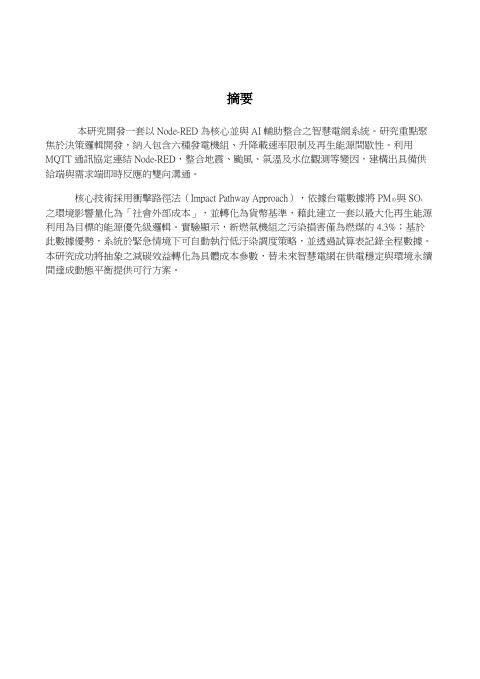
Official original of the smart grid science-fair project report
The four steps of the Impact Pathway Approach with sources, validation by scaling three real incidents, and the line I wrote myself: “even if the brain makes the right decision within 1 second, the system still cannot avoid a large-scale blackout.” Open source file ↗ Project video ↗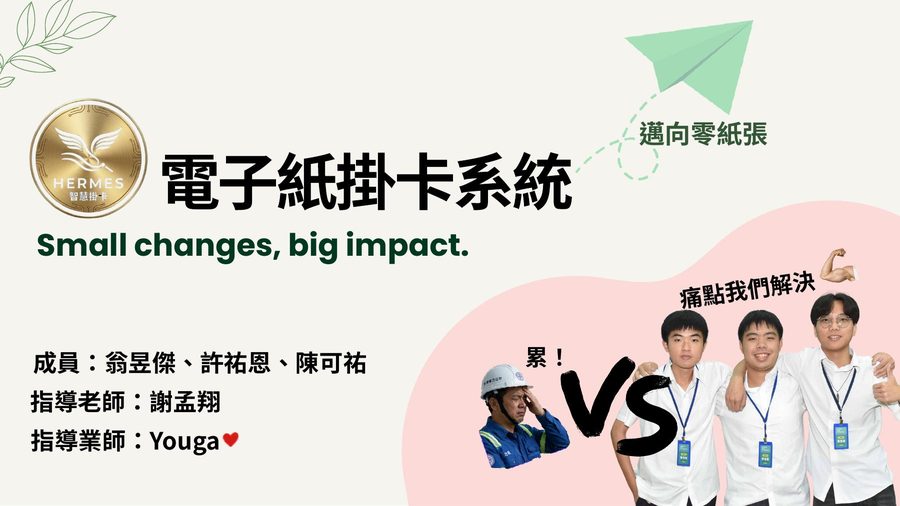 Semifinal version
HERMES e-paper tag system — semifinal deck
The full semifinal deck for Samsung Solve for Tomorrow: AEIOU observation, stakeholder map, three pain points from interview insights, a four-phase iteration timeline, and the photo of that physical paper tag on site. Open source file ↗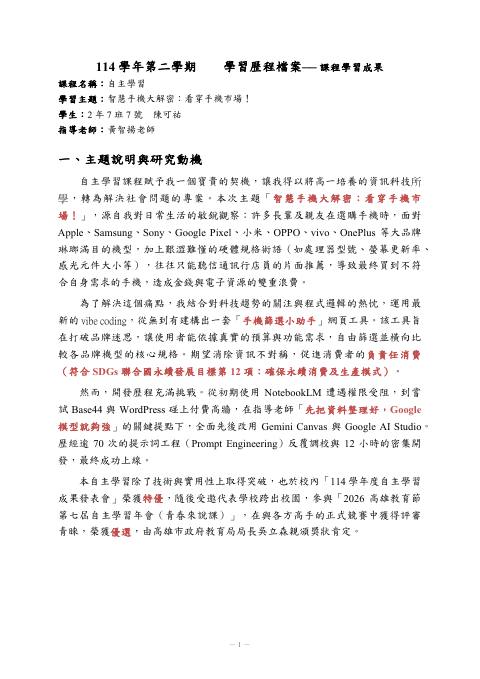 114-1 Self-directed learning outcome
114 academic year, 1st semester self-directed learning outcome
The official original of the phone-selection system: actual JSON database fields, the 21-folder partition architecture, the 18-week checklist, and the original record of Prof. Tsai Meng-Fang's comment. Open source file ↗ Presentation deck ↗Certificates · third-party issued, non-self-reported documents
 115.7.10 | Samsung Electronics Taiwan
2026 Samsung Solve for Tomorrow finalist certificate
An official finalist certificate issued and signed by the organizer's president. The project title, all three team members, and the advisor are listed. Open source file ↗Integrity · the only record with third-party written correspondence
 2026-02-12 approved the same day
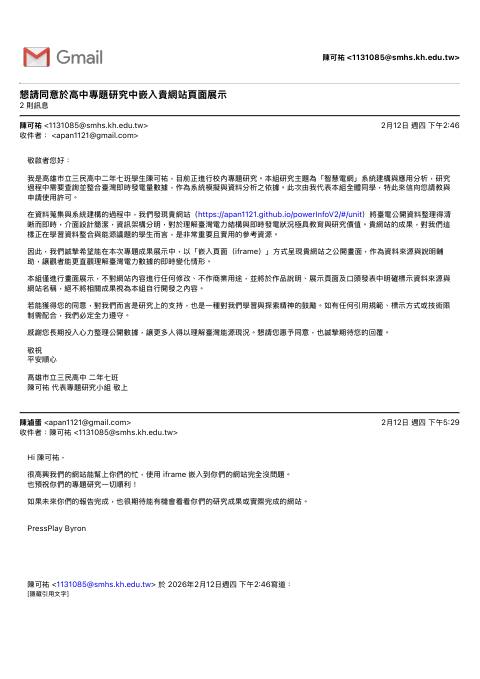
Third-party website iframe embedding permission letter
The original letter I sent under my own name, the four commitments I volunteered (display-only, no commercial use, citing the source, never claiming as our own), and the full reply. Open source file ↗Official learning portfolio originals · the original records in the school system
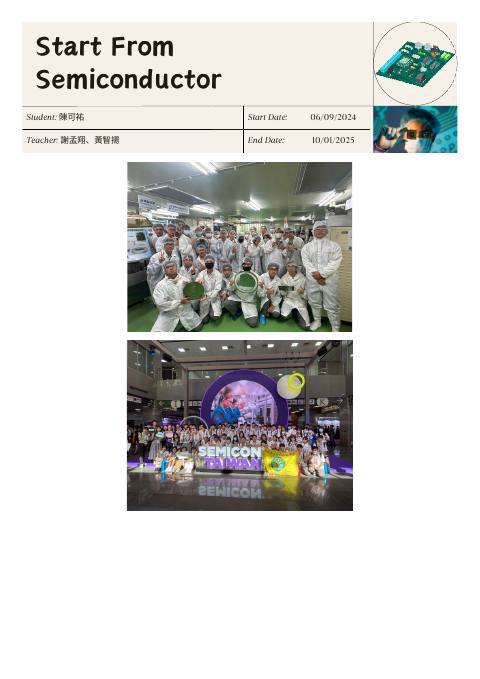 113-1
Introduction to Semiconductors — coursework portfolio
The original reason for choosing Apple Vision Pro (“be a myth-buster”), plus series/parallel circuit design and test records. Open source file ↗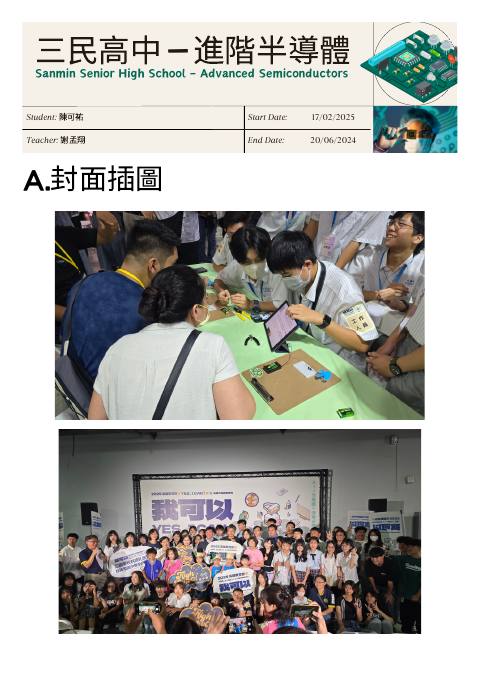 113-2
Advanced Semiconductors: AI & Chips — learning portfolio
nMOS leakage testing, Fritzing schematics, cost estimation sheets, and an idea notebook — a complete engineering workflow. Open source file ↗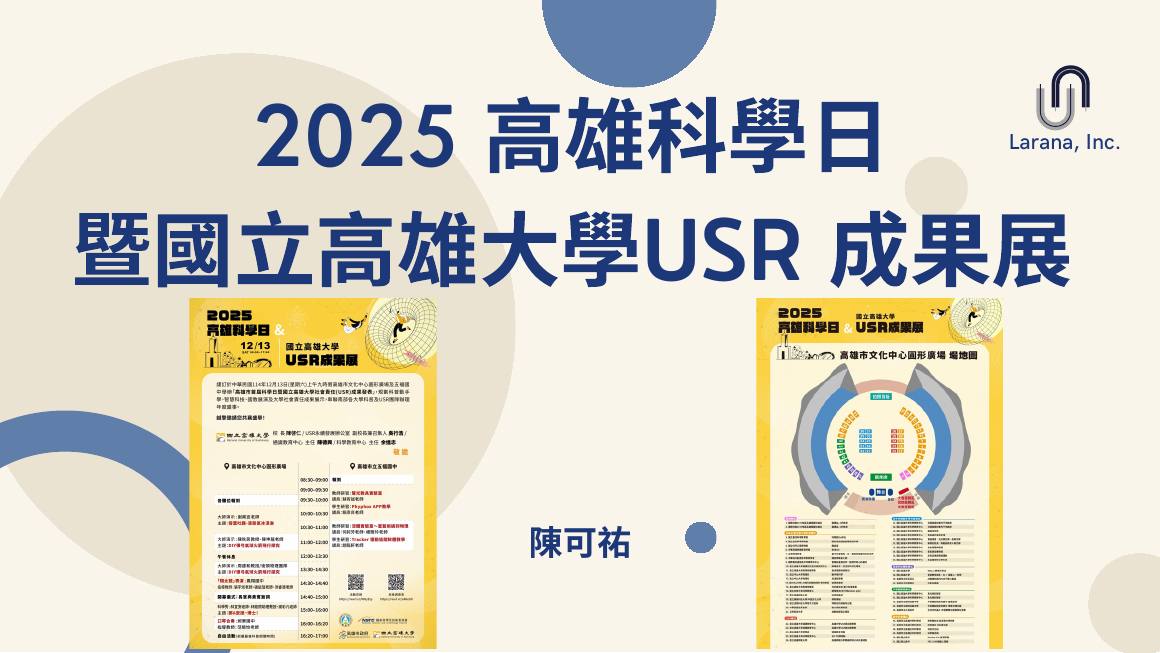 12/13 booth record
2025 Kaohsiung Science Day “Exploring Digital & Analog”
The full story of me explaining vinyl principles incorrectly at the booth and being corrected on the spot by Prof. Chen Chiu-Min of Soochow University, plus the reflection I wrote that day. Open source file ↗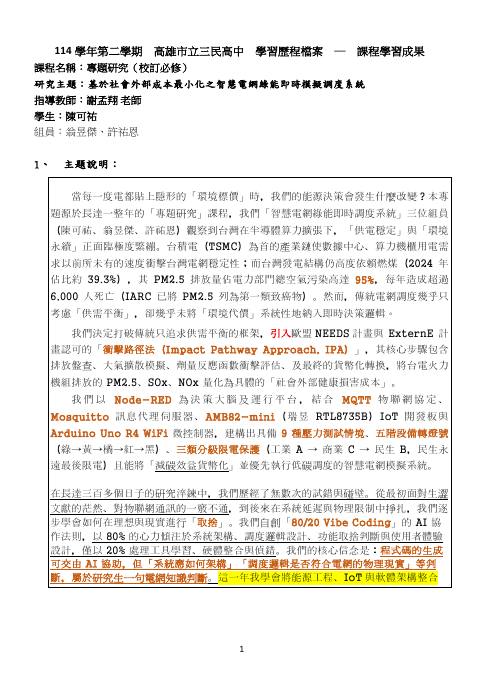 114-2 Capstone project — official semester record
114 academic year, 2nd semester learning portfolio
The official submitted original of the capstone (smart grid): reflections, division-of-labor table, results data, and the 20-week schedule. Open source file ↗Appendix: development environments and AI tools used
Development environment
VS Code↗Claude Code↗Cursor↗Windsurf↗Google Antigravity↗Codex↗Grok↗Perplexity↗Gemini Canvas↗Google AI Studio↗NotebookLM↗Base44↗
AI for research & discussion
Every item links to its official website for verification.